Tuesday, 4 April 2023

THE UNITED STATES IS NOT A FRIEND OF MYANMAR’S DEMOCRATIC RESISTANCE

Source DVB, 31 Mar

Guest contributor, Dr. Maung Zarni

For my fellow democrats from Myanmar, wherever they are, I have bad news. It is this: the United States (that is, the U.S. government) is not our friend in our uphill struggle for our basic human rights and democratic freedoms. As someone who was educated in the U.S., cut my political teeth as a grassroots activist and lived and worked there for 17 years, I have known this ugly fact for several decades. Washington talks the talk of democracy, human rights and freedom, but it typically fails to walk the talk. 

This absence of genuine support and solidarity for our pro-democracy Burmese opposition on the part of U.S. policymakers – not simply the hypocrisy of their government as a whole  – was one of the principal reasons I ended my exile in the U.S. after 17 years (the other is its illegal and immoral second invasion of Iraq, accompanied by numerous war crimes during the U.S. occupation of that devastated society, on the bogus twin-pretext of Saddam's non-existent WMD and advancing "freedom and democracy" for Iraqi people).

Completely enamoured with the rhetoric of the U.S. as "the land of the free," I went to there as a young student in my twenties, one month before the '8888 Uprising'.  But by the second invasion of Iraq, my youthful illusions of "democracy in America" (and by extension) its support for global democratic movement were irreversibly shattered. As a matter of fact, I was cautioned against my rose-tinted view of the U.S. as a bastion of global democracy by my close friend's father the late Dr. Tin Maung Aye. In his capacity as the Superintendent of Rangoon General Hospital, he buried the fourth year Engineering student Ko Phone Maw, the first casualty of the 1988 pro-democracy uprising. 

"You need to get rid of your jaundiced view of the USA and the West", were his perceptive words he uttered when I paid him a goodbye visit to his official residence in Rangoon a few days before I flew out to San Francisco. During my years as a grassroots organizer, first as a student activist and later as a start-up academic, I was intimately involved in and interacted with so many different American institutions and individuals who led or staffed them, from city councils, state legislatures, churches and student organizations all across the vast sub-continental country to the White House, U.S. State Department, Congress, U.S. government funding agencies (such as the U.S. Institute for Peace and the National Endowment for Democracy), and numerous think tanks of all ideological stripes and colours. There were so many wonderful Americans who cared, and who wanted to do the right thing – support democratic movements around the world. 

My old Free Burma Coalition colleague Naw May Oo, another American-educated refugee who now advises the Karen National Union (KNU) and I were fortunate enough to have met some of the straight-talking Americans who were part of Washington's Burma policy circles. They gave us an equivalent of a shock therapy when they told us very bluntly, out of appreciation for our committed activism. A few individuals deserve a mention for their honesty. Right after the infamous 2003 Depayin massacre during which the NLD leader Daw Aung San Suu Kyi and her deputy U Tin Oo escaped the botched assassination, we met at a Senate office with the two key aides to the Chair and Ranking member of the U.S. Senate Foreign Relations Committee Senators Richard Lugar (Republican, Indiana) and John Kerry (Democrat, Massachusetts) to see if there could be stronger support for the flagship NLD opposition in the heartlands and the ethnic armed organizations in the conflict zones.    

Their response? One said to us, "If Aung San Suu Kyi were assassinated by the junta [Burmese democrats] would get a statement of condemnation from the United States government."  Another chimed in, "You might also get a memorial service at the National Cathedral."   [Given Aung San Suu Kyi's moral standing in the world today – because of her ignominious defence of the indefensible (the Rohingya genocide) at the International Court of Justice, even a memorial service in honour of the 77-year old Lady in captivity seems inconceivable.] Matthew P. Daley, a former Korean War vet who was then Deputy Assistant Secretary of State in the East Asia Bureau within the State Department was far more specific and blunt. In our one-on-one conversation, he said, "I can't conscience my government's empty pro-democracy rhetoric. But in reality, we let pro-democracy dissidents mowed down by authoritarian regimes." 

He gave an example of the crushed Hungarian uprisings against the Soviet-backed regime in Budapest during the Eisenhower presidency in 1956. Over 20,000 Hungarian democratic activists were slaughtered, and Washington's support, which was never intended to be real, well, never came. He recounted in his meetings with the Chinese counterparts in Beijing, how he dropped the official script of Washington's pro-democracy concerns for Burma, in hopes that the Chinese Communist Party leadership may get the message that the giant neighbour had nothing to fear of U.S. backing for the Burmese democratic opposition. For there was no such thing! Since the Hungarian uprisings, there have been too many cases of pro-democratic and pro-Western movements and governments, that Washington has abandoned. Among them were Burma's neighbours, namely South Vietnam and Cambodia. The latest was Afghanistan falling back under the Taliban. Abandoned by their American allies in power, pro-American democrats in Saigon in the 1970's and Kabul in 2020, desperately trying to get on the last U.S. transport aircrafts, has now become a gut-wrenching iconic image in 'socio' media and on TV screens.

Alas, such warmth, honesty and solidarity don't extend beyond individual officials. You may be friends with U.S. officials. But their government is not a friend of your struggle. That is, unless supporting your resistance advances America's core interests, ala Ukraine. This was a rude awakening for me personally, which in turn compelled me to seek an alternative of finding ways to reconcile with the oppressive military leadership. In the absence of real support from the U.S. in particular and the liberal West in general, I sought to explore ways to help end the country's vicious cycle of violence and counter-violence, repression and resistance. My efforts came to nothing. Now I feel I am back to where I started some 20 years ago when I split with Aung San Suu Kyi-led flagship opposition movement and advocated the stance, "we must talk to the generals".

I knew that Washington would sell us, democrats, down the river. Then President Barack Obama and his Secretary of State Hilary Clinton went to Aung San Suu Kyi's fabled colonial mansion in Rangoon, with global publicity and fanfare, but they removed her only leverage, namely financial sanctions against her military captors. According to Obama's National Security Adviser Ben Rhodes, in her meeting with the U.S. President at the Oval Office in 2013, the Burmese opposition leader did ask Obama to retain financial sanctions. She wanted to use them as bargaining chips in her dealings with the generals. But beholden to the interests of American corporations, Obama offered Suu Kyi an all-or-nothing option. U.S. businesses could not wait to enter Burma as the virgin economy where the Chinese, Singaporean, Thais, Malaysians, South Koreans and Taiwanese had already built toeholds during the years of sanctions.

To labour the obvious, the world's most powerful government would do anything to pursue its core interests – not values.  Since its founding as a white settler colony, the U.S. has, according to the Congressional Research Services studies, waged over 300 wars and invasions, declared and undeclared wars, "legal" (that is, UN Security Council-authorized) and illegal invasions, covert and overt, sanctions or lifting them, at their convenience. There just isn't significant enough U.S. interests insofar as Myanmar for Washington to really support the Burmese democratic resistance – most violent, widespread and unprecedented in history – which sprang up organically in virtually all ethnic communities and in different social classes.  

Two years since the universally opposed military coup of February 2021, the U.S. has only offered the nationwide democratic resistance, made up of Generation Z fighters and several major ethnic resistance organizations (for instance, the Karen National Union, Chin National Front, and Karenni Progressive People's Party) "notional" support, to use former U.S. Ambassador to Burma Scot Marciel's adjective. In the face of 3,000 deaths and 20,000 arrests of Burmese resisters since the violent crackdown of nationwide peaceful protests began, all that the U.S., both Congress and the Biden Administration could do is the provision of "non-lethal assistance" and humanitarian assistance, in addition to a mix of empty statements of condemnation of this or that misdeed by the junta, and dribble of economic sanctions against a handful of Burmese businessmen and entities tied to the junta. 

Typically, U.S. officials such as Derek Cholet holds up photo ops with the leaders of the National Unity Government (NUG) and well-timed and well-publicized visits to its "Information Office" in Washington as Exhibit A of the American support. The Russian invasion of Ukraine and the reactive "unity of the West" in support of Ukrainian people's defence for their democratic rights have stripped bare Washington's pro-democracy rhetoric. The day NUG "Foreign Minister" Zin Mar Aung had a photo-op with British Foreign Secretary James Cleverly at the British Foreign Ministry in London, Washington's proxy-in-chief Zalensky addressed the British Parliament and openly demanded  – I repeat demanded, not requested – fighter jets and more weapons.

Some 25 years ago, I met James Woosley, former CIA director and a staunch proponent of the regime change in Bagdad, at a close American friend's book launch party in Washington, DC. I asked the spook for his advice on the subject of removing the Burmese dictatorship "back home."  He exclaimed, "you need a lot of money!".  And the man knew what he was talking about. No resistance or regime change could be undertaken on empty stomach or with poor arms. Within seven days of Myanmar coup two years ago, President Joe Biden was seen on live TV news, talking tough against the Burmese coup regime while proceeding to announce his executive decision to freeze US$1 billion that belongs to Myanmar state (that is, people) as a first step towards supporting Myanmar's pro-democracy movement. Like Woosley, Biden, who routinely voted funding Israel, the largest recipient of U.S. military assistance, for 30 years and supported the invasions of Iraq by the two Bush presidencies, too knows very well how costly war and resistance financing is. 

And yet Biden refuses to release that $1 billion to be used for the resistance. The lame excuse from the Americans was that they were safekeeping the money for rebuilding Burma as a federal democracy. But without removing the dictatorship no possibility exists for any reconstruction of Burma. Biden's silence and omission of the Burmese resistance speaks volumes. In Biden's remarks at the Summit for Democracy Virtual Plenary on Democracy Delivering on Global Challenges" delivered in Washington on March 29, Biden singled out "the unprecedented unity we've seen from democracies condemning Russia's brutal war of aggression against Ukraine and standing in solidarity with the brave Ukrainian people as they defend their democracy". And yet the man who froze $1 billion USD and, only two years ago, promised more in action to support the Burmese people who too defend their democracy, however flawed, chose not to even make an obligatory mention.

For revolutionary movements to succeed they need friends, particularly "frontline states", that is, neighbours adjacent to the theatres of resistance. To gain support and solidarity from neighbours is of paramount importance, particularly in light of the complete absence of real support from "democracies of the world". Admittedly, none of Burma's neighbours has shown any interest in or will to partner with or recognize the NUG, or support the broader resistance of ethnic resistance organizations and democratic resisters. As democrats we are in-between rock and the hard place. Beijing considers the Burmese resistance – in particular the NUG – as nothing but a semi-proxy propped up by Washington. As democrats and resisters against six decades of a mass-murderous military, we must bang our heads together and rethink the leadership, their orientation, capacities and achievements, against hard, cold odds. 

Maung Zarni is the co-author of Essays on Myanmar's Genocide of Rohingyas (2012-18). He is a UK-based Burmese exile with over 30-years of first-hand involvement and scholarship in Burma affairs. 

How India Betrayed the Rakhine People – And Why It Matters Today

Source TheDiplomat, 10 Feb 2023

Twenty-five years ago this week, India's government betrayed the people of Rakhine State in western Myanmar, when its armed forces smashed a nascent Rakhine revolutionary group in a remote part of the Andaman Islands. In the years since, the Indian government has never referred publicly to the incident, but it continues to resonate among the Rakhine people, who remember it as Gen. Khaing Raza's Day, or Betrayal of India over Rakhine Revolution Day. In a 2009 book, the prominent Indian human rights lawyer Nandita Haksar described the incident as "infamous."

On the morning of February 11, 1998, the Indian military launched a brutal operation codenamed Leech, in which it raided Landfall Island in the Andaman Sea, arresting at least 73 people, and killing at least six rebels. These included the Arakan Army commander Gen. Khiang Raza and Maj. Soe Tun and two leaders of the Karen National Union.

As the India-based news outlet Quint reported in 2019, 35 of the 73 people arrested were fishermen and were released after a year of detention on the island; two were Thai boatmen who were also released; two more reportedly tried to escape and went missing. The remaining 34 people were Rakhine and Karen rebels from Myanmar. Their trial took place in secret, and they were held in jail for 13 years, six-and-a-half of those years without charge. The 34 men were only released in 2011, when they were granted refugee status by the United Nations refugee agency and resettled in the Netherlands.

The violent incident brought to a premature end the first serious attempt to form a Rakhine nationalist resistance against Myanmar's military junta. The Arakan Army (AA) was initially formed in February 1991 by a group of patriotic Rakhines including Gen. Khaing Raza, with support from the Karen National Union (KNU), on the Myanmar-Thailand border. Shortly after its formation, at least 60 AA rebels attempted to travel from southeast Myanmar to Rakhine State on the Myanmar-Bangladesh border in early May 1991. The group confronted clashes for a month with the Myanmar military, and only 40 of them arrived at the border safely. In 1992, and 1993, the group sent a couple more consignments of troops and weapons from the Myanmar-Thailand border to the Bangladesh border area.

DIPLOMAT BRIEF

WEEKLY NEWSLETTER

N

Get briefed on the story of the week, and developing stories to watch across the Asia-Pacific.

GET THE NEWSLETTER

In January 1994, at least four Rakhine revolutionary groups made the historic decision to merge into a single organization: the National United Party of Arakan (NUPA), with an armed wing, also known as the Arakan Army (AA). The group's goal was home rule for the Rakhine. The AA was at this point re-formed under the leadership of seven commanders, including Gen. Khaing Raza and Maj. Saw Tun. By 1997, the strength of the army had grown to 500 troops armed with some 200 rifles, and it had established a small naval force.

Enjoying this article? Click here to subscribe for full access. Just $5 a month.

India's Betrayal

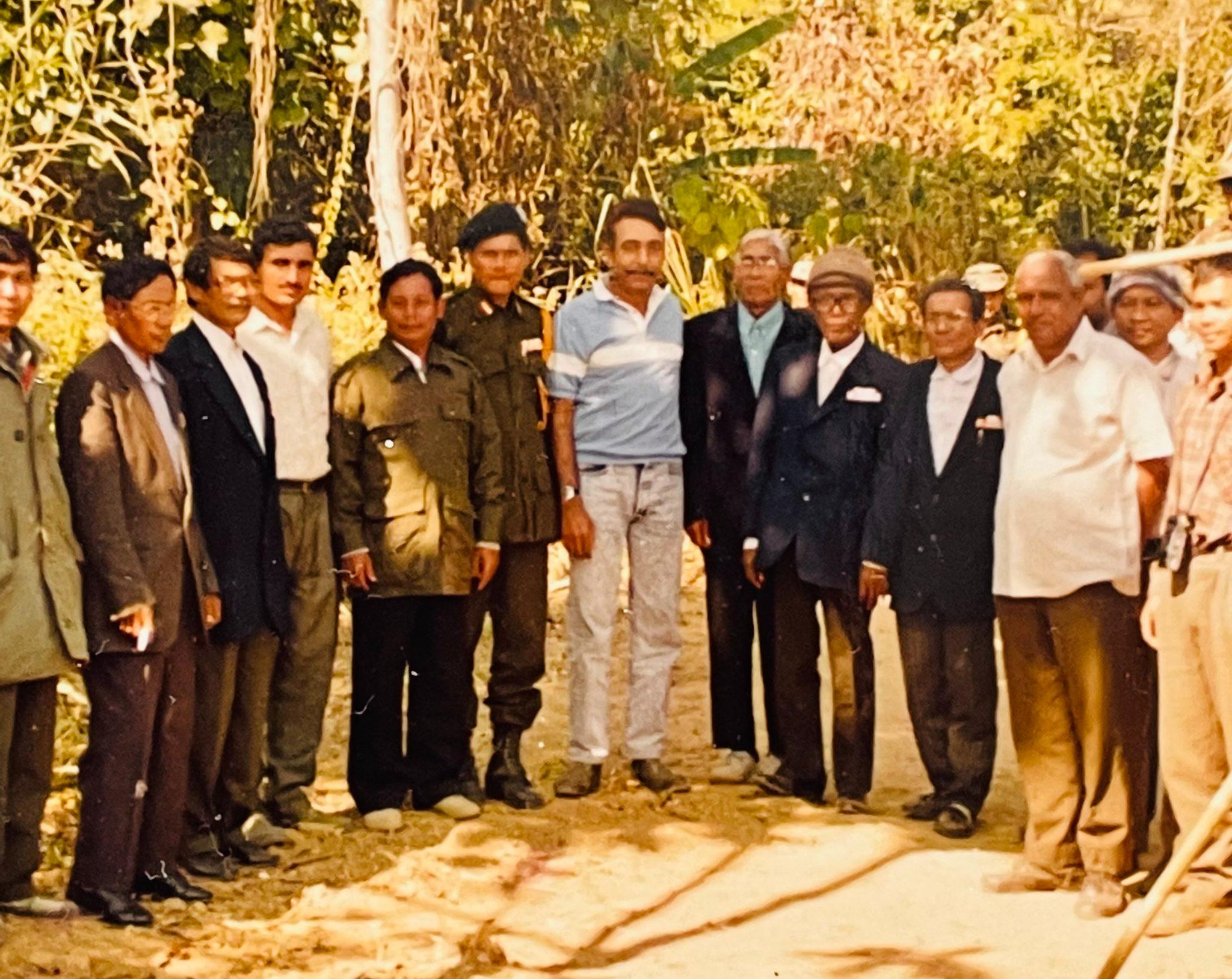
After the Arakan Army (AA)'s formation in 1991, Khaing Raza established a good relationship with officers from the Research and Analysis Wing (RAW), India's foreign intelligence agency, with whom he regularly shared information. Three years after the Rakhine revolutionary groups merged in 1994, these relations improved further and RAW officers eventually introduced Khaing Raza to a number of Indian military commanders and intelligence officers. Chief among these was the military intelligence officer Lt.-Col. Biswajit Singh Grewal, who notably had been born in Myanmar and studied at the University of Mandalay, and was fluent in the Burmese language. (He even had a Burmese name, Nay Win). In January 1995, Lt.-Gen. Pradeep Chandran Nair, commander in chief of the Assam Rifles, visited the NUPA/AA base along the India-Myanmar border, and met with Khaing Raza.

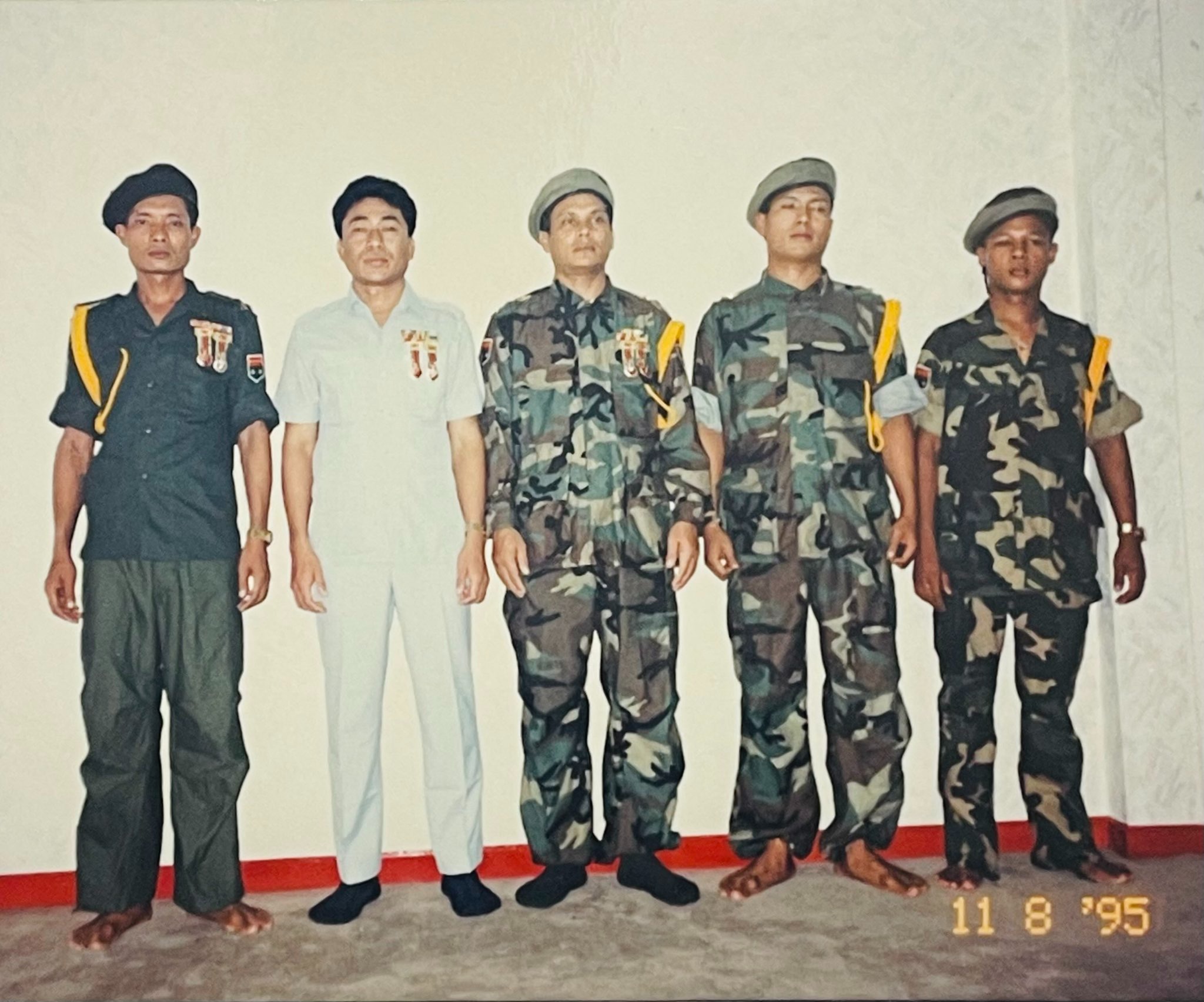
Former Rakhine marine leaders (from left): Maj. Kyan Sein Maung, Maj. Khine Kyaw Khine, Gen. Khaing Raza, and Capt. Mra Aung. (Photo courtesy of Maj. Khine Kyaw Khine)

ADVERTISEMENT

In early 1997, the NUPA/AA and KNU top leaders decided to establish a base in the Andaman Sea, to provide them access to the Ayeyarwady River delta in southern Myanmar. Maj. Saw Tun spoke to Lt. Col. Grewal, who initially allowed the NUPA/AA to set up a base first on Narcondam island, and then on Landfall Island, in the north of the Andaman Islands chain, around 300 kilometers from Myanmar's coast.

A month later, Saw Tun was taken to Landfall Island on an Indian Army flight, alongside Grewal. In May of that year, the NUPA/AA marine commander, Maj. Khaing Kyaw Khaing, and his group had attempted to reach the island by sea, but they gave up due to a heavy storm in the area. Next month, Grewal flew to Bangkok to meet with KNU and NUPA/AA leaders, and agreed that they could relocate to the island on February 11, 1998.

On February 8, 1998, a group of 40 men – 27 from the NUPA/AA and 13 from the KNU – led by Khaing Raza and Saw Tun departed for Landfall Island in two ships from the coast of Tanintharyi Region in southern Myanmar. They arrived on the evening of February 10 and slept one night there.

Then, early the next morning, Indian military officers, including Grewal, launched Operation Leech, executing at least four leaders from the NUPA/AA including Khaing Raza and Saw Tun, two KNU leaders, and two other Myanmar rebels. As mentioned above, the remaining 34 were taken into custody.

The Indian military informed New Delhi that Operation Leech had smashed a group of "gunrunners" who had been aiding anti-Indian separatists in the country's northeast. However, former Khaing Kyaw Khaing, formerly one of seven founding commanders of the AA, told this author recently that the leaders aimed to fight the military regime in Myanmar, and went to Landfall Island trusting India's promise that it would allow them a safe haven there. He said that the Indian military completely destroyed the embryonic Rakhine revolutionary force, describing it as an unforgettable betrayal of "all of our Arakanese."

Lt. Gen. Pradeep Chandran Nair, commander in chief of the Assam Rifles (center, in blue shirt), during a visit to the NUPA/AA base along the India-Myanmar border, January 23, 1995. (Photo courtesy Maj. Khine Kyaw Khine).

Indeed, DB Nandi, a former Indian intelligence officer and RAW deputy chief who worked in Myanmar, told The Guardian in 2007 that the Indian military operation was explicitly intended to destroy the Rakhine revolutionary movement. In 2019, Grewal, now retired, told local news outlets that the operation was not carried out on the army's own initiative, and that it had approval from New Delhi.

Enjoying this article? Click here to subscribe for full access. Just $5 a month.

After the events on Landfall Island in 1998, few people in western Myanmar believed that a Rakhine rebellion against the Myanmar military could succeed, given India's evident hostility to the cause and the group's inability to establish a base along the Myanmar-India border. It was only since the rebirth of the Arakan Army in 2009 that these dreams of Rakhine home rule have stirred back to life.

The New Arakan Army and Its Relations with New Delhi

Fifteen years after the Indian army smashed the NUPA/AA on Landfall Island, another version of the Arakan Army was formed by Maj. Gen. Twan Mrat Naing and 25 comrades in April 2009 in Laiza, on the Chinese border in Kachin State, with support from the Kachin Independence Army (KIA).

ADVERTISEMENT

In the years since, the AA has grown considerably. It now has 30,000 troops under arms, mainly in Rakhine State, though at least 6,000 troops are stationed in areas controlled by the AA's allies in the north and northeast of the country. Recently, the group's political wing, the United League of Arakan (ULA), claimed that it enjoyed de facto control over two-thirds of Rakhine. During 2018-2020, analysts described fighting between the AA and the Myanmar military as the fiercest Myanmar had seen in decades.

Relations between the New Delhi government and the ULA/AA during the armed conflict of 2018-2020 have been curious. Although India is the world's largest democracy, its government has traditionally maintained good relations with Myanmar's military. From February 17 to March 2, 2019, amid fighting between the AA and Myanmar military in Rakhine State, the Indian military took part in the joint Operation Sunrise with the Myanmar military against the AA in the India-Myanmar border area. Its operation was intended to eliminate the AA from the border region, where India is hoping to implement the Kaladan Multi-Modal Transit Transport Project connecting Mizoram to Kolkata via Rakhine State's capital Sittwe.

The Indian government seemingly believed that the armed movement of the ULA/AA was just a temporary uprising and that the Myanmar military would eventually be able to eradicate the insurgents. However, the armed conflict of 2018-2020 ended with AA still in control of its main strongholds in Rakhine, which seems to have shifted opinion within Indian decision-making circles about the need to negotiate with the ULA/AA. On August 11 of last year, for instance, the ULA/AA spokesperson said in an online press conference that the group had taken part in negotiations with New Delhi on the implementation of the Kaladan project.

However, the Indian government still hasn't openly engaged with the ULA/AA, and in order to maintain good relations with the Myanmar military, has remained mostly silent about the atrocities committed by the military since its coup on February 1, 2021, despite the junta arresting over 17,000 and killing nearly 2,900 of its own citizens, including children. Instead, the Indian government is trying to finalize and implement the Kaladan transport project. On January 9, India's Union Minister Sarbananda Sonowal said the project was "ready to operate."

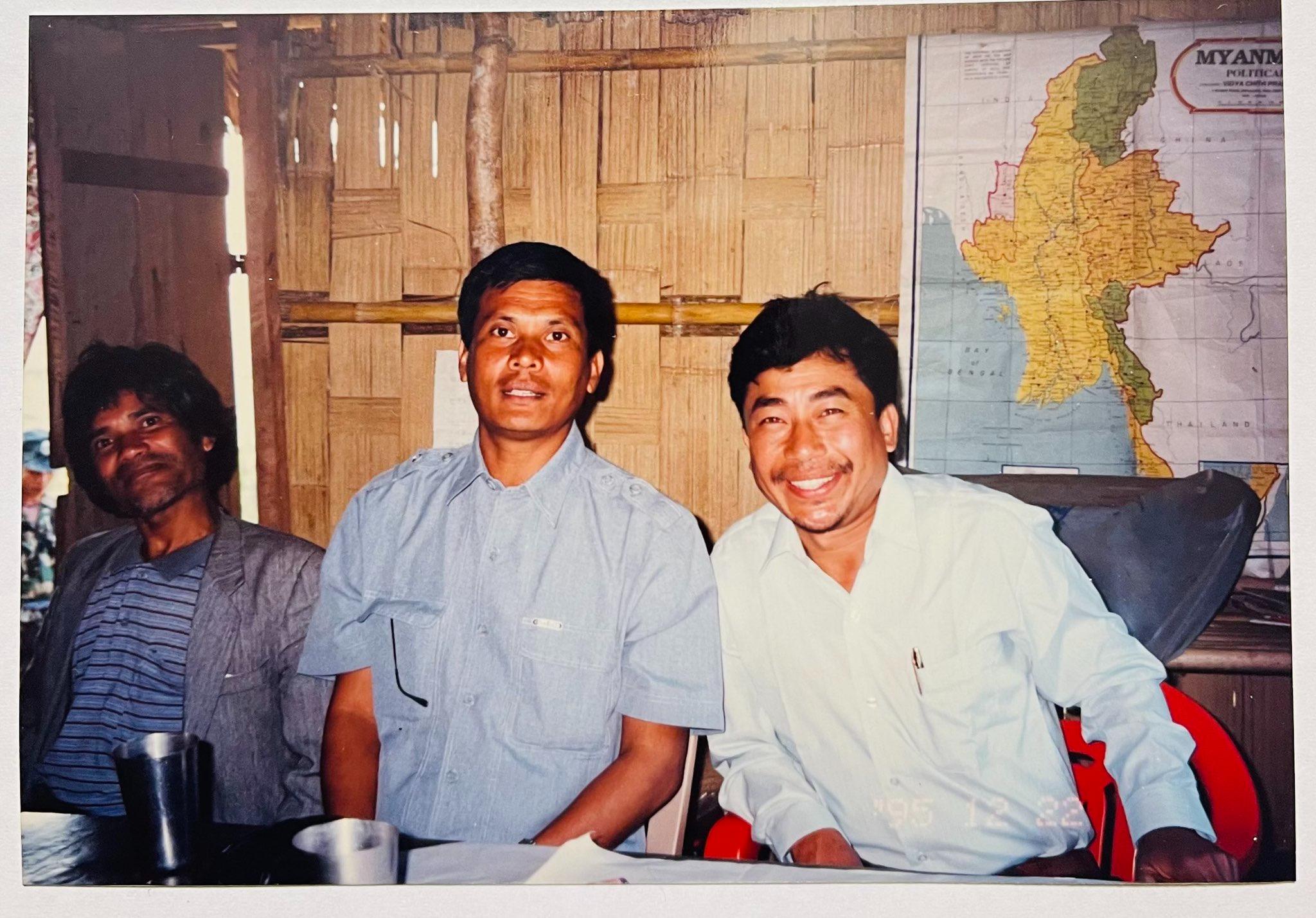
NULA/AA officials Khaing Mra Wa, Gen. Khaing Raza, and Maj. Khine Kyaw Khine after meeting with officers from the Indian intelligence agency RAW, at the Vara Va camp in the India-Bangladesh-Myanmar border area, December, 22, 1995. (Photo courtesy Maj. Khine Kyaw Khine)

Overall, India's current approach toward Myanmar is puzzling. The local security apparatus in India's eastern provinces has frequently arrested not just the members of the anti-junta resistance but also refugees who have fled across the Myanmar-India border due to Myanmar military attacks. Another critical issue is the fact that the Myanmar junta forces have used Indian rebel forces to stage attacks against the resistance in the upper Sagaing Region, close to India's border.

However, the growing strength of the Rakhine movement for home rule, led by the ULA/AA, demonstrates that New Delhi's strategy toward the current junta is serving neither its national interest nor the interests of the Myanmar people. When it comes to the Kaladan project in northern Rakhine State, a priority for New Delhi, the government's current approach is mostly counterproductive, given the ULA/AA's influence over the Rakhine State.

Now is the time for New Delhi to remedy the mistakes in its policy toward the Rakhine conflict and the country's anti-junta resistance movement more broadly. A good place to start would be to acknowledge India's betrayal of the Rakhine revolution in 1998 and atone for its past mistakes by forging a new cooperative path with the Rakhine people.

AUTHORS
Kyaw Hsan Hlaing
GUEST AUTHOR

Kyaw Hsan Hlaing

Kyaw Hsan Hlaing is an independent journalist and regular contributor to The Diplomat.


Thursday, 3 November 2022

BURMA’S ARAKAN ARMY REPLICATES RUSSIA’S PROPAGANDA PLAYBOOK, ARGUES ZARNI

Source DVB, 11 Oct

While the world's attention is fixated on the escalating NATO-Russia proxy war taking place on Ukraine's soil, with its nuclear saber-rattling and domino effect on the world's economy, on Burma's western front, the decades-old triangular conflict deserves some serious attention as the deeply troubled country's civil war has widened to engulf external powers, including the neighbouring country of Bangladesh.

This appears to be a case wherein one of Burma's key actors, namely the Arakan Army (AA) – with its Buddhist Rakhine nationalist base – is replicating Vladimir Putin's tactical moves in Ukraine.  

The AA is a separatist ethnic militia estimated to be 30,000-strong, and has been equipped with Chinese-made weapons. Its ethno-political base of Rakhine known for their genocidal racism and collaborative deeds against the Rohingya – reportedly base themselves among Rohingya villages – as opposed to their own Buddhist communities from which the AA draws its rank-and-file fighters. 

Rohingya activists in the diaspora have kept quiet about this deeply troubling development – that the AA have encamped themselves among Rohingya communities. Some tried to give the impression of impartiality that Rohingyas were being caught in the "crossfire" between the AA and the genocidal Burma Army. Understandably, Rohingyas are between a rock and a hard place – insofar as the collaborators in genocide against their communities are now fighting ferociously against each other. 

But that silence, and that "crossfire" narrative, came to a loud end when a Rakhine sniper killed Shekul Islam, a 45-year-old Rohingya community leader and educator who happened to be a close relative (uncle) of Wai Wai Nu, a celebrated human rights activist. 

Khaing Thukha, the AA spokesperson, denied responsibility for the killing and shifted the blame onto the Burma Army while speaking to RFA Burmese on Oct. 9. Tun Khin, president of the UK-based Burmese Rohingya Organization – UK (BROUK), took to Twitter: "Having spoken to the sources on the ground, it is clear that AA is responsible for (the) killing …."

The problem is incomparably bigger than the murder of a Rohingya leader and which party – the AA or the Burma Army – was behind the killing. Rather, it is the evidently sinister use of Rohingya villages and neighbourhoods along the Burma-Bangladesh border, as the chosen battlefield.  

Throughout my recent travels in the former Yugoslavia, I have had numerous in-depth discussions with my scholar friends who survived the "Balkanization" where ethno-religious triangular politics – among the Orthodox Serbs, Catholic Croats and Muslim Bosnians (or Bosniaks) – had produced nasty genocidal violence and concentration camps in the early 1990s. Some of them are now experts on the ethnic conflicts in their ancestral homelands.  

According to one scholar who specializes in paramilitaries and mercenaries across the Slavic regions – North and South (including Ukraine) – Putin has deployed the tactics of placing pro-Russian separatist militias in the civilian neighbourhoods of the Donbas region, where administrative buildings – including police and security stations – are mixed in with civilian homes and business. The move, explained my scholar friend, was designed to lure Ukraine's infamous neo-Nazi Azov regiment on to the battlefield.    

It worked as Moscow had anticipated. The Ukrainian Azov-commanded  units launched a counter-offensive against the separatist militias, having killed an unknown number of Russian-speaking civilians. The Azov units handed Putin the much-desired evidence, which Moscow then used to make the case at the UN that the Russian Federation was acting as the benevolent protector of the Russian population in Ukraine bordering Russia. To be sure, no two parallels are identical in international politics or history of conflicts. Actors and contexts differ. 

The Rakhine separatist militia AA's reported use of Rohingya villages in Maungdaw Township as their temporary bases immediately adjacent to Bangladesh has become home to an estimated one million Rohingya genocide survivors. This strikes me as remarkably similar to Putin's cold-blooded, calculated, use of Russian civilians in the separatist Donbas region of Ukraine. 

In Burma, I have spent the last decade arguing that the genocide perpetrated against the Rohingyas can only be fully understood as the culmination of the triangular ethnic power struggle among the three primary parties in the conflict. The Burmese central government, both civilian and military, the Buddhist Rakhine, who make up roughly two-thirds of the population in the strategic coastal region (with their decades-old independence aspirations), and the predominantly Muslim Rohingyas whose mass exodus in 2016 and 2017 have been a topic of international judicial and policy concern among UN bodies (such as the International Court of Justice, or ICJ, and the International Criminal Court, or ICC, the UN Human Rights Council, along with technical agencies like the UNHCR), along with the UN Security Council, namely China and the U.S.

In the last and largest wave of genocidal violence against the Rohingya in 2017, both local Rakhine extremists and the Burma Army joined forces to ethnically cleanse the Rohingya Muslim villages, towns and cities. The Rohingya are forced to live in segregated neighbourhoods similar to those in Northern Ireland during the Troubles (between Protestant Unionists and Catholic Republicans).  

Because the global judicial processes have focussed on Burma's central role in perpetrating genocide, more specifically in 2016 and 2017, anti-Rohingya and anti-Muslim Rakhine nationalist leaders have busied themselves, reinventing their local communities as "justice-minded."  

The AA leadership has reportedly handed over one or two Burma Army defectors, whom they had captured alive, to UN investigators while dimming the light on their active complicity and collaboration five years ago. But now they are fighting for their (Rakhine) independence.   

But irrespective of which Rakhine nationalist leader or organization is in the driver's seat of the separatist movement, what universally undergirds its ethno-religious nationalism is the view that the majority Rakhine Buddhist population are the only indigenous or "sons of the fatherland" and hence the rightful owners of the region.  

Through this mono-ethnic nationalist lens, the rest of the region's inhabitants such as the Muslims, including the Rohingya whom Rakhine Buddhists outnumber by three-to-one, are "guests" or "migrants" from Bangladesh. As a matter of fact, while promoting itself as a modern, liberal pro-human rights group, the Rakhine nationalists in the media as well as the senior leadership of the AA have refused to allow them to self-identify as Rohingya. Strikingly, the Rakhine nationalist sentiments and views are no different from the Bama nationalist discourses, popularized across Burma's dominant Buddhist society and institutionalized within the Burma Army.

The AA Commander-in-Chief Twan Mrat Naing, formerly a Thailand-based English-tour-guide-turned-separatist-leader, has cleverly outfoxed the Bama leadership in terms of its propaganda aimed at human rights-sensitive audiences (that is, the international media, the UN, and foreign governments). 

You have to give it to Rakhine separatist media strategists for their brilliant manipulation of international concerns of Rohingya genocide survivors. They have been able to cultivate the image of themselves as an acceptable alternative to Burma's junta not only among international circles, including Bangladesh and U.S. government entities such as the United States Institute of Peace (USIP), and the Rohingya diaspora in both countries.  

It is utterly impossible for any armed group to be more ruthless and murderous than the Burma Army. After the killing of a Rohingya community leader, the community has exploded with all kinds of reports indicating that the AA has also been perpetrating numerous human rights violations, including gang-rape, extortions, kidnapping, torture, forced labour, murder and so on. It is time for the international policy circles and media to sober up and stop drinking the liberally-coated propaganda "Kool-Aid" by the genocidal Rakhine nationalists.  

Maung Zarni is the co-author of Essays on Myanmar's Genocide of Rohingyas (2012-18). He is a UK-based Burmese exile with over 30-years of first-hand involvement and scholarship in Burma affairs. 
U.N. investigator says Facebook provided vast amount of Myanmar war crimes information

Source Reuters, 13 Sept

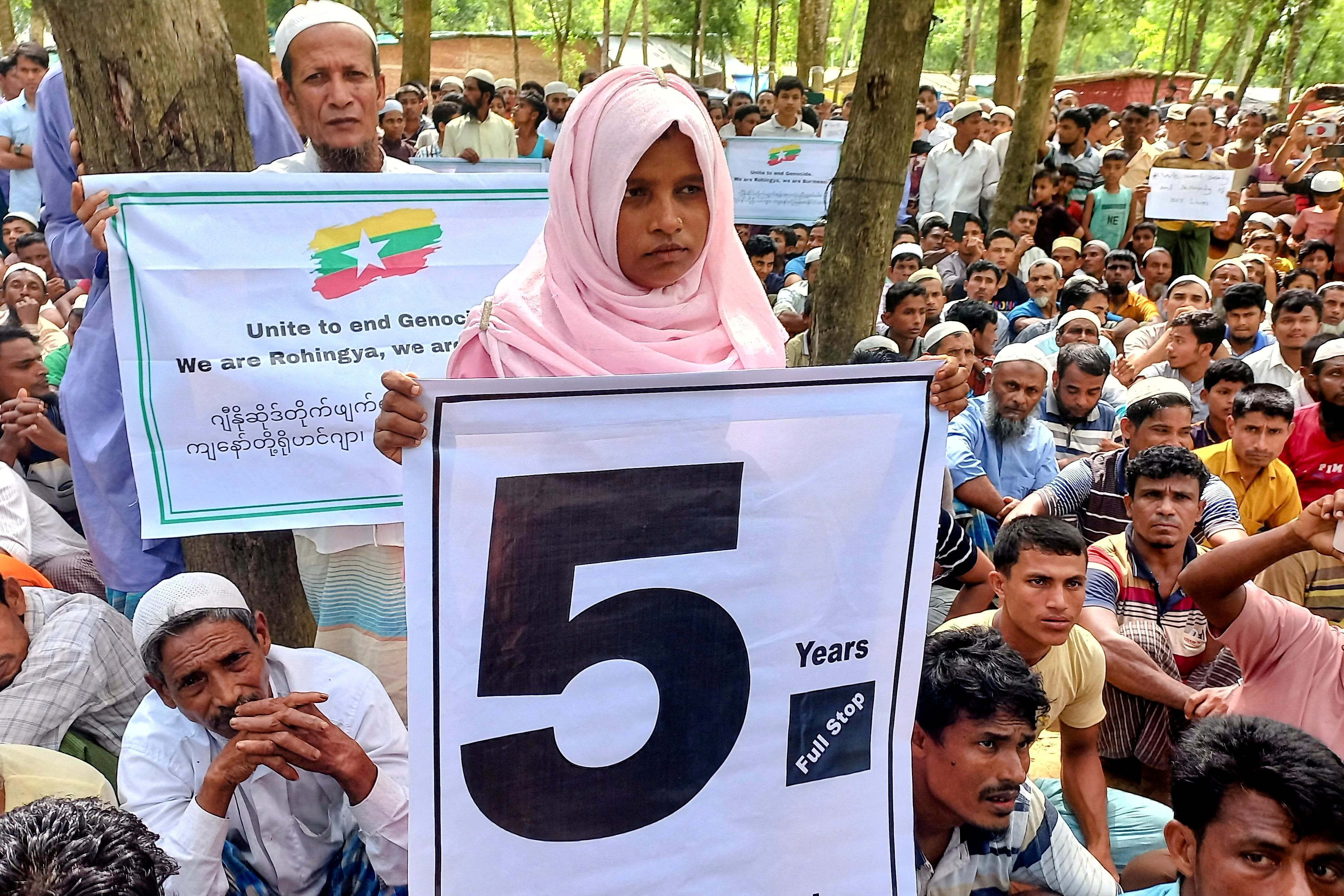
Rohingya refugees gather to mark the fifth anniversary of their fleeing from neighbouring Myanmar to escape a military crackdown in 2017, in Cox's Bazar
Rohingya refugees hold placards as they gather at the Kutupalong Refugee Camp to mark the fifth anniversary of their fleeing from neighbouring Myanmar to escape a military crackdown in 2017, in Cox's Bazar, Bangladesh, August 25, 2022. REUTERS/Rafiqur Rahman/File Photo

GENEVA, Sept 12 (Reuters) - The head of a U.N. team of investigators on Myanmar said on Monday that Facebook has handed over millions of items that could support allegations of war crimes and genocide.

The Independent Investigative Mechanism for Myanmar (IIMM) aims to build case files for proceedings in national, regional or international courts. It was established in 2018 by the U.N. Human Rights Council and began work the following year.

"Facebook has shared with the mechanism millions of items from networks of accounts that were taken down by the company because they misrepresented their identity," Nicholas Koumjian, head of the IIMM, said in a speech to the United Nations Human Rights Council in Geneva.

Myanmar is facing charges of genocide at the UN's International Court of Justice (ICJ) over a 2017 military crackdown on the Rohingya that forced more than 730,000 people to flee into neighboring Bangladesh.

Facebook, whose parent company changed its name to Meta Platforms Inc (META.O) last year, said that they support international efforts for accountability for the crimes committed against the Rohingya.

"(We) have made voluntary, lawful disclosures to the U.N.'s investigative mechanism as well as disclosures of public information to The Gambia" which has filed the ICJ genocide case, Miranda Sissons, director of human rights policy at Meta, said in an e-mail.

U.N. investigator says Facebook provided vast amount of Myanmar war crimes information

Rohingya refugees gather to mark the fifth anniversary of their fleeing from neighbouring Myanmar to escape a military crackdown in 2017, in Cox's Bazar
Rohingya refugees hold placards as they gather at the Kutupalong Refugee Camp to mark the fifth anniversary of their fleeing from neighbouring Myanmar to escape a military crackdown in 2017, in Cox's Bazar, Bangladesh, August 25, 2022. REUTERS/Rafiqur Rahman/File Photo

GENEVA, Sept 12 (Reuters) - The head of a U.N. team of investigators on Myanmar said on Monday that Facebook has handed over millions of items that could support allegations of war crimes and genocide.

The Independent Investigative Mechanism for Myanmar (IIMM) aims to build case files for proceedings in national, regional or international courts. It was established in 2018 by the U.N. Human Rights Council and began work the following year.

Advertisement · Scroll to continue
Report an ad

"Facebook has shared with the mechanism millions of items from networks of accounts that were taken down by the company because they misrepresented their identity," Nicholas Koumjian, head of the IIMM, said in a speech to the United Nations Human Rights Council in Geneva.

article-prompt-devices
Register for free to Reuters and know the full story

Myanmar is facing charges of genocide at the UN's International Court of Justice (ICJ) over a 2017 military crackdown on the Rohingya that forced more than 730,000 people to flee into neighboring Bangladesh.

Facebook, whose parent company changed its name to Meta Platforms Inc (META.O) last year, said that they support international efforts for accountability for the crimes committed against the Rohingya.

"(We) have made voluntary, lawful disclosures to the U.N.'s investigative mechanism as well as disclosures of public information to The Gambia" which has filed the ICJ genocide case, Miranda Sissons, director of human rights policy at Meta, said in an e-mail.

Advertisement · Scroll to continue
ADVERTISING
Report an ad

In 2018, U.N. human rights investigators said the social media site had spread hate speech that fueled the violence in Myanmar. Facebook has said it is working to block hate speech.

With the Facebook items and other pieces of information from over 200 sources, the mechanism has prepared 67 "evidential and analytical packages." These packages are intended to be shared with judicial authorities, including the International Criminal Court (ICC) and the ICJ, Koumjian added.

The ICC has also opened a case looking at deportation and other crimes against humanity in relation to Rohingya refugees who were forced into ICC member state Bangladesh.

Myanmar denies genocide and says its armed forces were conducting legitimate operations against militants.


Unprecedented Case Brought Against Myanmar Junta in Indonesia

Source Tempo, 7 Sept


Myanmar junta leader Senior General Min Aung Hlaing, who toppled the elected government in a coup on February 1, leads a military parade on Armed Forces Day in Naypyitaw, Myanmar, 27 March 2021. [REUTERS/Stringer]
TEMPO.COJakarta - A group of public figures in Jakarta has formally submitted a petition to the Constitutional Court effectively asking it to permit a case against the Myanmar junta, accused of crimes against humanity, war crimes and genocide against the country's Muslim population.
The move is unprecedented and could lead to the first universal jurisdiction case against the Myanmar military in an ASEAN member state.

One of the petitioners, former Attorney General, Marzuki Darusman, said "the Indonesian constitution is very clear that everyone, Indonesian and non-Indonesian, has the right to equal treatment before the law. That means the universal protection of human rights. One small change to the law governing the Human Rights Court would recognize this and pave the way to a trial in Indonesia for the crimes being committed by the Myanmar junta."

The case for action is clear and urgent. At the end of July, the Myanmar military executed four prisoners of conscience, which drew widespread international condemnation. Dozens of other activists are awaiting execution.

Meanwhile, the number of people killed by the junta since the coup in February last year has passed two thousand; fifteen thousand have been arrested or have disappeared; 1.2 million people have been displaced and, according to the UN, over 14 million people are in urgent need of humanitarian assistance.

The sheer scale of this human tragedy in the East Asian region is an affront to Indonesia's 1945 Constitution.

There are well documented cases including the torture of journalists, health workers, teachers, lawyers and humanitarian workers. The Rohingya Muslims have been subjected to the same atrocities and despite investigations in the International Court of Justice and the International Criminal Court, they have not been granted justice.

Unless there is accountability against the junta, there will be further crimes and abuses and the continuation of the anti-Muslim genocide.

The people of Myanmar will never find justice through their own court system which has become a politicized tool in the hands of a vindictive junta. Meanwhile, cases against the Myanmar military at the International Court of Justice (ICJ) and the International Criminal Court (ICC) are severely delayed.

This is why ASEAN countries, including Indonesia, must act now.

The Indonesian constitution guarantees the protection of human rights universally. This can be demonstrated by the use of the phrase "everyone" in the articles on human rights protection. The 1945 Constitution also protects human rights regardless of citizenship.

However, Article 5 of Law 26 dating from 2000, concerning the Human Rights Court, places restrictions on the protection of human rights that are contrary to the 1945 Constitution. The article stipulates that a trial of perpetrators of human rights violations can only be carried out if the crimes are committed "by Indonesian citizens."

But the law does permit a degree of "extra-territoriality". If the human rights crimes occurred outside the territory of Indonesia, a court can be established as long as the perpetrator is an Indonesian citizen.

Not only does Article 5 violate the 1945 Constitution. It also limits Indonesia's role in realizing world peace and upholding the rule of law, as stipulated by the Constitution.

Indonesia has a particular imperative to act, as Jakarta is widely viewed as the "capital" of ASEAN in that it hosts the ASEAN Secretariat and is often visited by perpetrators of gross and widespread human rights violations from Myanmar.

Indonesia can live up to the commitments and ideals of the 1945 Constitution, in protecting human rights universally, if the phrase "by Indonesian citizens" is removed by the Constitutional Court.

That is why the Petitioners are asking the Constitutional Court to remove this phrase and thus allow the human rights of some 55 million Myanmar people to be protected in accordance with Indonesia's 1945 Constitution.

Tuesday, 26 July 2022

ICJ ruling raises hope for Rohingya justice

Source Asia News, 25 July

DHAKA – We welcome the ruling of the International Court of Justice (ICJ) on the legality of the trial of the Rohingya genocide case. This gives us hope that the Myanmar military will not be let off the legal hook easily, even as it continues to dillydally in the repatriation bid with Bangladesh. The court's ruling paves the way for the case to be heard in full, which we hope will lead to justice sooner than later. The trial and finding a long-lasting solution to the Rohingya crisis are both key priorities, and both should be given due importance.

It's been several years since the Myanmar military committed what has been termed "ethnic cleansing" with genocidal intent, the kind of which the world hasn't witnessed in recent decades. Although the junta has been rejecting the "genocide" aspect of the crisis, the World Court on Friday invalidated its objections. The central argument of Myanmar was that Gambia, which brought the suit, had no standing to do so at the top UN court. But the president of ICJ, Judge Joan Donoghue, made it clear that Gambia, as a state party to the 1948 Genocide Convention, can act to prevent genocide, and that the court has jurisdiction in this case.

The Rohingyas have had to go through a series of calamitous episodes since they were brutally murdered, raped and ousted from their ancestral homes in Myanmar. The trauma still haunts them as they wait in squalid camps in Bangladesh to go home and begin a new life. But safety, dignity and integration are of essence while their fate is being decided, and care should be taken so that they do not fall from the frying pan into the fire. No doubt the question of international justice and accountability will be crucial in finding a durable solution to the crisis. We believe all parties involved should maintain their focus on the question of confidence-building among Rohingyas, first by ensuring swift justice in the ICJ case, and then by ensuring that their return home is accompanied with their rights as citizens restored.

In this regard, we would like to reiterate the importance of starting the repatriation process which has been dragging on for a couple of years. As well as getting justice for what happened to them in the past, the Rohingyas are equally concerned, and rightly so, about what will happen to them in the future. World leaders cannot champion the cause of justice on one front, and abandon its pursuit on another front.

Why Has the World Forgotten About Myanmar?

Source HIR, 27 June

The world was stunned when the Tatmadaw, Myanmar's military, deposed popular civilian leader Aung San Suu Kyi in a coup on January 21, 2021. As the opposition protests against the coup led to a violent retaliation by the military and the country dissolved into civil war, the international community watched with concern. Nations condemned the military junta's actions, piled sanctions onto top military officials, and crossed their fingers. But the situation has continued to worsen, and now more than two years later, the country is in an all out civil war with no end in sight.

Despite Myanmar's continuing humanitarian crisis and democratic disintegration, the conflict has lost the attention of the international community, particularly in the West. While this may at first seem like another tragic tale of affluent and powerful nations refusing to step in and help restore justice in less developed countries, the true picture is much more complicated. Substantial intervention by the US and other Western nations is highly unlikely, given the lack of economic potential in Myanmar and the loss of faith in the nation's democratic leadership. Moreover, intervention by Western powers may arguably be unwise due to Myanmar's deep-rooted national military culture as well as China and Russia's vested interests in Myanmar, both making the country a dangerous boat to rock.

A History of Economic Isolationism

Myanmar's military has securely held power since 1962. There was a brief period of republican government after Myanmar's—then called Burma's—independence in 1948, but that period abruptly ended with a military coup. For the following decades, the military tightly controlled Myanmar with an isolationist foreign policy and a tight grip on the economy. Because of this isolationist foreign policy, foreign firms were not incentivized to invest in Myanmar. The military junta instituted "the infamous 'Burmese Way to Socialism' – an ideology that resulted in unprecedented economic devastation and Myanmar's near-total isolation from the international community." Myanmar was isolated economically by the junta's increasing restrictions on foreign aid, nationalization of key industries, and tight control of foreign trade. Ideologically, the junta closed off Myanmar from the West by removing English education from primary schools, clamping down on visas to and from the West, and instituting harsh press censorship.

Myanmar's economic model changed after the Saffron Revolution protests, in which citizens protested the military junta government because of fuel price hikes. In response to the protests and international pressure, the Tatmadaw began to loosen its grip on power. This loosening of the reigns continued for the next few years, and in 2011, the military junta officially dissolved and a military-dominated citizen parliament was created. The parliament engaged in reforms such as decreasing media censorship and economic regulations, which encouraged international investment. Foreign countries started to invest in Myanmar as the country looked to be entering into a new, more modern stage of development. In 2019, Myanmar's GDP had grown to nearly double what it was in 2008, and the country's poverty rate declined from 48 percent in 2005 to 25 percent in 2017.

But since international investment in Myanmar only started to ramp up in 2011, and that investment was not substantial for most countries, few nations have deep economic ties with Myanmar. This lack of foreign investment is one reason many countries are not highly concerned with the instability in Myanmar, since their companies and profits are not on the line.

Myanmar's Democratic Transition

Also during this period of loosening, the call for democracy was strengthening in Myanmar. This movement was led by Aung San Suu Kyi, an activist whose fame entered the spotlight in the 1980s thanks to her democracy campaign in Myanmar. The campaign culminated in a 2015 election in which the citizens of Myanmar voted for Suu Kyi by wide margins to run the country. The international community was ecstatic about Myanmar's democratic transition, and hopes were high for the burgeoning democracy.

Countries around the world then had their hopes dashed when the military embarked on a genocide campaign against the Rohingya Muslim population in Myanmar—and Aung San Suu Kyi defended the killings. Many lost faith in her leadership, and this marked the beginning of the West's re-distancing from Myanmar. The moderate foreign investment that had just begun in 2011 was quickly reversed. The violence against the Rohingya population made foreign investors nervous, and many pulled out their already-meager investments. Along with the loss of faith in Suu Kyi, the divestment in Myanmar led many countries to distance themselves from Myanmar diplomatically.

The 2021 Coup

Despite the violence being carried out against citizens in Myanmar under Suu Kyi's presidency and her declining international popularity, Aung San Suu Kyi remained popular among the Buddhist majority in Myanmar. As a result, Suu Kyi and her National League for Democracy (NLD) party won the December 2020 elections by a landslide. The military had backed the opposition party, so they claimed that the election was fraudulent and demanded a rerun of the vote. When the election commissions proceeded to deny their claims of fraud, the military carried out a coup against Aung San Suu Kyi and other NLD leaders in February 2021, piling on accusations of corruption against Aung San Suu Kyi that could amount to 100 years in prison. But the citizens of Myanmar were not content to renounce their democratic progress without a fight. Opposition forces reacted to the coup with acts of civil disobedience, such as banging pots and boycotting military-supported companies, ultimately transitioning into mass protests.

The military has reacted violently to the protests with rubber bullets, water cannons, and fire directed at protesters. But the opposition movement did not acquiesce, so the civil war still rages on. The military's brutal tactics include shooting live ammunition into homes and protesters, razing entire villages, and arresting over 8,000 suspected opposition forces. The Council on Foreign Relations (CFR) reports that at least 1,500 people have been killed, but this is likely a grave underestimate.

Beyond the suffering caused by direct violence, Myanmar citizens are victims of a shrinking economy, a collapsed healthcare system, and skyrocketing poverty rates: millions of people in Myanmar have faced serious hunger crises, with poverty levels expected to double in 2022. CFR writer Joshua Kurlantzick explains that "because of the coup, Myanmar has become a failing state." While some of this damage has been caused by the COVID-19 pandemic, the civil war has greatly exacerbated the deteriorating living conditions of these citizens.

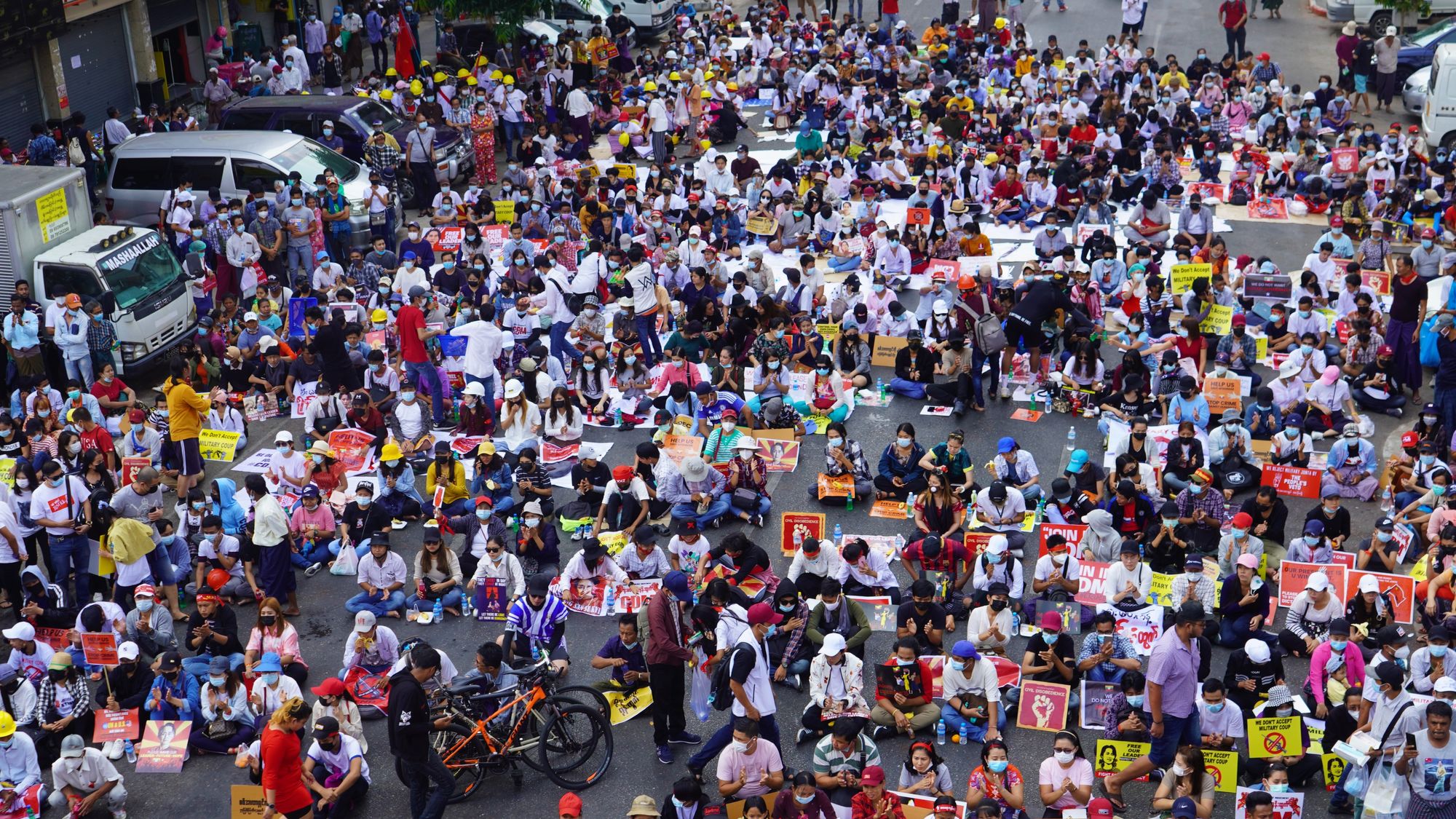
A large protest following the 2021 military coup in Myanmar.

An Anti-Climactic International Response

The international community's response to the coup has been, on the whole, underwhelming. The Biden Administration has sanctioned military officials and companies, condemned human rights abuses, and pressured the Association of Southeast Asian Nations (ASEAN) to put more pressure on the military junta. But the administration could strengthen their support by sanctioning Myanmar's oil and gas revenues, persuading other countries to stop supporting the junta, and increasing aid to the opposition movement. The UN has similarly come out with statements against the coup and the military's violent acts but has hesitated to directly intervene in Myanmar.

Some of the few countries that have remained highly involved in Myanmar are China and Russia, which are close allies of Myanmar's military junta. Due to China and Myanmar's close geographic proximity, China has been able to exert significant economic and diplomatic influence over Myanmar. In fact, China is the most supportive ally of Myanmar and its largest trading partner because of their extensive infrastructure and energy projects as part of the Belt and Road Initiative (BRI). Therefore, China has a vested interest in preventing violence and instability in Myanmar by keeping the junta in power, both because of its geographic proximity and China's economic interests in the county. Some military leaders in Myanmar are wary of losing power to Chinese influence, but with the West's refusal to accept junta leadership, military leaders are forced to grow closer to China.

Russia is also an increasingly strong ally of the military junta. They did not support an arms embargo on Myanmar and have not condemned the coup. In fact, Russia has even continued arms sales to Myanmar during the coup period. In return, Myanmar has wholeheartedly backed Russia's invasion of Ukraine. Russia needs strong allies right now, given the backlash they face over the war, so they have a clear interest in keeping the military in power.

China and Russia's vested interest in keeping the junta in power in Myanmar make intervention on the side of the opposition a formidable task. What's more, although the international community was optimistic about Myanmar's democratic transition, the military never really lost its hold on power in Myanmar. Even when the parliamentary democracy was nominally in control, the Tatmadaw still maintained control over foreign relations, domestic security, and many other policies. The military also has significant holdings in major national companies, so their control extends far into both the economic and political spheres.

That being said, the strength of the military junta is currently being questioned given their struggle to crush the opposition movement and their lack of recognition internationally, as both the UN and ASEAN have refused to recognize the junta as the official government of Myanmar. But regardless, the military is so entrenched in Myanmar's systems and bent on holding power that replacing them with a democratic government is a task no nation wants to take on.

As such, the status quo of limited international intervention will likely remain. Western nations may continue to send hopes, prayers, and sanctions, but not much more. China and Russia will likely continue to support Myanmar's military but fall short of dedicating their forces to the fight. But not all is lost for democracy in Myanmar. The Tatmadaw has promised to eventually return to democratic elections, a promise that does look admittedly questionable now but could be acted upon in the future. The opposition movement has also managed to put up an impressive fight against the Tatmadaw, with the military regularly losing battles to opposition forces. At the present moment, then, the military's victory is not a foregone conclusion; but it does seem that Myanmar's future is in no one's hands, but those of its people.