Friday, 28 January 2022

Australia: Sanction Myanmar’s Coup Leaders

Source HRW, 27 Jan

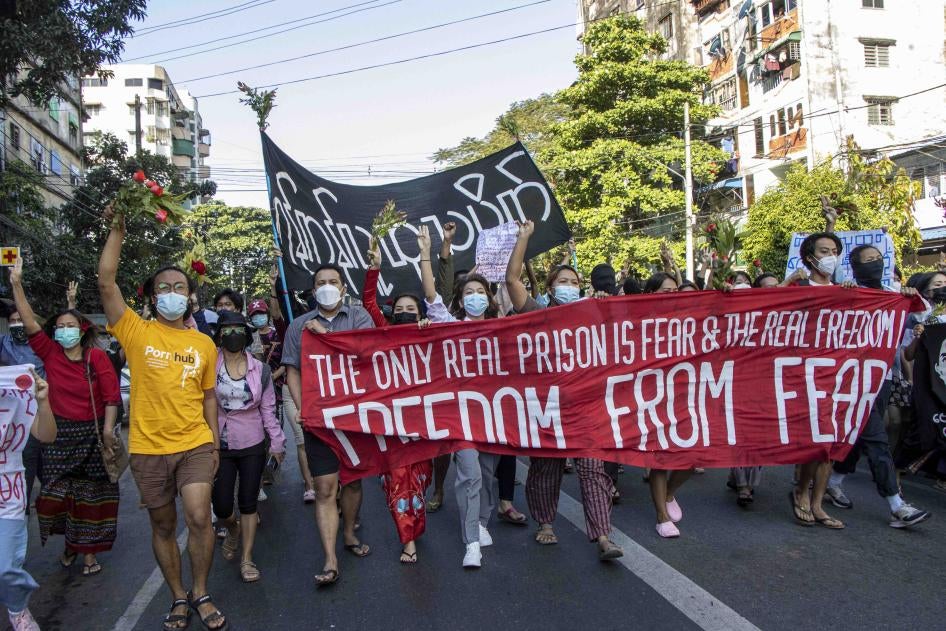
Demonstrators in Yangon protest the military coup in Myanmar, December 4, 2021. © 2021 Santosh Krl / SOPA Images/Sipa USA via AP Images

(Sydney) – The Australian government, one year after Myanmar's February 1, 2021 military coup, should impose targeted sanctions on Myanmar's abusive military leaders and their business interests, six nongovernmental organizations said in a letter to Foreign Minister Marise Payne released today.

In December the Australian government passed amendments to enable targeted sanctions against serious human rights abusers, but the sanctions have not been used. In the past year governments such as the United States, the United Kingdom, Canada, and the European Union have imposed various targeted sanctions against Myanmar individuals and entities.

The letter was signed by the Australian Centre for International Justice, Australian Council for International Development, Australian Council of Trade Unions (ACTU), Human Rights Watch, Publish What You Pay, and the Refugee Council of Australia.

Since the Myanmar military overthrew the elected civilian government last year, the Australian government has not imposed any additional sanctions on military leaders or their business interests. Since then, the military junta has carried out a nationwide crackdown on anti-junta protesters and the political opposition that amounts to crimes against humanity.

State security forces have killed more than 1,500 people, most recently the horrific summary execution of at least 39 people, including 4 children and 2 humanitarian workers, in Karenni State, yet no one has been held accountable for these crimes. Australia should demonstrate its strong public opposition to these atrocities by announcing targeted sanctions on February 1, 2022, the organizations said.

On January 27, the Australian company Woodside, a natural gas producer, announced it was exiting from Myanmar, underscoring the need for coordinated and targeted sanctions from Australia, the US, EU, and other concerned governments on Myanmar's natural gas revenues.

The letter to Australia's foreign minister lists the individuals and entities who should face sanctions. Acting on that list should serve as a starting point for the Australian government to harmonize its position on Myanmar with like-minded governments.

Quotes from signatories to the letter:

"Australia should mark the one-year anniversary of Myanmar's coup by joining join its allies in imposing targeted sanctions against Myanmar's abusive generals and military-owned businesses. The Australian government should heed the calls of people in both Australia and Myanmar to help deprive the military of its revenue sources and to maximize pressure on the junta to end its campaign of terror."

Elaine Pearson, Australia director at Human Rights Watch

"The Australian government needs to act by introducing targeted sanctions, and not just wring its hands. The Myanmar generals stand accused of committing genocide and crimes against humanity against the Rohingya people and snuffing out democratic government, and attacking their own people for voicing democratic aspirations. When will the Australian government stand up for freedom and democracy?"

Marc Purcell, chief executive officer of the Australian Council for International Development

"A year on from the military coup in Myanmar, the Morrison government has failed to introduce further sanctions against Myanmar's military leaders and business interests – putting Australia behind likeminded countries like the US, UK and EU. Workers in Myanmar are risking their lives to protest the military takeover while the Morrison government sits idly by, when they should be taking action to support democracy."

Michele O'Neil, president of the Australian Council of Trade Unions (ACTU)

"The mining, oil and gas sectors are like an ATM for Myanmar's murderous military. The Australian government should introduce sanctions that will outlaw Australian mining, oil and gas companies lining the pockets of the generals with tax and royalty payments."

Clancy Moore, Australian director of Publish What You Pay

Rebel yell: Arakan Army leader speaks to Asia Times

Source Asiatimes, 18 Jan

Tun Myat Naing, commander-in-chief of the Arakan Army (AA), attends a meeting of leaders of Myanmar's ethnic armed groups at the United Wa State Army (UWSA) headquarters in Pansang in Myanmar's northern Shan State, May 6, 2015. Rebel leaders in Myanmar on Wednesday urged the government to amend the military-drafted constitution to give more autonomy to ethnic minorities, a step they said would make it easier to sign a national ceasefire agreement.    REUTERS/Stringer - RTX1BTVZTwan Mrat Naing, commander-in-chief of the Arakan Army, attends a meeting of leaders of Myanmar's ethnic armed groups at the United Wa State Army headquarters in Myanmar's northern Shan state, May 6, 2015. Photo: Twitter

CHIANG MAI – At just 43, Major General Twan Mrat Naing may be the youngest and most successful rebel commanders in Myanmar. The force he leads, the Arakan Army (AA), has grown from a handful of recruits when it was first established in April 2009 into one of the war-torn nation's most powerful and potent ethnic armies.

AA first waged war against the Myanmar military in 2012 in northern Kachin state arm-in-arm with the Kachin Independence Army (KIA). It later fought alongside the Myanmar National Democratic Alliance Army (MNDAA) in northeastern Shan state before launching an insurgency in its home state of Rakhine, also known as Arakan, where thousands have flocked to join its ranks.

Thanks to an unofficial ceasefire reached in late 2020, Rakhine state has not seen the kind of turmoil and violence that has engulfed the rest of the country since the military's democracy-suspending coup last February 1. In that relative vacuum, AA and its United League of Arakan (ULA) political wing have gradually built up a parallel administration and now effectively run much of the state, especially its northern regions.

But AA's rebel threat is alive and well, not least through its membership in three key anti-military alliances – the Brotherhood Alliance, the Northern Alliance and the Federal Political Negotiation and Consultative Committee (FPNCC) – that combined account for most of the nation's ethnic fighting forces. If AA were to resume its hostilities full force, some believe it could critically overstretch the Tatmadaw.  

In his first lengthy interview with international media, Twan Mrat Naing recently spoke over digital media with Asia Times' senior correspondent Bertil Lintner about the future of AA and prospects for Myanmar's spiraling civil war.

Asia Times: The situation in Arakan (Rakhine) has been relatively calm since you entered into an informal ceasefire agreement with the Myanmar military shortly after the November 2020 election. But, given the fact that the rest of Myanmar is in turmoil, for how much longer do you expect the peace to last?

Twan Mrat Naing: The informal ceasefire is not that stable.  We have been at daggers drawn. It's uncertain how long the ceasefire will last, but we wish to have a meaningful ceasefire for mutual benefit and interests.

The SAC [State Administration Council] is fighting on other fronts but with an ad hoc strategy. We know they are furious because we have established our own administration with judicial, taxation, public security branches and other governmental institutions.

Asia Times: What is your relationship with other ethnic armed organizations in Myanmar, not only your allies but also the Karen National Union (KNU), the Karenni National Progressive Party (KNPP) and its Karenni Army, and the Restoration Council of Shan State (RCSS), which are not members of any of the fronts to which you belong?

Twan Mrat Naing: The Arakan Army is actively engaging in the operations of the Brotherhood Alliance and the Northern Alliance, and we are still a member of the FPNCC. We also maintain good relationships with the KNU, the KNPP as well as most other ethnic armed organizations.

Myanmar's insurgent Arakan Army has deployed hit-and-run tactics the military has found difficult to counter and combat. Photo: Twitter

Asia Times: What is your overall assessment of the SAC's performance since it seized power on February 1 last year? Are talks possible or is armed struggle the only way forward?

Twan Mrat Naing: The SAC's health system is crumbling, economically the country is going bankrupt and the country is paralyzed politically. SAC is paranoid and has become more of a diplomatic pariah than ever before. And its military is overstretched on many fronts. The junta has found itself in the middle of a storm, and they do not have much leeway for any mistake.

Once their chain of command and cohesion is disrupted with inner cleavages and mutinies, they could be blown out like a supernova. But we can't underestimate their military strength and resilience – they will do anything to remain in power and they have manifested that with indiscriminate barbarity.

It seems to me that peace talks are very unlikely under current circumstances. With such animosity prevailing, peace talks would amount to mere political rhetoric, not real negotiations.

Asia Times: How do you view the National League for Democracy's role (NLD) in national politics and the Arakan National Party (ANP), the main overground political party in Rakhine state, in regional politics?

Twan Mrat Naing: NLD is not in very good shape either, although it won the majority of votes in a staggering victory in the previous [2020] election. But with its aging and ossified leadership, its future does not look promising and is not up to the expectations of the people. The NLD needs a new leadership, or, for the good of the people of Myanmar, another new capable political force should take over in the political vacuum that exists today.

In regard to the ANP, it would hinge on whether or not there will be an election in 2023, as promised by the SAC. [Myanmar's] political future is dire and unpredictable. Another likely scenario for ANP is that it could merge with the ULA along with other parties and individuals if there are no more elections in the years to come.

Asia Times: Is your final goal independence for Arakan (Rakhine) or autonomy within a federal union? What kind of future state structure do you envisage for Myanmar?

Twan Mrat Naing: The right to self-determination and sovereignty is at the heart of our national movements. We will see whether a Federal Union of Myanmar will have the political space for the kind of confederation that our Arakanese people aspire for.

We would prefer to remain with our [ethnic] brothers and sisters, but if our rightful political status which we desire is not accommodated within this union, it would behoove us to be a member of the international community on our own.

Asia Times: How strong is your army and how much of Arakan (Rakhine) does it control?

Twan Mrat Naing: We have trained over 30,000 soldiers in 13 years (since founding in 2009), and there are still more combatants undergoing training in command and control, and technical skills. Around 70% of our troops are battle-hardened and have combat experience. 5,000-6,000 thousand troops are deployed in our allies' areas, the rest are in Arakan (Rakhine).

We control around 60% of the areas in the north of Arakan (Rakhine) but less in the south. In some areas, it is difficult to draw distinct lines of control between us and the Myanmar army. They still control urban areas and have to keep those for strategic reasons, but we still project our authority as required in those areas and there are still a lot of contested areas as well.

An Arakan Army rebel soldier at an undisclosed location. Photo: YoutubeAn Arakan Army rebel soldier at an undisclosed location. Photo: Youtube

Asia Times: What is your relationship with the People's Defense Forces and associated resistance armies in nearby Chin state?

Twan Mrat Naing: So far, no significant cooperation. 

Asia Times: You said in an interview published by Prothom Alo (Bangladesh) on January 2 that you recognize the human rights and citizenship rights of the Rohingyas. Does that mean you are advocating the return of Rohingya refugees now in Bangladesh and their right to citizenship?

Twan Mrat Naing: We recognize the human rights and citizenship rights of all residents of Arakan (Rakhine), but a massive repatriation of refugees in the current situation could unleash a new wave of unrest. Any repatriation would have to be voluntary and be done by legal means under international supervision.

A major issue for most Arakanese would also be the name with which the refugees would want to be identified. "Rohingya" is not a term that most Arakanese accept. They find it offensive as they feel that it deprives them of their history. They are the original inhabitants of the land.

The Muslim population has come in different waves, and then chiefly when the country was under British rule. If they have lived in Arakan (Rakhine) for generations, they can become citizens. But it's also a question of identity.

Asia Times: What are the chances of Muslims, Buddhists, Hindus and Christians being able to live together peacefully in Arakan (Rakhine)?

Twan Mrat Naing: It is achievable when we don't have outsiders manipulating us and using one group against another. Evidently, our Arakan (Rakhine) state never had the current level of social stability and racial harmony during 1941/2 to 2019. Now, we have more social stability, racial tension has started to decline and more positive social activities can be found. These are observable shifts and more changes should be started from within.

Asia Times: What is your view of Rohingya organizations such as the Rohingya Solidarity Organization (RSO) and the Arakan Rohingya Salvation Army (ARSA)?

Twan Mrat Naing: We do not have any ties with either of them. The RSO appears to be politically more mature than ARSA. But ARSA has more networks and is more active. You can see what ARSA has been doing against their own community leaders at the villages inside Arakan (Rakhine) and at refugee camps in Bangladesh. Some educated Muslims in the diaspora are irresponsibly manipulating ARSA and exploiting the troubled political environment.

Asia Times: Your only foreign neighbor is Bangladesh. How would you describe your relationship with authorities and people across the border, for instance the Marma community? And, a bit further afield, India?

Twan Mrat Naing: The Marma, and the Magh (the Mog of Tripura) are of the same blood as us, as are other ethnic inhabitants across the tri-border region. They have a profound understanding of our movement and sympathy for us.

In regard to Bangladesh's authorities, it's not that bad, but not yet so good either. We haven't noticed that the Bangladesh government has a clear policy or strategy for a formal or informal relationship with us yet.

It should be improved though; they should take a step forward and do so proactively. A better relationship will be mutually beneficial for both of us, and, more importantly, in coping with the refugees, aid delivery, the pandemic and security issues. In order to better serve the interests of the people on both sides, the relationship could also be extended to include health care, education, trade and commerce and other sectors.

Rohingya men look at smoke billowing above what is believed to be a burning village in Myanmar's Rakhine state, as members of the Muslim minority group take shelter in a no-man's land between Bangladesh and Myanmar, in Ukhia on September 4, 2017. Photo: AFP/ K M AsadRohingya men look at smoke billowing above what is believed to be a burning village in Myanmar's Rakhine state, as members of the Muslim minority group take shelter in a no-man's land between Bangladesh and Myanmar, in Ukhia on September 4, 2017. Photo: AFP / K M Asad

Asia Times: Can other countries such as China and Japan play a role in the efforts to reach a peaceful solution to the conflict in Arakan (Rakhine) and the rest of Myanmar? What about the strategic competition between China and the United States?

Twan Mrat Naing: In theory, they can play a vital role but reality is more complex. Changes have to come from within, and that would sound more probable and realistic to me. But the odds are still unclear. The US-China competition has not affected us and is not our concern.

Asia Times: And, lastly, a personal question: why and when did you decide to take up arms against the Myanmar military and the rule of the central government?

Twan Mrat Naing: Myanmar does not have a healthy political space to settle political inequalities and entitlements. I won't be crying for the moon. My rationale is that we are not requesting or asking for what we want from our enemy who has deprived us by force.

We shall create our own destiny with our own hands, no matter what they think. We must build on our own and earn what we deserve. My mission is to restore our sovereignty and reclaim a rightful political status for Arakan (Rakhine).

Follow Bertil Lintner on Twitter at @gardlunden

Friday, 17 December 2021

In Rakhine, more than 100 Rohingya were sentenced to five years in prison each

Source RFA, 16 Dec

aungdaw Township Court on December 14 sentenced 109 of the more than 190 Rohingya arrested in Rakhine State on a boat trip from Malaysia to Malaysia and sentenced them to five years in prison each, and sent them to Buthidaung Prison, a lawyer told RFA.

The other 90 were released after being warned by a court they were under the age of 18.

On November 29, the military arrested 228 people in a boat 17 miles northwest of Mayu Island near Sittwe, Rakhine State, along with a motorboat.

Of those, 35 children under the age of 10 were released the same day, and the rest were prosecuted by the Maungdaw District Immigration Department.

They are refugees from Rakhine State in a refugee camp in Bangladesh and have been sentenced to the maximum sentence under Section 13 (1) of the 1947 Immigration Act, "Tin Hlaing Oo, a lawyer representing the case, told RFA.

"They went to Malaysia illegally from Bangladesh," he said. Many of them took refuge in Bangladesh during the 2017 uprising. And there are five Burmans from Tanintharyi. And two Bangladeshi nationals. Section 13 (1) of the current provisions of the 1947 Immigration Act provides for a maximum sentence of five years in prison. We have clients who have been handed over to Thazin. "I will appeal to them."

Five Burmese nationals were among those arrested and imprisoned.

A family member of the detainee told RFA that the Rohingya had fled to Malaysia because they were facing difficulties in a refugee camp in Bangladesh.

"There are difficulties in the refugee camps in Bangladesh," he said. I am going to Malaysia because I do not want to live in a refugee camp because I can not live with the violence. Some people who have families in Malaysia go to their families. Some go to get married. Some took their brothers with them. It costs about 120 lakhs per person to go there. Some 110 lakhs. Some of them are 100 lakhs. In some cases, it costs 90 lakhs. "

They were killed during the 2017 conflict in Buthidaung. He said he had to flee from Maungdaw Township to a refugee camp in Bangladesh.

A Muslim village head in Buthidaung Township, who spoke on condition of anonymity, told RFA that Muslims currently living in Rakhine State are also subject to travel restrictions.

"Everywhere you look today, the tide of protectionist sentiment is flowing.

They do not want to be named for security reasons, as they are often interrogated when reporting their problems to the media.

On November 25, Muslims in Buthidaung Township were required to travel on Form 4, and the township administration issued a local order restricting them to three months.

He said the ban on Rohingya Muslims from crossing the border and the arrest and imprisonment of them were inhumane.

"Wherever we find and arrest our people in Burma, we will be sentenced to two years in prison," he said. Three years The five-year sentence is inhumane. That should not be the case. We can not go anywhere in Rakhine State where we now live. For example, Maungdaw or Sittwe. If something goes wrong, do not go. He was arrested and interrogated. You have to take Form 4. It is not easy to take Form 4. There are difficulties. "

rohingya.jpg( Photo: Tatmadaw News Agency) 

Nay San Lwin, co-founder of the Rohingya Liberation Coalition, said he could not accept the arrest.

"Imprisonment is not fair. According to Article 13 (1) of the Immigration Act, the minimum sentence is six months and the maximum is five years. But we do not care about the international community because of the pressure from the military on the Rohingya in the international community. Last month's issuance of travel permits made it clear that the International Court of Justice could not comply with the order.

Buthidaung, Rakhine State In Maungdaw townships, more than 600,000 Rohingya Muslims fled to Bangladesh in 2017 due to military clearance.

They have not been able to return home and are still facing difficulties in the camps. 

Saturday, 11 December 2021

A Day After Rohingya Refugees Sued Facebook for $150B, the Company Announced Some Changes

Source Time, 8 Dec

BANGKOK — Facebook's parent company Meta said Wednesday it has expanded its ban on postings linked to Myanmar's military to include all pages, groups, and accounts representing military-controlled businesses. It had already banned advertising from such businesses in February.

The February action, which also banned military and military-controlled state and media entities from Facebook and Instagram, followed the army's seizure of power from the elected government of Aung San Suu Kyi.

The new action came just a day after a high-profile lawsuit was filed in California against Facebook parent Meta Platforms seeking over $150 billion for the company's alleged failure to stop hateful posts that incited violence against the Muslim Rohingya minority by Myanmar's military and its supporters, which crested in 2017.

The army, known in Myanmar as the Tatmadaw, was notorious for a brutal counterinsurgency campaign in Myanmar's western state of Rakhine, which drove more than 700,000 Rohingya to seek safety across the border in Bangladesh. Critics say the campaign, which included mass killings, rape and arson, constituted ethnic cleansing and possibly genocide.

Since February's takeover, security forces have used lethal force to put down nonviolent protests against military rule. At least 1,600 civilians have been killed by security forces, according to a detailed tally compiled by the Assistance Association for Political Prisoners. The army also has been accused of abuses against villagers as it fights members of pro-democracy militias in the countryside.

Activists say the military uses the internet to spread disinformation and hate speech. In April, Facebook announced it was "implementing a specific policy for Myanmar to remove praise, support and advocacy of violence by Myanmar security forces and protestors from our platform."

The group Burma Campaign UK, which had sought to get Facebook do more to curb the military's reach through its platforms, welcomed the move but noted that Facebook had resisted taking down military companies' pages.

"The belated decision to remove military company pages appears more an act of desperation after being sued for $150 billion for being involved in Rohingya genocide than any genuine concern for human rights," Burma Campaign UK's director, Mark Farmaner, said in a statement.

Wednesday's statement from Rafael Frankel, Asia-Pacific director of policy for Meta, said the company was taking action "based on extensive documentation by the international community of these businesses' direct role in funding the Tatmadaw's ongoing violence and human rights abuses in Myanmar."

The military controls major portions of Myanmar's economy, largely through two big holding companies. Because corporate links are not always clear, Meta said it is using a report compiled by U.N, investigators in 2019 to identify relevant firms.

In response to the abuses committed against the Rohingya, Facebook in 2018 banned 20 military-linked individuals and organizations including Senior Gen. Min Aung Hlaing, who now leads the army-installed government. From 2018 to 2010, Facebook removed six networks of accounts controlled by the military, which did not acknowledge the backing.

This year, Facebook disabled pages belonging to state media that violated Facebook rules about promoting violence and harm to others.


Myanmar Junta Jails Aung San Suu Kyi

Source TRTWorld, 7 Dec

watch video thru the link here

After she was forced from her seat in a military coup, Myanmar's ousted leader has now been sentenced to four years in prison. Hundreds remain detained for their opposition to the military takeover. Is Aung San Suu Kyi now the symbol of the military junta's desperation to maintain total control? While the military is promising to hold an election in 2023, many doubt there is a sincere will to hold a vote. So, where does this leave the country's decade long journey towards democracy? Guests: Maung Zarni Co-ordinator of the Free Rohingya Coalition Phil Robertson Deputy Asia Director for Human Rights Watch Mu Sochua ASEAN Parliamentarians for Human Rights Board Member Subscribe: http://trt.world/TheNewsmakers Livestream: http://trt.world/ytlive Facebook: https://www.facebook.com/TheNewsMaker... Twitter: https://twitter.com/The_Newsmakers Instagram: http://trt.world/instagram Visit our website: http://trt.world

Friday, 3 December 2021

Myanmar opposition raises $6.3 mln on launch of 'revolution' bonds

Source Reuters, 23 Nov, 

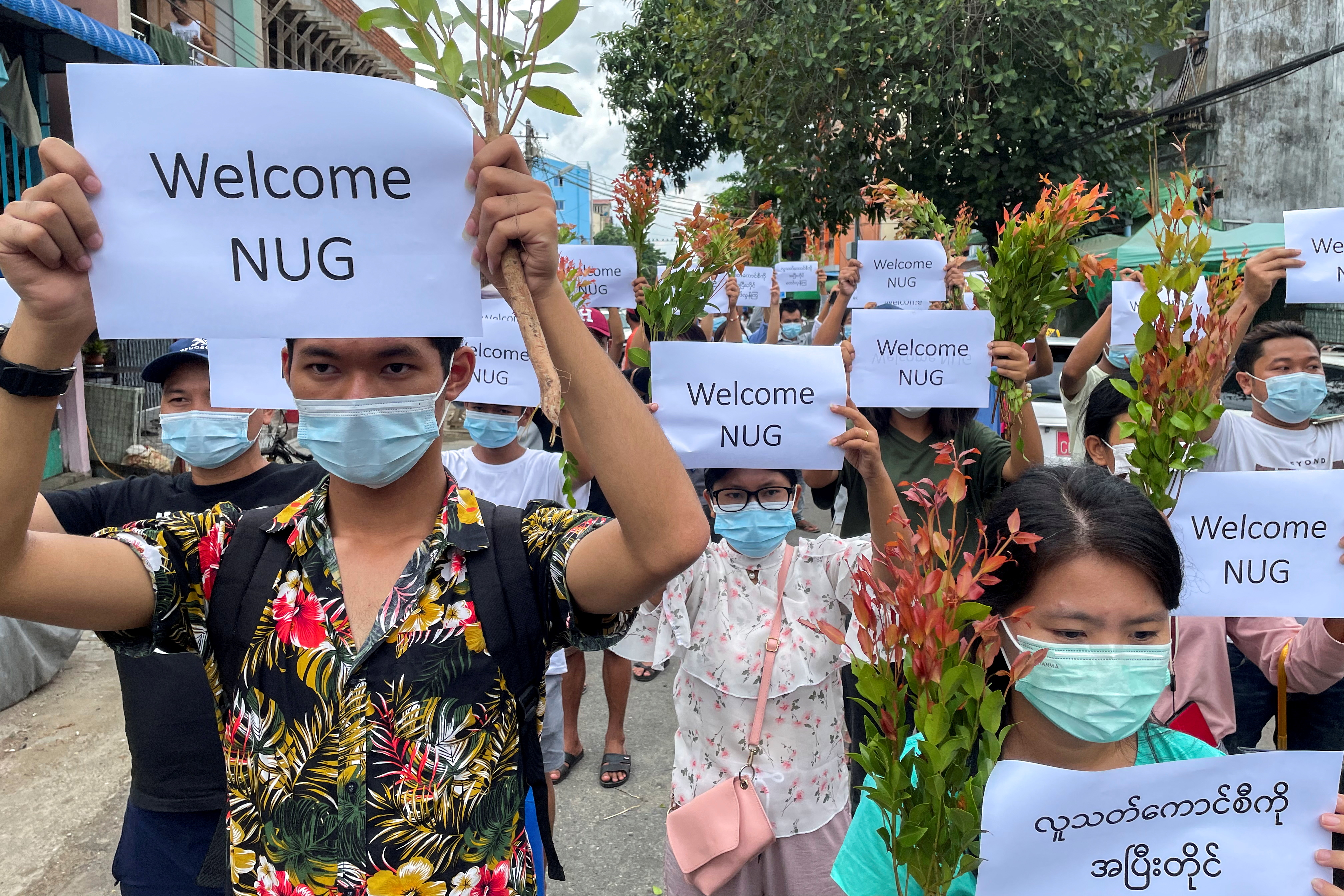
Anti-government protesters hold placards to show their support and welcome the new National Unity Government found by ousted NLD legislators and call to continue strike from traditional new year in Myanmar, in Yangon, Myanmar, April 17, 2021. REUTERS/Stringer/File Photo

Anti-government protesters hold placards to show their support and welcome the new National Unity Government found by ousted NLD legislators and call to continue strike from traditional new year in Myanmar, in Yangon, Myanmar, April 17, 2021. REUTERS/Stringer/File Photo


Nov 23 (Reuters) - A shadow government in Myanmar said it has raised $6.3 million on the opening day of its inaugural bonds sale, in its biggest move yet to generate funds for its "revolution" to topple the ruling military junta.

Myanmar has been in bloody turmoil since the military's Feb. 1 coup and movements that have sprang up to challenge the junta have been mainly supported by public donations.

The National Unity Government (NUG), an alliance of pro-democracy groups, ethnic minority armies and remnants of the ousted civilian government, said bonds went on sale on Monday to mainly Myanmar nationals overseas in denominations of $100, $500, $1,000 and $5,000, with two-year tenures.

Even though the bonds will generate no interest income for buyers, $3 million worth were sold in the first three hours, the NUG said, increasing to $6.3 million by the end of the day. Its overall target is $1 billion.

"From this, I witness the enthusiasm of people in the case of uprooting the fascist military," NUG spokesman, Dr. Sasa, said on Facebook.

The junta has outlawed the NUG and designated it a "terrorist" movement.

The NUG has not disclosed how the funds would be used.

A spokesperson for the junta did not immediately respond to a request for comment.

Opposition groups have been trying to stifle the military's efforts to consolidate power by encouraging people not to pay taxes and to join protests, a civil disobedience campaign and boycotts of army-linked businesses and a national lottery.

Buyers of the bonds made payments via international transfers to an account in the Czech Republic, the NUG said.

A 27-year-old Myanmar citizen, who asked not to be named for security reasons, said she invested $500 in the bonds.

"We do not expect to get money back after two years. We are buying it because we want to contribute to the revolution," she said.

Friday, 15 October 2021

Malaysia houses 200,000 Rohingya refugees, Saifuddin reveals

Source TheMalaysianreverse, 7 Oct

THE number of Rohingya refugees in Malaysia is currently around 200,000 — the highest in South-East Asia, Foreign Affairs Minister Datuk Saifuddin Abdullah said.

Saifuddin told the Dewan Rakyat yesterday that Malaysia, together with other countries need to continue working towards the cessation of Rohingyans or other citizens' expulsion from their respective countries.

"Malaysia is taking steps to continue highlighting the issue of Rohingya refugees regionally and globally," he said.

"At the Asean level for example, Malaysia constantly and loudly spoke out on the issue of Rohingya refugees. Malaysia also strongly supports Asean's efforts in facilitation on the repatriation of Rohingya refugees back to Myanmar."

Saifuddin further said Malaysia also sees that if accountability or accountability for this issue can be achieved through International Court of Justice and International Criminal Court, the Rohingya ethnic group is likely to get due protection while deportations as well as violations against them can be stopped.

"In the past, Malaysia had been the first country to facilitate constructive engagement even before Myanmar became a member of Asean," he said during a question-and-answer session.

He said this in response to Wong Chen (PKR-Subang) queries on whether Malaysia is willing to have a dialogue with the current Myanmar's unity government, without having to go through Asean as en bloc for the dialogue.

Malaysia is of the opinion that it would be difficult to invite the army chief currently in power in Naypyidaw to attend the Asean Summit on Oct 26 to 28.

Bernama reported that since the elected government of Aung San Suu Kyi was overthrown by Myanmar's junta led by General Min Aung Hlaing on Feb 1, there had been internal unrest with nearly 1,000 civilians killed by security forces.

Asean has also appointed Brunei Foreign Minister II Erywan Mohd Yusof as special envoy to Myanmar but he has not been able to play his role because of the military government's refusal to cooperate.


Myanmar's genocide bleached as 'ethnic cleansing'

Source English, 29 Aug

The West's liberal democratic regimes - in this case the Anglo-American governments - manipulate the principles of human rights and international treaties such as the Convention on the Prevention and Punishment of the Crime of Genocide to suit their geopolitical and corporate interests

I was shocked and deeply repulsed beyond words to witness the apparent coordinated attempts by the administrations of Boris Johnson and Joe Biden at bleaching Myanmar's international legal crime of genocide on the very day Rohingya survivors around the world have come to recognise as Genocide Remembrance Day.

While the British Embassy @UK-in-Myanmar was busy tweeting "Today marks the 4th anniversary since the military's committed ethnic cleansing against the Rohingya," the US State Department issued a press statement, entitled "Marking the 4th Anniversary of Ethnic Cleansing in Rakhine State". The American version of spin begins with the opening sentence, "Four years ago, Burma's military launched a horrific ethnic cleansing against Rohingya in northern Rakhine State."

Advertisement
Advertisement

In a different moral universe where rights activists such as myself and dozens of scholars and activists firmly anchor ourselves, human rights are lived principles. International crime codes like the Genocide Convention are lived law.

The West's liberal democratic regimes - in this case the Anglo-American governments - manipulate the principles of human rights and international treaties such as the Convention on the Prevention and Punishment of the Crime of Genocide to suit their geopolitical and corporate interests.

The Johnson and Biden regimes have added insult to the injury of several million Rohingya survivors

For the Americans, the Myanmar genocide is viewed through its paranoid prism that Beijing is dislodging the US as the global hegemon.

Post-Brexit Britain is chiefly concerned about maintaining its market access and shoring up corporate profits in emerging markets, however evil their business partners may be as evidenced in the Independent's headlines "European allies are alarmed by the UK's 'de facto recognition' of the Myanmar junta by sending a new British envoy" two days ago.

Advertisement

But even my 30 years of international human rights activism did not prepare me for the level of moral depravity to which American and British policy-makers are prepared to sink. Washington and London in effect denied and dismissed the crime of genocide on the very day Rohingya have set aside each year to mourn their dead families and friends, and burning of their villages and destruction of their way of life. Blindly the two great powers throw humanitarian crumbs at the survivors who live in sub-human conditions in Bangladesh and Myanmar.

By misnaming Rohingya genocide as "ethnic cleansing," they employ the favourite euphemism for genocide invented by the Serbian genocidal leader Slobodan Milošević. The Johnson and Biden regimes have added insult to the injury of several million Rohingya survivors. The survivors are trapped in refugee and IDP camps and in diaspora dislocation. They drown when their boats are driven back out to sea by the navies of governments like Bangladesh, India, Thailand, Malaysia, and Indonesia.

UK and US leaders, both Democrats and Republicans, routinely use the morally loaded term "genocide," to score points against their enemies, such as China, Libya, or Syria. But Washington and London now seem to coordinate their Milosevicesque use of the term "ethnic cleansing," dismissing the Rohingya demand that they call a spade a spade, a genocide a genocide.

The Biden administration's refusal to officially recognize Myanmar's intentional physical destruction of Rohingyas as "genocide," as defined by the Genocide Convention, stands in sharp contrast with the overwhelming recognition and condemnation of Myanmar's crime of genocide by the US Congress.

US Senator Bob Menendez (D-NJ) and Representative Gregory W Meeks (D-NY-5), the two leading lawmakers, who chair the US Senate Foreign Relations Committee and the House of Representatives Foreign Affairs Committee respectively, have publicly pressed US President Joe Biden "to make a formal determination that these crimes (against Rohingya) constitute genocide." On the day of commemoration of the Rohingya genocide, Gregory Stanton, former State Department official and the world's foremost legal and anthropological scholar of genocide – trained at Yale Law and the University of Chicago – read his poem "What is justice?", at the Free Rohingya Coalition Genocide Memorial Event on 25 August. He asked pointedly, "What is justice for a lawyer who still won't call it genocide?"

In his forthcoming publication, entitled '"Ethnic Cleansing" is a Euphemism Used for Genocide Denial,' Stanton argues persuasively that "ethnic cleansing" is tantamount to genocide denial.

As used by Milošević, the press, the UN, and many governmental policy makers, the term "ethnic cleansing" is used to avoid using the word "genocide." "Ethnic cleansing" has become a euphemism used for genocide denial.

In Stanton's scathing words of indictment: "The UN, press, human rights groups, and many governments still call the Myanmar Army's aggression, genocidal massacres, and forced deportation against the Rohingya "ethnic cleansing." "Ethnic cleansing" is a term invented by Slobodan Milošević and Serbian propagandists as a euphemism for forced deportation and genocide.

"Ethnic cleansing" in common usage means forced deportation. But unlike the crime against humanity of deportation or forcible transfer of population, and the crime of genocide, it is not a term that appears in the Rome Statute of the International Criminal Court. It has no legal meaning in international law. There is no treaty outlawing it. No national legal codes prohibit "ethnic cleansing." No prosecutor can charge anyone for committing it. The term is a license for impunity.

As used by MiloÅ¡ević, the press, the UN, and many governmental policy makers, the term "ethnic cleansing" is used to avoid using the word "genocide." "Ethnic cleansing" has become a euphemism used for genocide denial. Because Article 1 of the Genocide Convention implies the obligation to act to prevent genocide, avoiding use of the term "genocide" has the same practical outcome as genocide denial. Users of the term "ethnic cleansing"—like genocide deniers—are freed from their duty to prevent or stop genocide."

At the same FRC Genocide Memorial Event, Dr Katherine Southwick, another Yale-trained American legal scholar who warned of genocide against the Rohingya as early as 2014, vented her frustration. Southwick said to the Facebook LIVE audience of 20,000+ viewers on Wednesday, "so with frustration with the international community's own lack of accountability, yet with hope and gratitude, the international community must do nothing less than acknowledge genocide and renew our solidarity and support for the Rohingya and equal rights for all in Myanmar."

Advertisement

Taking a non-legal perspective, Gayatri Chakravorty Spivak, the leading scholar of post-colonial studies and University Professor in the Humanities at Columbia University in New York, was emphatic with her demand for legal acknowledgment of genocide – which Rohingya have long been subjected to – when she invoked "common sense".

Also Read

Genocide in a shared death

Suffering etched on the faces of little Rohingya children driven from their country. Picture taken at the Balukhali camp

The Indian scholar told the worldwide audience at the FRC Genocide Memorial Facebook LIVE yesterday thus: "I want to speak to my Rohingya brothers and sisters and talk to them about a possible future. It is the unacknowledged genocide that has made it impossible for me to do what I want to do today. I don't think our conscience needs to go to legal definitions to acknowledge that a Rohingya is killed simply because she is a Rohingya. By common sense, that is genocide. But we must have an international legal acknowledgment in order for the possibility of legal redress to begin."

Rohingya – and their international friends – worldwide mourned the mass-death and destruction of numerous victims raped, maimed, slaughtered, and genocidally murdered – and lamented the absence of any effective acts by the "abstract international community" – to borrow Spivak's coinage.

On the same day, General Sadat, a US-trained commander in the Afghan National Army, was writing in the New York Times, with justified anger towards the US government for having abandoned the Afghan people. (The Afghan Army Collapsed Against the Taliban. Here's Why. - The New York Times) General Sadat writes, "I am exhausted. I am frustrated. And I am angry. President Biden said last week that 'American troops cannot and should not be fighting in a war and dying in a war that Afghan forces are not willing to fight for themselves.' It's true that the Afghan Army lost its will to fight. But that's because of the growing sense of abandonment by our American partners and the disrespect and disloyalty reflected in Mr. Biden's tone and words over the past few months."

The betrayal and a palpable sense of abandonment that the wretched of the earth who struggle for their right to life and liberty have felt towards the liberal West in general and the US in particular, with US signature honey-tongued support for human rights and "the rule-based international order," is nothing new.

In the early years of the Cold War, after having made promises of solidarity which they never intended to keep, the US and western allies abandoned thousands of Hungarian rights activists in the wintery month of November 1956.

Almost 20 years ago, Matthew Daley, then serving as the Deputy Assistant Secretary of State in the Bureau of East Asian Affairs at the US State Department, met with me in his office in Washington, DC. Daley pointedly warned me against trusting and relying on the US government for the Burmese liberation struggle.

"My government's Burma policy is unconscionable. We made empty promises to the Hungarian democrats in 1956. Then when they were slaughtered (by the Soviets), we did nothing. So, you Burmese must find your own solutions."

The ugly truth is Western and Eastern birds of the same feather flock together in the UN Security Council, where they take turns denying their own war crimes, crimes against humanity, and genocides, and where they flout international treaty obligations that conflict with their national interests
Advertisement

But it's one thing for the US and its British poodle to abandon dissidents worldwide against corrupt and brutal regimes, be they Hungarians, South Vietnamese or, pro-human rights and anti-Taliban Afghan people. It is another moral low for British and American foreign ministries to coordinate their statements of genocidal denial as they did on the 4th anniversary of "ethnic cleansing" in Rakhine State.

Ten years ago, my research colleague and partner Natalie Brinham (writing under the pen name Alice Cowley), and I conducted a 3-year path-breaking study based on hundreds of interviews with Rohingya survivors in Malaysia, India, Bangladesh, Saudi Arabia and Myanmar. We reached the unequivocal conclusion that Myanmar has institutionalised the intentional physical destruction of its Rohingya minority. The genocidal process started with the destruction of their group identity and denial of their history in Burma centuries before Burma or Myanmar came into existence in 1948. We published our findings as a commissioned peer-reviewed article entitled "The Slow-Burning Genocide of Myanmar's Rohingya" in the Pacific Rim Law and Policy Journal of the University of Washington School of Law in the spring of 2014.

The Public International Law and Policy Group (PILPG) was the Washington law firm that the US State Department hired to conduct a forensic investigation of crimes against the Rohingya, using a representative sample of 1,000 Rohingya survivors in Bangladesh in 2017. When the State Department refused to use the term "genocide" in the official State Department report of the findings, PILPG went public with its genocide findings.

PILPG's Paul Williams told a press conference in Washington in 2018, "It is clear from our intense legal review that there is, in fact, a legal basis to conclude that the Rohingya were the victims of war crimes, crimes against humanity and genocide." But the Trump Administration decided to shelve its own commissioned report, when the findings did not suit the US government's agenda.

British politicians were no more receptive of facts and findings about the Myanmar genocide, according to Queen Mary University of London Professor Penny Green, whose International State Crime Initiative, documented the evidence of the genocide in 'Countdown to Annihilation: Genocide in Myanmar' (2015). She spoke on the FRC Genocide Memorial Event on Facebook LIVE this week.

It is no wonder that the Taliban, the Xis and the Putins of the world, and rogue regimes everywhere pay no attention to Anglo-American joint statements that bark about democracy, human rights, and the rule of law. Nor do these rogue regimes think twice before they commit mass atrocities.

The ugly truth is Western and Eastern birds of the same feather flock together in the UN Security Council, where they take turns denying their own war crimes, crimes against humanity, and genocides, and where they flout international treaty obligations that conflict with their national interests.

Those in high offices who have been entrusted to ensure the peace, security and well-being of humanity have turned out to be the worst enemies of "We the People."

* Maung Zarni is a co-founder and Burmese coordinator of the Free Rohingya Coalition and an advisor to the Genocide Watch