Tuesday, 7 May 2013

Dalai Lama decries Buddhist attacks on Muslims in Myanmar

Source Courant, 7 May 
 
Tibet's exiled spiritual leader the Dalai Lama waves to the audience after his first speech during the European Tibetan Buddhist Conference in Fribourg

Tibet's exiled spiritual leader the Dalai Lama waves to the audience after his first speech during the European Tibetan Buddhist Conference in Fribourg (Pascal Lauener Reuters, / April 13, 2013)

COLLEGE PARK, Maryland (Reuters) - Exiled Tibetan spiritual leader the Dalai Lama on Tuesday decried Buddhist monks' attacks on Muslims in Myanmar, saying killing in the name of religion was "unthinkable."

The Dalai Lama, a foremost Buddhist leader, told an audience at the University of Maryland at the start of a U.S. tour that the root of seemingly sectarian conflict was political, not spiritual.

"Really, killing people in the name of religion is unthinkable, very sad. Nowadays even Buddhists are involved in Burma," another name for Myanmar, with monks attacking Muslim mosques, the Nobel Peace Prize laureate said after delivering the Anwar Sadat Lecture for Peace at the university.

                                                                                                                                                                                                                                    "I think it is very sad," he said, adding, "I pray for them (the monks) to think of the face of Buddha," who had been a protector of Muslims.

A wave of sectarian violence erupted in March in the central Myanmar town of Meikhtila, causing 44 deaths and displacing an estimated 13,000 people, mostly Muslims.

A Reuters investigation found that radical Buddhist monks had been actively involved in the violence and in spreading anti-Muslim material around the country.

Sectarian clashes between Buddhists and Muslims, who make up about 5 percent of Myanmar's population, have erupted on several occasions since a quasi-civilian government took power in March 2011 after five decades of military dictatorship.

The 77-year-old Dalai Lama, whose name is Tenzin Gyatso, also urged his largely student audience of 15,000 to create a new world in the 21st century, saying that he was a man of the last century.

"That group of individuals of the 20th century are ready to say bye-bye," Tibet's most revered spiritual leader said. "You have the responsibility to create a new world based on the concept of one humanity."

China brands the Dalai Lama, who fled into exile to India in 1959 after an abortive uprising against Chinese rule of Tibet, as a separatist. The Dalai Lama says he is merely seeking more autonomy for his Himalayan homeland.

The address in College Park, Maryland, was the start of a U.S. visit that includes stops in Oregon, Wisconsin, Kentucky and New Orleans, Louisiana.

(Reporting by Ian Simpson; Editing by Scott Malone and Kenneth Barry)

The BRAFA Bulletin: Volume-2, Issue-3

by BRAFA,

..
..
..


Wednesday, 1 May 2013

Myanmar's Muslims Face Uncertain Future

Source Huffingpost, 1 May
 

OKKAN, Myanmar -- They slept terrified in the fields, watching their homes burn through the night. And when they returned on Wednesday, nothing was left but smoldering ash and debris.

Myanmar

{A Muslim man pushes his bicycle by debris of damaged shops near local bazaar following fresh anti-Muslim violence broke out in Okkan, 64 kilometers (40 miles) north of Yangon, Myanmar, Wednesday, May 1, 2013. Hundreds of rampaging Buddhists armed with bricks on Tuesday, stormed a clutch of Muslim villages in the country's latest outbreak of anti-Muslim violence.}

One day after hundreds of Buddhists armed with bricks stormed a clutch of Muslim villages in the closest explosion of sectarian violence yet to Myanmar's main city, Yangon, newly displaced Muslims combed through the wasteland of their wrecked lives. Unable to go home, they faced an uncertain future – too fearful of more attacks even to leave.

"We ran into the fields and didn't carry anything with us," Hla Myint, a 47-year-old father of eight, said after the mobs overran his village.

Tears welling in his eyes, he added, "Now, we have nothing left."

Thet Lwin, a deputy commissioner of police for the region, put the casualty toll from Tuesday's assaults at one dead and nine injured. He said police have detained 18 attackers who destroyed 157 homes and shops and at least two mosques in the town of Okkan, 50 miles (80 kilometers) north of Yangon, and three outlying villages.

The unrest was the first reported since late March, when similar Buddhist-led violence swept the town of Meikthila, further north in central Myanmar, killing at least 43 people. It underscored the failure of reformist President Thein Sein's government to curb increasing attacks on minority Muslims in a nation struggling to emerge from half a century of oppressive military rule.

Muslim residents said a mixture of local villagers and people from nearby areas were responsible for the attacks around Okkan. Police gave no details on who was behind the assaults. But a local politician from the pro-government National Union party, Myint Thein, said members of a Buddhist campaign called "969" were involved.

The movement, which urges Buddhists to shop only at Buddhist stores and avoid marrying, hiring or selling their homes or land to Muslims, is small but has spread rapidly in recent months, and human rights activists say it has helped fuel anti-Muslim violence.

Stickers and signs bearing the 969 emblem – each digit enumerates virtues of the Lord Buddha, his teachings and the community of monks – have been popping up on shops, taxis, and buses in numerous towns and cities, including Yangon.

Hla Myint said that after the March violence, residents of Okkan began conducting informal security patrols to protect the village. But nothing happened for weeks and authorities told them not to worry.

"Things happened unexpectedly," he told The Associated Press. "When the crowds came, they shouted things like `Don't defend yourselves, we will only destroy the mosque, not your homes, we won't harm you.'"

They burned his village's mosque, whose corrugated iron roof lay crumpled on the ground between the building's charred walls, and "they destroyed our houses" anyway, he said.

Around 300 police stood guard Wednesday in the area, which was quiet. Debris from trashed shops in Okkan spilled into dirt roadsides. The town's market was crowded, but Muslims were absent.

It was not immediately clear what would happen to the newly displaced in Okkan. Some were taking refuge in the few houses that were not razed; others simply sat in the open, under the shade of trees.

Several Muslims said they didn't feel safe, but would not leave because they feared more attacks elsewhere. They wondered how they would survive and get food.

Hla Aung, a 39-year-old Muslim who lost his home in the violence, said police did nothing to protect him – echoing reports of idle security forces in Meikhtila and elsewhere. "They didn't help us. They did not do anything. That's why it's really difficult to trust them."

Aung Myint, 46, who lives in a predominantly Buddhist area nearby that was undamaged, said several men from his village were beaten after they tried to convince the attackers to stop. "We didn't dare to help them because we were worried for our own security," he said.

Stopping the spread of sectarian violence has proven a major challenge for Thein Sein's government since it erupted in western Rakhine state last year. Human rights groups have recently accused his administration of failing to crack down on Buddhist extremists as violence has spread closer to Yangon, at times overwhelming riot police who have stood by as machete-wielding crowds attacked Muslims and their property.

Last week, New York-based Human Rights Watch accused authorities in Rakhine state – including Buddhist monks, local politicians and government officials, and state security forces – of fomenting an organized campaign of "ethnic cleansing" against a Muslim minority known as the Rohingya. Hundreds of people were killed there, and some 125,000 people, mostly Muslims, remain displaced with large swathes of the state effectively segregated along sectarian lines.

On Monday, a government-appointed commission investigating the Rakhine violence issued proposals to ease tensions there – including doubling the number of security forces in the volatile region and introducing family planning programs to stem population growth among minority Muslims.

Muslims account for about 4 percent of the nation's roughly 60 million people. About one third of the nation's population consists of ethnic minority groups, and most have waged wars against the government for autonomy.

___

Pitman reported from Bangkok. Associated Press video journalist Raul Gallego Abellan in Okkan contributed to this report.

Myanmar whitewashes ethnic cleansing

Source Atimes, 1 May
 
By Maung Zarni

An official report into last year's violence in Rakhine State, launched on April 29 at the government's foreign donor financed Myanmar Peace Center, is intellectually, ideologically, empirically and analytically flawed, underscoring President Thein Sein's bid to whitewash the recent ethnic cleansing of Muslim Rohingya in the western state, which borders Bangladesh.

Established on presidential order, the Inquiry Commission has been conflicted from the day of its inception on August 17 last year. The five individuals who were hand-picked to launch the
report on Monday were a curious mix themselves: the country's most famous political comedian, the former daughter-in-law of the late despot General Ne Win, a well-known former student leader, a well-known former exile, and the president's personal adviser and interpreter.

Thein Sein and his allies are increasingly using various crisis inquiry commissions, including the Aung San Suu Kyi-led Letpadaung Mountain Copper Mine Inquiry Commission and now the Rohingya Ethnic Cleansing Inquiry Commission, as public relations instruments to deflect public attention from its spectacular failures in handling popular discontent, state-sponsored violence against civilian populations, and mass ethno-religious violence.

In instances where the role of government institutions was instrumental, for instance in last year's pogroms in Rakhine State, inquiry commissions have become useful tools of deflection for Naypyidaw. The latest official report, originally classified as "secret", of the Rakhine Sectarian Violence Inquiry Commission was strategically released to counter the damning and credible April 22 report "All You Can Do is Pray: Ethnic Cleansing and the Crimes Against Humanity in Myanmar", released by US-based rights lobby Human Rights Watch.

The Inquiry Commission was stacked with cooperative technocrats, ethnic minority leaders, socialites, religious leaders and so-called human rights activists who were prepared or compelled to sign off on the report despite knowing it contained verifiably false and distorted facts about important issues under investigation.

As a product of such an unholy alliance, the commission's report is patently un-professional, non-independent and unprincipled. Devoid of crucial truths, it is a document utterly uninformed by any well-established analytical concepts such as "ethnic formation", "identity formation", "state's mobilization" in genocide studies, "discourse", "nationalism", "history" - through which all scholars and researchers of the social world attempt to make sense of even ordinary human affairs, including genocides.

Ethnic labels in Myanmar, including for the Chin and the Kachin, were externally imposed by British colonial administrators and American Baptist missionaries on the "natives". These were disparate groups who originally identified themselves tribally, as clans and along geographic lines. The new ethnic labels were less than 50 years old upon independence in 1948. Mal-informed by the prevailing pseudo-scientific knowledge about race and ethnicity in Europe, the British colonials and American missionaries grouped these "tribal peoples" in borderlands together for administrative expediency.

As Indian economist and Nobel laureate Amartya Sen correctly pointed out during a public seminar on Myanmar at Columbia University last September, the geographical areas now known as Arakan or Rakhine State frequently changed hands among neighboring feudal rulers, and boundaries were always elastic in the pre-colonial era.

The Rohingya Ethnic Cleansing Inquiry report officially stresses how the Rakhine feudal lords expanded their reach over territories in what was then Bengal, while making light of the fact that there were Bengali kings who ruled what was then the Kingdom of Arakan. Academics, especially establishment ethno-nationalist historians, have long proven capable of recounting the past only from a victor's perspective. The two leading scholars on the Inquiry Commission are no exception.

For a commission that was led by two historically trained Burmese and a retired Rangoon [now Yangon] University history professor, the report's treatment of the history of a people whom the commission insisted on referring to as "Bengali" is anything if not "ethnocidal" - that is, an attempt to erase concrete historical evidence that the Rohingya, a self-referential identity, existed as an ethnic community and was officially recognized by the state under the democratic government of prime minister U Nu.

This recognition of the Rohingya as an official constitutive ethnic group of the country, as well as their full citizenship status, was not confined to civilian politicians from the ruling political parties. During its two-year caretaker government (1958-60), the army's senior most leadership of General Ne Win and his deputies including Brigadier Aung Gyi officially recognized the Rohingya by their own self-chosen ethnic name: the Rohingya.

While Thein Sein's commission's historians claimed to have poured over the archival records at the country's National Archives relevant to these "Bengalis", to borrow the standard Rakhine reference to the Rohingya of western Myanmar, they violated professional ethics as researchers by blatantly omitting any concrete evidence that the Rohingya were both an official ethnic group and citizens of Myanmar.

In fact, one doesn't need to bother going to the archives to verify the Rohingya's ethnic identity and their citizenship status. Photographic copies of the verifiably authentic official records (for instance, Burma's Encyclopedia published by the Government Printing Press in 1964, official transcripts of speeches by the Burmese generals bearing the Rohingya's name, Burmese state newspaper clippings announcing a national radio program for various ethnic languages including the Rohingya language, parliamentary records, etc) are easily accessible in numerous social media sites and on-line archives.

But the commissioners, either as anti-Rohingya Islamophobes or under duress from the government that appointed them to the Inquiry Commission, especially the professional historians among them, evidently chose to weed out any historical evidence that contradicts Myanmar's racist Citizenship Act of 1982, which was designed with input from Rakhine nationalists and earlier anti-Muslim elements in the Ministries of Defense and Immigration to strip Muslim Rohingyas both of their ethnic identity and citizenship standing.

Forgotten history
In the hands of the commission's Cornell- and Harvard-trained historians, including the likes of chairman Myo Myint, secretary Kyaw Yin Hlaing and Professor Tun Aung Chain, the Rohingya's migratory history began only in 1824 and going on to the Japanese advent in 1942, when large scale communal violence between the Rakhine and the Rohingya took place. The entire two decades of the 1950s and 1960s, during which the Rohingya were both official ethnic peoples and had citizenship rights, were completely skipped in the report's historical section. This omission highlighted the anti-Rohingya Rakhine nationalist version of history which denies that the Rohingya ever existed.

State-sponsored ethnocide, which began with the brutal immigration campaign of 1978 which drove out nearly 200,000 Rohingya from the Rakhine state across to neighboring Bangladesh, was "unproblematized" by the commissioners, all of whom insisted that they were "politically independent". The ethnocide is all the more shocking considering the commission's ethnic diversity, including representatives from the ethnic Kachin, Chin, Karen, Shan and other communities that have experienced oppression from state authorities.

Ethno-religiously, the commission was a good mix - that is, except that there was no Rohingya - nay, "Bengali" - representation. Dr Myo Myint (Bama or Bama-identified), Khun Tun Oo (Shan), Jana Lahtaw (Kachin), Dr Salai Andrew (Chin), U Soe Thein (Bama), Dr Yin Yin Nwe (Shan-Bama), Dr Kyaw Yin Hlaing (Shan-Bama), Zarganar (Bama), Aung Naing Oo (Bama), Ko Ko Gyi (a national security race?), Tin Aung Moe (Bama), Daw Than Than Nu (Bama), (Vet) Dr Aye Maung (Rakhine with neo-Nazi views), Aye Thar Aung (ultra-nationalist Rakhine), Reverend Margay Gyi (Karen), U Tun Aung Chain (Karen). There are also Myanmar Muslims (ethnically Indians) and Myanmar Hindu.
 
With the exception of the Muslim commissioners, none of these ethno-religious diverse commissioners fought against the state-sponsored ethnocide of the Rohingya in the form of the commission's vehement opposition to the word "Rohingya". The two Muslim leaders who challenged this ethnocide and stood up for the Rohingya's own "imagined identity" were kicked out. Their crime? - frivolous charges of speaking to the press about the inquiry while others who also spoke to the media were left untouched.

As to be expected, the report made no mention of how politics got in the way of establishing truths about the mass violence in Rakhine State. In fact, the commission sought to confirm the popular anti-Muslim racism without problematizing the recent growth of this increasingly virulent strain of Islamophobia and anti-Bengali sentiment across all indigenous national races of Myanmar.

The commission did raise passing concern about the 969, a neo-Nazi movement ostensibly led by Buddhist monks from Myanmar's leading teaching monasteries, and its divisive impact on ethnic and social relations in society. But it fell far short of pointing out the need to take seriously the new neo-fascist turn in the country's well-known anti-Muslim, pro-Buddhist racism. The report's authors chose to describe the now world infamous 969 rather mildly as "a campaign among the Buddhist to defend their own faith and to encourage intra-Buddhist commerce and trade".

All this is troubling but not unexpected. It was under the Religious Affairs Director-Generalship of Commission chair Dr Myo Myint that there was a proliferation of anti-Muslim quasi-religious publications, long before the previous crop of ruling generals allowed for greater freedom of press, assembly and speech. The leading voice of 969, Buddhist monk Wirathu, recently told the Associated Press that his views were formed as early as 2001.

Sadly, nearly half of the commissioners are my old, and now former, friends. Their collective document is unmistakably Bama racist/Orientalist in orientation, treating both communities in the conflict with a typical popular Bama contempt and dislike. This is adding insult to injury for both parties in the conflict, namely the Rakhines and the Rohingya.

The Rakhines are portrayed essentially as lazy natives who can not compete with the thrifty, business-savvy, hard-working "Bengalis" without the intervention of the state and its blood-based neo-fascist 1982 Citizenship Act.

The Rohingya are described as elementary school children-like people who, having obtained commission members' hand-phone numbers from their Muslim contacts in Yangon, kept on calling the commission members to blabber on about their sufferings and whine about their grievances.

These portrayals repeat a crucial racially charged popular narrative that turns out to be factually incorrect, namely that three Bengalis raped and brutally murdered a 28-year-old Rakhine Buddhist woman, the supposed first spark of the following pogroms. This was pointed out to me personally by a more honest commission member, Myanmar's most famous political comedian and former political prisoner, Zarganar.

This rape case is vitally important because the commission identified it as a key trigger for anti-"Bengali" mobilization by Rakhine nationalists, politicians and parties, including some of the Rakhine members of the Inquiry Commission, including Aye Maung, a vet-cum-MP in Naypyidaw from the Rakhine National Development Party, an ultra-nationalist group that has claimed to be working for the "purification of Rakhine state".

But the arrested and alleged rapists were officially registered as two Kaman Muslims and a Rakhine adopted by a Rohingya Muslim family in Pauk-taw Township. Zarganar, one of the five members who was one of the leading spokespersons for the commission at the press conference where the report was launched, told this writer in no uncertain terms that he interviewed the doctor in Rakhine state who performed the post mortem of the raped woman's corpse.

According to this videotaped interview, the alleged Rakhine rape victim bore no sign of having been raped. Yes, she was brutally murdered and her jewelry was gone. But she was certainly not raped, recounted Zarganar, based on his one-on-one recorded interview with the doctor. The doctor was eventually forced by the authorities to sign the official post-mortem report that established the rape that did not take place.

Then there was no mention of the "suicide in police custody" of one of the alleged rapists - Htet Htet, a non-Bengali adopted son of a Bengali family. Nor was there any mention of the fact that his freshly widowed wife was also found dead, allegedly having "drowned" in a local well.

Was there foul play? It appears that Zarganar, the well-respected political comedian and dissident who went to jail four times since the 1988 pro-democracy uprisings crushed by the military, was compelled to put his name to the official commission report which contained statements and misinformation which he himself knows are patently and verifiably false.

The entire report is riddled with inter-contradictions and inconsistencies that are not explained. For instance, the report raises the issue of the lack of or weak inter-agency coordination among the army, intelligence, civil administration, immigration, attorney general's office and Rakhine chief/prime minister's office. It discusses how and why the security forces and constitutive agencies only listened to direct orders from Naypyidaw.

But the commission chose not to ask why Naypyidaw failed to issue orders to provide adequate measures to protect the targeted Rohingya communities. Instead, the National Defense and Intelligence Council (or Kar-lon in Burmese) did nothing to mobilize security forces to protect the Rohingya, troops which Thein Sein and his deputies knew would obey only direct orders from ministerial headquarters.

Perhaps one silver living in the dark episode is that the report accurately states that local authorities in Rakhine State have absolutely no power to order security forces, including army, police, and border-control interagency troops, to do anything to quell mass violence. This was and still is something only Thein Sein's central government can do.

Command questions
That begs the question: why did the union level leadership of Thein Sein and his deputies on the Council in Naypyidaw choose not to mobilize the troops to restore order while the same security troops were called in to firebomb sleeping Buddhist monks protesting a China-invested mining project at 2 am using canisters containing white phosphorous? Alas, this is a question that fell outside of the purview of the presidential commission.

Furthermore, vague if not imaginary statistics are cited throughout the 186-page document without accompanying narratives or explanations. The commission did not even bother to account for its own official statistics from the government. The fact is that the greatest number of deaths and destruction were borne by the Rohingya. And yet a highly disproportionate number of the Rohingya vis-a-vis the Rakhine have been tried.

In the first wave of Rohingya-Rakhine violence in June last year, 4,188 Rohingya homes were destroyed while the Rakhine suffered the loss of 1,150 homes. In the second wave of violence in October, 2,371 Rohingya homes were destroyed as opposed to only 42 homes that belonged to the Rakhine. And again, out of a total of 1,835 arrested in connection with the mass violence, 1,589 are Rohingya and only 246 are Rakhine.

Perhaps the scholarly presidential investigators on the commission could advance and test a hypothesis that the economic productivity of Rakhine Buddhists (all Buddhists in Myanmar?) must be inversely correlated with the destructive capacity of the group. For the report orientalized the Rakhine as a low-productivity group, or more crudely, lazy natives.

The commission's official statistic implies the awesome power of a small group of Rakhine - 246 to be exact - to destroy thousands of homes and dozens of mosques in about a dozen different towns and cities and make over 120,000 Rohingya refugees homeless, shelter-less, internally displaced persons in a span of just five months.

If this number of Rakhine terrorizers, arsonists and slaughters does not seem quite convincing given the magnitude of death and devastation they had wrought throughout northern and southern Rakhine State, then who else aided and abetted the principal terrorizers among the Rakhine who wanted a Rakhine State only for the Rakhine?
 
There is no mention in the report of a single case wherein any official, security or civil, was held accountable for his or her leadership failure, or worse, participation in the pogroms. According to Zarganar, his official request that the investigators be allowed unfettered access to all the important officials alive, past and present who have served in western Myanmar over the past 25 years was never granted. He told me that many of the officials were transferred to remote places after the commission was formed on August 17.

So what is Naypyidaw trying to hide? That question, of course, also lied outside the mandated scope of the Presidential Inquiry Commission.

The spread of rumors and hate-speech against Rohingya on social media was touched on as an important issue, and yet no attempt was made to point out that Thein Sein's spokespersons, Major Zaw Htay and Deputy Minister of Information Ye Htut, are internationally known figures who use social media to disseminate deliberately false news and engage in hate and fear-mongering.

At the time of the crisis, Zaw Htay was spreading grossly inaccurate news, including that "a group of armed radical Muslims have entered Rakhine from [the] Bangladesh side". Meanwhile, Ye Htut spread official lies, including the notion that there was "no need for further provision of shelter for the Bengali IDPs because the government has provided them with everything for the coming rainy season".

The report rightly recommends urgent provision of adequate shelter and other humanitarian assistance because of the dire, overcrowded IDP camps for 100,000-plus "Bengali". Echoing the International Crisis Group's monocausal explanation that communal violence often accompanies democratic openings, the report sees greater freedom of speech as a causal explanation for the spread of hate speech.

The commission decided it was not worth noting that it purged U Nyunt Maung Shein and U Tin Maung Than, the two prominent and non-pliant Muslim members of the commission who were actually pushing for truths about the communal violence. That push obviously did not go down well with chairman Dr Myo Myint and Border Control Minister Lt-General Thein Htay.

According to U Tin Maung Than, two days after a 15-minute heated phone conversation last autumn over what should be reported to commission patron Thein Sein and how frequently reporting should be done, he was expelled from the commission in the same manner he was appointed - that is, with no prior knowledge nor explanation.

Chairman Myo Myint was on record saying to U Tin Maung Than that "the welfare and security of these people are not the commission's responsibility, nor do you need to send President Thein Sein important updates." Although Zarganar pushed to get access to crucial heads of security forces stationed in Rakhine State to conduct a proper inquiry, he later complained that both the commission's chairman and secretary did their best "to derail the inquiry".

Inquiry commissions are generally not about seeking or finding incriminating evidence that will lead their commissioning presidents to the gallows. Thein Sein may be a liar with a straight face but he ain't dumb. Preemptively, the eight mandates outlined by Thein Sein in fact did not include any study of the role of the state, its institutions, or the responsibilities of the national leadership.

Above all, the report simply reinforced the state-sponsored Rohingya ethnocide and chose to overlook the elephant in the room: the military-led state and its crucial role in the Rohingya ethnic cleansing. Instead of shedding light on the utter inaction of the characteristically trigger-happy Myanmar security forces, the commission focused instead on highlighting the need to modernize these already heavily and happily armed troops.

Rigged recommendations
The first dozen recommendations in the four-page English-language Executive Summary of the report are all about security sector modernization, not security reform, while lip service is paid to the need to act in line with international human rights standards and Myanmar's international treaty obligations.

The report recommends that the international community, spelled Washington, help to equip security forces with new toys, including CCTV capacities, assault speedboats, and various new weapons to deal with the cross-border problem of Bangladesh's "population explosion". Certainly, the US Pentagon would love to help bring the Tatmadaw (Myanmar's army) and other auxiliary units up to the human rights standards exercised at the US-run Abu Ghraib prison in Iraq or Guantanamo Bay detention facilities in Cuba.

For a report that bore the signatures of 24 technocrats, establishment historians and academics, wealthy local merchants and traders, socialites and religious leaders, the recommendations about security sector modernization are rather impressive, so much so that one wonders if the report was the commission's gift to the Ministry of Defense and its next generation of generals.

For a report littered with references to "human rights" and "international legal norms", its contents shows no sign that commissioners even bothered to glance at the Universal Declaration of Human Rights, or the UN Conventions on the Prevention and Punishment of Genocide. Nor did the commission deem it worthwhile to consult with either the research findings and reports from the Arakan Project or the National University of Galway's authoritative "Crimes Against Humanity in Western Burma".

In fact, the commission considered the use of the term "ethnic cleansing" as part of an attempt to unduly internationalize local issues and an act of international nongovernmental organization (INGO) exaggeration. Or, perhaps, the commissioners felt human rights documentation was out of their professional depth without such training or an official political mandate. The commission must have known, however, that other non-native organizations such as Human Rights Watch were going to do an independent and more professional job of investigating the violence.

Meanwhile, the commissioners seemed very much at ease when advocating "voluntary" population control of the Rohingya. The commissioners were of the view that this rapid procreation or "population explosion" among the people they insisted on calling "Bengalis" made worse the already acute sense of collective existential insecurity among the Rakhine.

There is detectable patriotic sentiment in the reports finding that 80% of the fertile agricultural acreage in certain locations of Rakhine State are now in the hands of hard-working and thrifty "Bengali" agricultural workers and land-owners while landless and lazy Rakhine have fallen deeper into destitution.

Even Myanmar's civil society, manufactured by the European Union and international donor funding, must be pleased with the commission's emphatic framing of the genocide as simply "communal violence". Alas, this is the civil society that refuses to call ethnic cleansing in their midst by its proper name.

In the words of Aung Myo Min, a Myanmar human rights educator from the Human Rights Education Institute: "In such a sensitive situation, the use of the phrase 'ethnic cleansing' is unacceptable. Ethnic cleansing means eliminating other ethnic groups. This is not the case [in Rakhine State]."

George Orwell, the inventor of the phrase "double-speak", worked in Myanmar during the colonial period in the 1920s. Orwell's ghost continues to roam in "democratic" Myanmar, possessing the dissidents, technocratic and intellectual mountebanks, ethnic nationality leaders, religious figures, human rights educators, and civil society leaders. In sum: Allah bad, Buddha good.

Buzzword phrases such as "clean government", "good governance" and "transparency" perversely litter the commission's report. No doubt the new policy of this soon-to-be clean government will be to approach the issue of "communal violence" holistically, including through the preventative use of the "weapons of conflict resolution" the report recommends the international community provide to Myanmar's ethnocide-complicit security forces.

A truly independent inquiry would have recommended the establishment of an early warning system of future genocidal waves. It also would have recommended more empirical research that probed the deeper causes of last year's "communal violence" in Rakhine State. The commission's varnished findings suggests the need for a new resolution research center, located perhaps near the Rohingya mass graves which Human Rights Watch uncovered.

Scholars in the field of genocide studies have established that extraordinary mass violence, including ethnic cleansings, are seldom simply domestic or internal events in nation states. Rather, they frequently have an international dimension. These dark events generally take place in an international environment where external players are more concerned with their own strategic and commercial interests than large scale human sufferings, be they in Cambodia, Rwanda, Bosnia, Sri Lanka, and now Myanmar.

Donor governments of the pro-human rights West have reacted with hostility to Human Rights Watch's characterization of their newfound business and strategic partners in Myanmar as "ethnic cleansers" and "criminals against humanity". Thein Sein's inquiry, on the other hand, is sprinkled with the liberal discourses of conflict resolution, humanitarian management, and national reconciliation. It is thus no doubt more palatable to the international community of diplomats, investors and military strategists determined to cozy up to his self-proclaimed "democratic" regime.

If anything, the Rohingya Ethnic Cleansing Inquiry Commission report offers a hint of things to come out of Thein Sein's Myanmar Peace Center, into which foreign donors have already poured millions of dollars to pursue state-sponsored "peace" with the Kachin, Karen, Shan, Chin and other ethnic victims of over 50 years of state-sponsored terror. One can only hope that these ethnic communities are not given similar racist treatment as that suffered by the Rohingya.

Maung Zarni is a Burmese activist blogger (www.maungzarni.com) and visiting fellow of Civil Society and Human Security Research at the London School of Economics.

(Copyright 2013 Asia Times Online (Holdings) Ltd. All rights reserved. Please contact us about sales, syndication and republishing.)


Tuesday, 30 April 2013

Anti-Muslim Violence in Okkan Township Injures 10

Source ABC news, 30 April

Buddhist mobs hurling bricks overran a pair of mosques and set hundreds of homes ablaze in central Myanmar on Tuesday, injuring at least 10 people in the latest anti-Muslim violence to shake the Southeast Asian nation.

Terrified Muslim families who fled the assaults around Okkan, about 70 miles (110 kilometers) north of Yangon, could be seen hiding in forests along roads and crouching in paddy fields afterward. Some, in a state of shock, wept as their houses burned in the night and young men with buckets futilely tried to douse the flames.

The unrest was the first reported since late March, when similar Buddhist-led violence swept the town of Meikthila, further north, killing at least 43 people. It underscored the failure of reformist President Thein Sein's government to curb increasing attacks on minority Muslims in a nation struggling to emerge from half a century of oppressive military rule.

Residents said as many as 400 Buddhists armed with bricks and sticks rampaged through Okkan on Tuesday afternoon. They targeted Muslim shops and ransacked two mosques; about 20 riot police were later deployed to guard one of them, a single-story structure, which had its doors broken and windows smashed.

The worst-hit areas were three outlying villages that form part of the town. Each village contained at least 60 mostly Muslim homes; all were torched. Columns of smoke and leaping flames could be seen rising from burning homes in the villages as a team of police approached, pausing to take pictures with their cellphones.

Regional police chief Win Naing said at least 10 people were injured, most rescued from burning homes in the villages. There were no immediate reports of deaths.

Win Naing gave no details on who was behind the assault. Khin Maung Than, a Muslim in Okkan, said he recognized some of the attackers, but many faces were unfamiliar.

The mobs smashed his shop, stealing watches, breaking glass, and leaving overturned lamps and furniture scattered across the floor.

He said he climbed to the roof to escape and then took refuge with Buddhist neighbors who hid him. Returning to the shop that doubles as his home, he said: "I am speechless. I have never experienced such riots in my life."

The 60-year-old, who is married to a Buddhist woman, said he had heard of last month's violence in Meikhtila, but: "I didn't realize we'd face this because our town was very peaceful."

His wife, San Htay, said police in the town were quickly overwhelmed. They tried to disperse the crowds, she said, and several were injured in the mayhem.

"I can't explain how desperately sad I am now. My heart beats so fast because of fear," she told The Associated Press.

Stopping the spread of sectarian violence has proven a major challenge for Thein Sein's reformist government since it erupted in western Rakhine state last year. Human rights groups have recently accused his administration of failing to crack down on Buddhist extremists as violence has spread closer to the economic capital, Yangon, at times overwhelming riot police who have stood by as machete-wielding crowds attacked Muslims and their property.


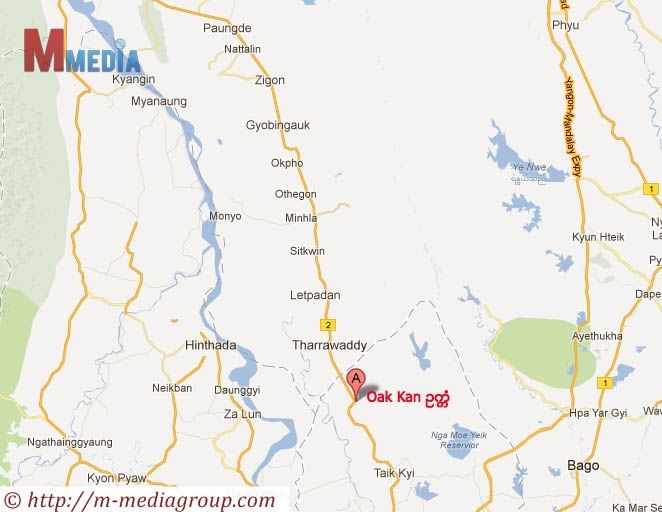
Interview with a resident on violence in Oak Kan

Source Mmedia, 30 April

Oak Kan

The following is the transcript of M-Media interview with a Muslim resident on Ok Kan resident.

"The mob destroyed mosque, religious school, and shops and homes owned by Muslims. They burnt down a hut next to the school. The other shops and homes are destroyed but not set on fire. I am sure the school is gone. I can't go and see that area now.

They also destroyed Haji Maung Shwe's building and Haji Tin Oo's shop. Many Muslim owned shops and houses were destroyed. Until now, they are still destroying. I am hearing the noise.

Also in my ward, destruction and attacks are going on right now. The house in front of mine is gone, so my house might have been gone as well.

There are police and army, but they can't do anything. Many people from nearly villages marched to town for the attack. I can't estimate how many. They all came from all four sides. We are stuck in the middle.

I know how it was started. About 10 AM, a Muslim woman and a young novice monk bumped accidentally as they walk past each other. The bowl of the monk dropped and the elm went to the ground. She was accused of doing it intentionally. I heard she bought the bowl and elm for the monk as compensation. At that same time, many people came. Immediately, the crowd became a mob.

Now we are running away from our home. We are staying at a Buddhist friend's home. My Buddhist friend said riots are doing this intentionally. He told me not to leave the house. He said two mosques have been destroyed. These mosques are Zay Mosque (Market Mosque) and Lan Cho mosque. There are only these two mosques in Ok Kan. Many shops have also been destroyed"

M-Media learns that although the incident was an accident, it has been manipulated to make it a religious riot. Although a case is open at a police station, it did not work. Only violence took place.

According to latest information, security forces fired into the air to control the riot.

Sunday, 28 April 2013

Myanmar's Thein Sein - Oversee a Genocide and then Receive a Nobel Prize?

Source Salam News, 26 April

Once coveted award is now handed to false heroes and a president overseeing a Genocide.

Rohingya expulsion
Image by Carlos Latuff, friend of Salem-News in Brazil.

(SACRAMENTO, CA) - Burma, or Myanmar as it is called today, was run by a military junta for several decades, and in recent years, opened the country to democracy, (cough) and allowed Hillary Clinton and her band of corporate rapists to sink their teeth into this mostly unexploited, virgin-like SE Asian country.

People will do a lot for money and power. In fact Clinton's buddy during all of this, is the once respected Aung San Suu Kyi, who many of us viewed as a hero among world leaders. She spent years under house arrest in her native country, her father was a highly relished Burmese political leader. (see: Aung San Shoot Thee?)

Once 'democracy' started taking hold in Burma, fear of government fell, and the majority Rakhine Buddhists turned their sites on the native Rohingya Muslim population.

Aung San Suu Kyi kept her mouth shut and was given a Nobel Prize, now the national leader, Thein Sein, who has overseen the murder of hundreds, (probably thousands) of Rohingyas, the eradication of their villages by fire, and the placement of survivors in heavily documented 'IDP camps' -

Rohingya mom after Buddhist attack.

has reportedly been nominated for a Nobel Peace Prize, casting him alongside figures such as "Egypt's Mother Teresa" Maggie Gobran, US army whistleblower Bradley Manning, and a 15-year-old Pakistani schoolgirl named Malala, Mizzima News reports.

The people Sein and Suu Kyi turns her back on, the Rohingyas, are considered the most abused people in the world. Exterminated, abused, Rohingya women are sexually violated almost routinely, with no recourse of any kind.

The goal of the Burmese government and Buddhist mob leaders has been to brand them as "illegal immigrants" from Bangladesh, which they are not. In fact, there is indispensable evidence of Rohingya Muslims living in Burma for hundreds of years.

Of course it goes without saying that only a truly lawless band of religious extremists living as an immoral mass of humanity with extremely poor education, would be so bizarre in their interpretations.

The government of Myanmar wants to kill and oppress Muslims the way Sri Lanka takes out Hindus and Christians. Buddhist militant extremism is one of the biggest problems in the world today.

Summer of 2012

Alleged Buddhist rape murder victim

Myanmar, home of the Buddhist bigot

In June of 2012, a Buddhist woman was reportedly raped and murdered by Rohingya Muslims in Burma, one of whom was executed, the others all died in custody. That should have been enough.

Photos of a woman's dead body with her clothing on was circulated and attributed to Rohingyas. The inside scoop is that the woman was in a relationship with a Rohingya and that she was murdered by her own people - the crime hung on the political enemy of the Buddhists.

In other words, based on a number of credible accounts, the rape and murder of a Buddhist woman was a sham, a false flag event; by all accounts the crime never took place.

As if part of a continuing plan, the following day after this terribly sensational headline was reported, ten Muslim men were ripped out of a public bus on a city street and hideously murdered by Buddhists. These men had nothing in the world to do with the so-called crime involving the Buddhist woman, they lived hundreds of miles from where the alleged incident happened. Since then hundreds of been murdered, and tens of thousands place in camps.

From: My Oh Myanmar !

Insiders say the rape was staged by a militant monk named Wirathu, who is a key leader in the militant Buddhist "969″ movement, which seeks to exterminate all Muslims in Burma. As hard as it may be to believe, the Buddhists of Myanmar wear swastika's on their clothing, according to a recent report. Images of Hitler are common, it makes no sense yet is true.

The alleged rape was all it took to bring the Rohingya population great harm. Less than a year ago, Muslims and Buddhists lived in peace, and now the country has a Bosnia-style Genocide on its hands.

The most recent incident carried out by the government of Nobel Prize Nominee Sein Thein involved forcing Rohingya children to sign a note stating they are immigrants from Bangladesh for the Myanmar national census.

Thursday, 25 April 2013

Two Rohingya Fishermen Chopped by Rakhines in Kyauktaw Township

Source here,
Information received from Mr. Naain from Kyauktaw township confirms that two Rohingyas fishing captured by a group of Rakhine people were chopped to death.
The source said that the first victim was chopped to eight picies. The victim was captured while fishing in the Kaladan River at around 1am of 24 April. The death body was discovered throwing into the trench near by the village. Later, the Rohingya villagers confirmed the victim as Nurulsalam-35 @ Fokker s/o Abu Fazal from Wakin ward (Khansi Fara).
The second victim is Dawlar-33 from Pizi Village (Noja Fara), who was took away from fishing in the Pichaung Creek at around 8pm of 24 April.
The number of Rohingyas killed in this manner has been uncountable.
No Aid agency has power to deliver food while arbitrary killings by Rakhine people and additional oppressions in place by the government authorities. The remaining Rohingyas have therefore no choice to risk to find food.

EU’s flawed approach to Myanmar

Source Mizzima news, 25 April
Mark Farmaner
This week's decision by European Union(EU) member states to lift all sanctions on Burma [Myanmar] except the arms embargo has received widespread criticism. It was, however, just one of the Conclusions published by the EU Foreign Affairs Council on April 22. 

These Council Conclusions are worth examining as they highlight just how far the EU has shifted its policy on Burma in the past two years. 

EU Foreign Ministers have decided to trust Thein Sein, and throw everything they have behind him. There are no caveats or reservations—instead it's a wholehearted endorsement of a man whom the United Nations Special Rapporteur on human rights in Burma twice named for personally ordering human rights abuses. 

It is an extraordinarily risky and reckless diplomatic move, but having made this decision, they now seem willing to make shocking compromises on human rights abuses and twist reality to try to make it fit their new view of Burma.

First to be abandoned are the EU's own benchmarks for human rights improvements. These were laid out clearly in last year's Council Conclusions: all political prisoners should be released unconditionally (they haven't been); there should be an end to conflict (fighting has actually increased in Kachin State); there should be substantially improved humanitarian access (there hasn't been and lives have been lost as a result); and there should be improvements in the welfare and status of the Rohingya (the situation has deteriorated so badly that the Rohingya have been subjected to ethnic cleansing and crimes against humanity, with government forces allegedly complicit).

No mention of these benchmarks not being met was made by EU Foreign Ministers. Nor has the EU or any member state issued a statement pledging action or even expressing concern about evidence released by Human Rights Watch on the same day they lifted sanctions, of government involvement in ethnic cleansing and crimes against humanity against the Rohingya.

There is no reference in their Council Conclusions of the multiple human rights violations which may violate international law, which were highlighted in the recent UN Human Rights Council resolution on Burma. All talk of justice and accountability has been forgotten.

Any idea of striking a balance between welcoming and supporting reforms so far, while acknowledging their limitations and maintaining pressure for deeper change, has been abandoned. 

Instead Burma is a country with a "remarkable process of reform". The EU "congratulates the government of Myanmar/Burma on what has been achieved". EU Foreign Ministers state that they are willing to "open a new chapter" and look forward to "working in partnership" with the government.

Instead of demanding the immediate release of political prisoners, the EU is now making excuses for Thein Sein keeping political prisoners in jail. Rather than the detention of political prisoners being described as a gross violation of human rights, the release of political prisoners is now described as one of the "complex challenges" Burma faces. EU Ministers noted with "satisfaction" the creation of the political prisoner review mechanism, despite knowing full well that this mechanism is deeply flawed and will not lead to the release of all political prisoners. It does not seem to occur to them to wonder how genuine the reform process is if two years since it started, hundreds of political prisoners are still in jail.

In Rakhine State, government restrictions which violate international humanitarian law and which have led to unnecessary deaths, are described as "humanitarian risks" which are another "complex challenge" the government of Burma needs help with.

Conflict in Kachin State, during which the Burmese army has committed multiple war crimes and crimes against humanity, including rape and gang rape, torture, arbitrary execution, deliberate shelling of civilians, use of forced labour, use of child soldiers and arbitrary detention, is now described using the much softer word, "hostilities". 

Completely ignoring the fact that President Thein Sein asked for international assistance in expelling all Rohingya from Burma, a proposal for what amounts to ethnic cleansing, and ignoring evidence recently published by the Chin Human Rights Organisation of ongoing discrimination against Christians, the EU instead praises Thein Sein for his "commitment to a multi-cultural, multi-ethnic and multi-faith society." 

Another example of just how far the EU is going in avoiding highlighting ongoing human rights abuses and other problems is the fact that they have lifted all sanctions except the arms embargo, but not stated why they are keeping the arms embargo in place. 

EU Ministers state that the bloc will "use all means and mechanisms at its disposal to support Myanmar/Burma's political, economic and social transition." Missing from the sentence are the words, "to democracy", although EU Foreign Ministers seem to be taking Thein Sein at his word that such a transition is under way.

It is this assumption, that Thein Sein is genuine about democratic change, rather than just taking Burma on a path to a 'normal' authoritarian regime, that underpins the willingness of the EU to look the other way, even when ethnic cleansing is taking place. It's a massive gamble, and an immoral one. 
Mark-Farmaner-sMark Farmaner is director of Burma Campaign UK, a London-based NGO that advocates for democracy and human rights in Burma/ Myanmar.

Muslim jailed for removing Buddhist logo from shop

Source DVB, 25 April
A sticker of the "969 movement" is seen at a shop in Minhla
A sticker of the "969 movement" is seen at a shop in Minhla on 29 March 2013. (Reuters)

A Muslim man was sentenced to two years in prison in central Burma this week for "insulting" religion, after he removed an extremist Buddhist "969" sticker from a shop, according to local media.

Forty-two-year-old Armin (aka Soe Lwin) from Kyaukgyi township in eastern Pegu division scraped the nationalist symbol – which has been used to promote anti-Muslim propaganda in Burma – from a local betel nut shop's window on Saturday. Local authorities sued him two days later, according to the Voice Daily newspaper.

After a one-day trial, Judge Myint Kyaw from Kyaukgyi township court sentenced him to two years imprisonment under a draconian section of Burma's penal code, which bans "deliberate and malicious acts intended to outrage religious feelings of any class by insulting its religion or religious beliefs".

The notorious "969" logos have been used as part of a targeted anti-Muslim campaign – led by the self-proclaimed "Burmese bin Laden" or monk Wirathu – to spread Islamophobia across Burma. The movement has been largely blamed for a wave of anti-Muslim riots, which swept through the country in March.

The news comes the same week that seven Muslims, suspected of murdering a Buddhist monk on the first day of the unrest – are standing trial in a Meikhtila court, where they could face the death penalty.

"They should be punished with the death sentence. I would be satisfied with this," a local monk told Reuters.

Last month's violence erupted after a dispute in a Muslim-owned gold shop escalated, culminating in the murder of a local monk – allegedly by 11 men. His death prompted mobs of Buddhists to go on a seven-day rampage throughout central Burma, torching mosques, homes and murdering dozens of Muslim civilians.

The UN's Vijay Nambiar described the violence as being carried out with "brutal efficiency" and fuelled by "incendiary propaganda". Wirathu is known to have held a number of anti-Muslim sermons in nearby Mandalay in the weeks ahead of the violence in Meikhtila.

The Burmese authorities have been criticised for failing to stop the violence, which follows two bouts of ethno-religious clashes between Buddhists and Rohingya Muslims in western Burma last year. Earlier this week, video footage obtained by the BBC shows police officers standing by and watching as a Buddhist mob sets houses on fire in Meikhtila, while a Muslim man burns to death.

Although President Thein Sein vowed to hold perpetrators – including "political opportunists and religious extremists" – to account for the violence, questions remain over why Wirathu and his legion of "969" followers have been allowed to continue the practice of hate speech.

The nationalist monk is currently touring Karen state in eastern Burma, where he has reportedly delivered a series of inflammatory sermons, in which he described the destruction of mosques as "sinless" because they are "buildings of the enemy". However, Wirathu has repeatedly denied that his "969" campaign played a role in fuelling last month's violence and insisted that his only agenda is to "preserve" the Buddhist faith.

Three Muslims involved in the gold shop brawl, which sparked the riots, were sentenced to 14 years in jail earlier this month. But so far no Buddhists have been prosecuted for inciting violence, although a small number of residents have been charged with "breaching" the state curfew, which carries a much lighter sentence.

The wave of anti-Muslim unrest left 43 dead and displaced over 13,000 people, most of whom are living in temporary shelters near Meikhtila. A number of locals report that renewed threats of arson attacks are preventing them from returning home.

Myanmar's Rohingya left with little hope

Source Aljazeerablog, 24 April

Thousands of Muslim refugees stuck in squalid camps in Rakhine state, left to wait for government to decide their fate.
Last modified: 24 Apr 2013 23:02
Wayne Hay is a roving correspondent covering the Asia-Pacific region.


undefinedMosques in Rakhine state were destroyed in ethnic violence, Human Rights Watch reported [AFP]

For Muslims displaced by last year's religious violence in western Myanmar, there is no light at the end of the tunnel and the strain is beginning to show.

I have visited the refugee camps on the outskirts of the Rakhine State capital, Sittwe, several times, but this was my first visit in six months and I was struck by several changes, none of them positive.

More than 100,000 people remain homeless after attacks that were at first described as communal clashes. Subsequent violence and burning made it clear, however, that this had been largely an anti-Muslim campaign.

Most of the people in the camps are Rohingya Muslims, an ethnic group largely viewed as illegal immigrants from neighbouring Bangladesh. Their homes were burned down by groups of Buddhists as part of a campaign that Human Rights Watch described as ethnic cleansing.

The only way refugees can leave the camps is by getting on a boat and heading south in the hope of finding a better future in Thailand or Malaysia, but few can afford the bribes that need to be paid along the way. For many Rohingya, there is no choice but to sit and wait for the Myanmar government to decide their fate.

Government promises

The best they can hope for, at the moment, is for is some sort of more permanent housing to be built by the government. Such shelter has been promised for some time, but not delivered.

In my previous visits there had been a lot more fervor in the camps. People surrounded us, wanting to tell us their often-horrific stories. We were asked to spread the word to the international community.

Those feelings and memories haven't gone away, of course, but this time I was left with the sense that the refugees are understandably being worn down. An air of hopelessness is setting in.

People are hungry, but there is plenty of food around. People are dying, even though there is a hospital just down the road. If you were a Muslim caught up in the violence, your freedoms have now been taken away.

Yet, amid the desperation there are incredible stories of people helping their own. I was fortunate to meet Maung Maung Hla, a health worker who for 30 years was employed by the government to provide assistance at hospitals in Rakhine State.

Ten months ago, the government stopped paying him. Why? Because he's Rohingya. Now, he lives and works in the camps providing what medical assistance he can to those who live there.

There is not enough medicine to go around and not enough room for those who need in-patient treatment in his tiny medical centre.

Buddhist doctors make brief visits from the town and very occasionally a seriously ill patient is allowed to be taken to the main Sittwe hospital for treatment and medication. In some cases, much-needed surgery is denied because the patient is a Muslim.

Maung Maung Hla busily moved from one end of the medical centre to the other. He took the blood pressure of pregnant women, checked the cast on a fisherman's broken leg, and provided what little comfort he could to a man who was bitten by a rabid dog and was having regular seizures.

The man will die soon and should be in a proper hospital. He's not, because of his religion.

I asked Maung Maung Hla why he continued to do this work even though the government has cut him off. He broke down and said his people have no one else to turn to.

The people of these camps are not just being let down by the government of Myanmar, but by governments around the world who continue to trip over themselves in the rush to reap the financial rewards on offer in this evolving democracy.

Wednesday, 24 April 2013

Indonesian president urges Myanmar to address Muslim violence

Source Yahoo
  • Indonesia's President Susilo Bambang Yudhoyono talks at a Reuters Newsmaker event in Singapore April 23, 2013. REUTERS/Edgar Su
    View Photo

    Reuters/Reuters - Indonesia's President Susilo Bambang Yudhoyono talks at a Reuters Newsmaker event in Singapore April 23, 2013. REUTERS/Edgar Su

By Jason Szep and John O'Callaghan

SINGAPORE (Reuters) - The president of Indonesia, the world's most populous Muslim country, said on Tuesday he would urge Myanmar's leaders to address Buddhist-led violence against Muslims that he said could cause problems for Muslims elsewhere in the region.

Susilo Bambang Yudhoyono's visit to Myanmar on Tuesday and Wednesday comes a month after at least 43 people, mostly Muslims, were killed in four days of violence led by Buddhist mobs in the central city of Meikhtila, 80 miles north of the capital, Naypyitaw. That sparked a wave of anti-Muslim violence.

"If it's not addressed in the best way possible, its impact is not good for Myanmar and even for Indonesians who are majority Muslims," Yudhoyono told a Thomson Reuters Newsmaker event, a forum held in Singapore.

Calm has been restored in Meikhtila and other volatile central areas after authorities imposed martial law and dispatched troops. A Reuters examination showed it was well organized, abetted at times by police turning a blind eye.

"I will encourage that Myanmar will address it wisely, appropriately and prevent tension and violence. We in Indonesia are ready to support them to reach those goals," he said.

Yudhoyono will meet with Myanmar President Thein Sein during the visit and sign a memorandum of understanding on rice trade, an Indonesian government official said.

His visit also follows deadly unrest last year against Muslim Rohingya, an ethnic minority, in western Rakhine State which Human Rights Watch, a New York-based rights watchdog, described in a report on Monday as ethnic cleansing -- a charge rejected by the government.

"There are other challenges in Myanmar like communal tensions facing the ethnic Rohingya," Yudhoyono said.

Last year's violence in Rakhine State killed at least 110 people, mostly Rohingya Muslims, and left 120,000 homeless.

Rohingya activists claim their historical lineage in Rakhine dates back centuries, but Myanmar's government regards the estimated 800,000 Muslim Rohingyas as illegal immigrants from Bangladesh and denies them citizenship. Bangladesh has refused to grant Rohingyas refugee status since 1992.

The violence has sparked an exodus of thousands of Rohingya fleeing Rakhine State by boat. Many have ended up in other Southeast Asian countries including Indonesia, where Buddhist and Rohingya Muslims clashed in an overcrowded immigration detention center last month.

Yudhoyono said Indonesia has a long history of engaging with Myanmar's leaders dating to military rule "to encourage them to continue their process of democratization so they didn't need to be hurt by embargoes".

The European Union on Monday lifted sanctions imposed in response to human rights abuses during nearly five decades of military rule that ended in March 2011. The country, also known as Burma, has since embarked on a series of democratic reforms.

"World leaders now are visiting Myanmar because they see Myanmar has changed," he said. "I will visit Myanmar today firstly to support and promote the process of democratization, of nation-building, of the rule of law, human rights."

(Editing by Neil Fullick)

Burma's Rohingya Ghettos Broke My Heart

Source Vice,
undefined

Sittwe, the capital of Burma's restive Rakhine state, is a town divided. Or, put more accurately, segregated, thanks to the majority Buddhist Rakhine people developing a passion for beating, raping, murdering, and setting fire to members of the local Muslim Rohingya minority. As it stands, the Rohingya have been ghettoized into a series of internally displaced-person (IDP) camps just outside of Sittwe.

Things have been this way since last June, when the region witnessed a massive outbreak of sectarian violence following the alleged rape and murder of a Rakhine woman and a revenge attack that killed ten Muslims. From there, things escalated dramatically. Countless houses have been razed, and large numbers from both communities displaced. However, only the Rohingya suffered from systematic persecution by government security forces—again, involving rape and murder—in the aftermath. Further violence elsewhere in the state during October pushed the total number of IDPs over the 100,000 mark, almost all of them from the Rohingya community.

Such persecution for the Muslim minority is nothing new—they have been subjected to marginalization and violence within Burma for decades, mostly at the hands of the former ruling junta. Almost all have been effectively stateless since a citizenship law was passed in 1982, which effectively classified the group as foreigners, despite their presence in the country for centuries. Many NGOs have characterized the law and its consequences as part of a long-standing campaign to pressure the Rohingya into leaving Burma.

The situation for the minority, described by the UN as one of the world's most vulnerable, is undeniably rough. Yet not everyone sees them as victims. During a visit to one of Sittwe's many Buddhist monasteries, a resident cenobitic monk told me, "All the problems here are the fault of the kalar." (Kalar being a racist term for the Rohingya). "They want to take over all of Rakhine state," he insisted. They were "terrorists" and the Rakhine people could not be made to live with them or violence would break out once again, he asserted.

A day later, visiting the Rohingya IDP camps, I had the opportunity to gain a very different perspective. I sat in on an art-therapy session hosted by a visiting humanitarian volunteer, in which children were encouraged to draw their memories of last year's violence using colored pens and paper. Many of their drawings depicted members of the Burmese government's Hlun Tin paramilitary outfit shooting at people outside of burning homes. One child, explaining what she drew in a particularly affecting piece, mentioned calmly that she had seen the severed head of a mentally disabled boy she once knew lying by the bank of a river. Another said that she saw a Rakhine man smash a woman's skull in until some of her brains spilled out.

That night I refreshed my memory on what the government line on the unrest had been last year. President Thein Sein mystifyingly appeared to deny that that the violence was connected to racial tension. His foreign minister, Wunna Maung Lwin, told the Irrawaddy newspaper that the violence was "not the fault of the government or the people of Myanmar"—a grouping that, tellingly, did not exclude the Rohingya from blame, but managed to clear the Rakhine. It was hard not to see such remarks as indicative of discrimination against the worst victims of the violence—those children included.

Two days later, I visited one of the most deprived parts of the camps, an area populated by "unregistered" IDPs who don't qualify for the limited official aid allowed into Rohingya wards. According to a source within the human rights community, the decision to confer registered status on some IDPs and not others was determined on an "arbitrary" basis.

As I walked around the dusty encampment, malnourished children approached me, making plaintive begging gestures while pointing to their stomachs. I saw an infant whose skin had been nearly burnt off much of her upper body after a cooking accident in one of the makeshift straw-covered tents. Her only aid came from a visiting nongovernment doctor.

In the midst of this shocking scene, a modestly sized food truck appeared, announced with a sudden uproar of joy from the camp's children, who chased it excitedly up a worn path to an unloading point above their field. I had no idea where it had come from, yet the people there seemed to assume its cargo was meant for them. The feeling of relief expressed was infectious, and it was impossible not to be deeply grateful on their behalf.

Within minutes, the mood darkened. It emerged that what had seemed to be a marvel of deliverance was more like a sadistic joke. We were told by some of the IDPs that, despite initial impressions, they now believed the food would be distributed exclusively in the registered camps nearby. I was later informed by reliable sources that no one in the unregistered area received a single bag of rice from the truck.

I went back to my hotel that night, acutely aware of my own privileges, feeling a sickening blend of exhaustion and seething anger. As bad as the false hope of the rice was, it was a greater agony to consider what the coming weeks promised for them and the rest of the camps: death and sickness on a massive scale.

In May, the rainy season will begin and the open-air prisoners of Sittwe's ghettos will almost certainly face what Human Rights Watch, relevant UN bodies, and the European Commission predict will be a humanitarian disaster. Malaria and many other diseases will likely kill thousands—a scenario only made more inevitable by the criminal inaction of the Burmese authorities, who have dismissed calls to move the IDPs to grounds that will not flood. It's almost as if they want them to die.

That's still the impression I have. It's no consolation to consider how little the West has done so far to step up and help these desperate people, given its newfound influence over Burma. As astute commentators have observed, Washington is seeking to "counter rising Chinese assertiveness by engaging its neighbors," which may account for its apparent reluctance to get tough with those in power in Naypyidaw. Meanwhile, the EU—which has been similarly muted—is on the verge of permanently lifting sanctions against Burma over the objections of rights groups.

Perhaps only when displacement and humanitarian disaster mutate into full-blown ethnic cleansing will the global community act decisively to help this imperilled population. That this may occur seems far from impossible, particularly given the enduring tensions in Rakhine state and the recent wave of anti-Muslim violence elsewhere in the country.

That it may take such an event to get the West to intervene should be an international scandal in itself. But it seems the world has a short memory, and while economic imperatives dominate over moral ones in global affairs, it's entirely plausible that Rohingya children may be sketching corpses for some time yet.

Follow Emanuel on Twitter: @EmanuelStoakes