Tuesday, 3 August 2021

The Misuses of Histories and Historiography by the state in Myanmar: The Case of Rakhine and Rohingya

Source Forsea, 29 July

Some look to find solutions in holding Myanmar to account through international law regarding what the Myanmar military has done to Rohingya. That is what they can do. I am not a lawyer, but a historian. When I look at Myanmar, I am trying to unravel the ways in which religious haters in the country misuse history to legitimate what they do. As Daniel Taylor has indicated,1 this has a real impact because countries, not willing to accept the stories that constitute genocide are partly influenced by the claims made by Myanmar that the Rohingya are foreigners, that they are Bengali.

I will give here essentially two seemingly different sub-papers that actually must be viewed together before they can be synthesized into a single three-dimensional view. First, I am going to discuss what I think is important about the long-term historical background of the current crisis involving Rakhine and Rohingya, because so much is already going around about more recent decades, the Citizenship Law of 1982, the Tatmadaw, NLD etc, that I do not have to do that here. Second, I will explain why so much of this crisis has been built on historical misunderstanding of Rakhine and Rakhine misunderstanding of history and how people picture history and people in that history. I will then wrap all of this up in the end with some brief comments about some of the historical things western academics have been doing in accepting one historical narrative that works against the Rohingya and why I think they are wrong.


1. The Historical Background

We have thousands of years of the human past in Rakhine, a lot of archaeological remains, coins, inscriptions in non-Bamar languages that really give us little more than Sanskrit royal names and titles. There is nothing that could serve as a historical story you might relate to students or a lay audience until really the fifteenth century. You have historicised stories that are almost certainly apocryphal.

Then, in the early fifteenth century, the Kingdoms of Ava and Pegu tried to establish cultural hegemony over the Indo-Aryan kingdom of Rakhine, importing kings and queens, courtiers, Buddhist monks, and Bamar settlers. You have a local king supposedly flee to the Muslim world, gain protection from the Sultan of Delhi or Bengal (it changes in different traditions), he teaches the sultan's court various kinds of war tactics and the sultan sends him back to Rakhine with a Muslim army.
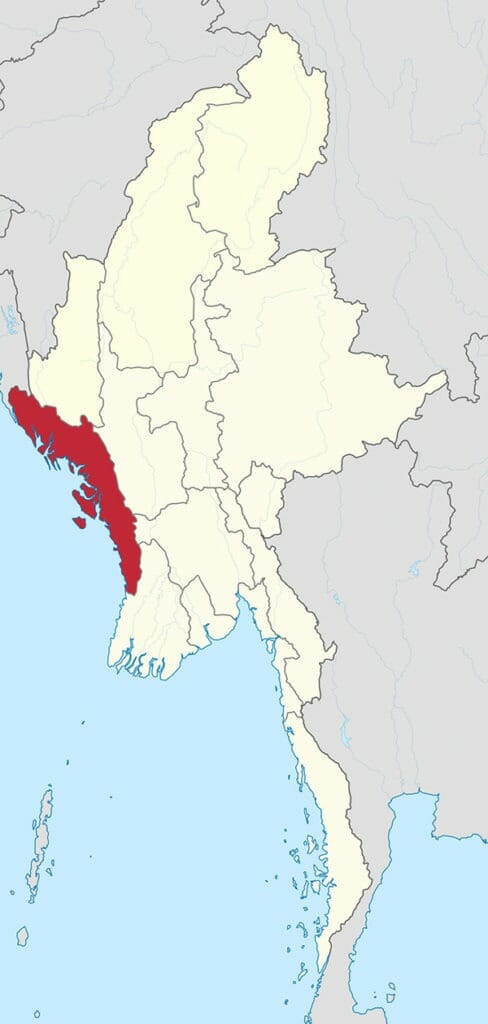
Location of Rakhine State in Myanmar. Wikipedia Commons

In 1430, we then have the Rakhine ruler, supposedly the same guy, who comes back and ousts the foreign, Bamar and Mon, invaders, establishes a religiously hybrid court, a sultanate from one perspective, a Buddhist court from another, but from inside the court, both at the same time. The physical geography and climate favoured approaches to living and ruling, interacting, and community building, social mentalities that were flexible and inclusive, that favoured the emergence of ethnically and religiously diverse communities, and states that by European standards would be seen as heterodox and a major source of confusion. Thus, we find lots of evidence that Buddhists and Muslims got along quite well. Certainly, this creation myth of sorts identifies Muslims and the Muslim world as the saviour and protector, not the enemy of Rakhine. That latter role is reserved for Myanmar and the Buddhist political world. The Irrawaddy world is something Rakhine needs saving from.

The new Mrauk-U court relied upon a Muslim army to protect it and its first religious building was mosque, the Santikhan mosque, its kings began using Muslim as well as Buddhist titles and issued coins with the Kalima. More importantly, in a population poor area, the court tried to build up its labour pool by raiding Bengal and bringing back to Rakhine thousands of Bengali Muslims and Bengali soon-to-be Muslims captive every year. Many of these people were planted in villages along the Kaladan River in areas close to the concentrations of Muslims in Rakhine we find today, or up until August 2019, where they grew rice and engaged in other kinds of primary agricultural produce cultivation. By the mid-18th century, observers claimed that 75% of the population of Rakhine south of the Naf, because the Mughals had taken the rest of the region in the 1660s, was of Bengali origin.

When Myanmar conquered Rakhine in 1784-85, it would again try to extend Irrawaddy civilization over it as part of their empire-building. The Myanmar court commissioned state histories that placed Rakhine historically within the orbit of greater Myanmar. Myanmar Buddhism was introduced, court literature and local Buddha mages were brought back to the Irrawaddy Valley and so too were tens of thousands of Muslims, Hindus, and Buddhists. Rakhine Buddhists and Muslims unhappy with Myanmar rule both fled to British Bengal, the Buddhists settling in the area that became a big refugee camp, which became known as Cox's Bazaar (after Hiram Cox). Absent their own court literature, Buddhist monks from Rakhine rewrote from memory and produced new chronicles in opposition to Myanmar rule, but in doing created a Rakhine history only from their particular point of view, not purposely leaving the Rohingya voice out, but not including it either.

This is what we know from many different sources, but much of this is gradually erased by a new kind of source that emerges after this period, the Bamar-language chronicle of conquest and domination and the Rakhine-Bamar language chronicles of fear and insecurity. Histories are written for particular reasons—and when a great many are written with varying narratives it is a sign that something important is at stake. No one ever asks why the Rakhine were putting together so many histories in the late 18th century—why they were trying to legitimize their historical presence. The Rohingya were like many borderland peoples an oral and not text-based society and, they had little to complain about, because the main cultural and religious tension at the time was between Bamars and the Rakhine Buddhists—it was the intra-Buddhist take that was at stake not any threat from Islam. Muslims were not the chief concern of the Bamars in the late 18th century when they occupied Rakhine. There was no denying their presence—Rakhine of that time had mosques and coins with Muslim motifs. Again, most of the population was believed by the British of the time to have been 75% of Bengali origin. The foundational languages of the area were clearly Indo-Aryan. By contrast, the Buddhist past in Rakhine was in doubt, being under challenge by the Myanmar court. Not needing to compete, the Rohingya did not.

The relics of decades of Rakhine Buddhist insecurity—numerous chronicles that are mutually irreconcilable in which they admitted that their kingdom was founded by a refugee prince coming from India, protected by a Muslim army, were evidence that the Rakhine desperately wanted to create documentation that they had always been in the region, back to the time of Buddha. In later time, they would claim that with the presence of so many different chronicles that they did not "know" about an earlier Muslim presence, but they knew, they knew, generations of Rakhine Buddhists have always known. But, over generations, even the most basic truths of one's origins are forgotten (after all, how many of you know who your own great, great grandparents were?).

This is hugely important. It is impossible for us today—lay reader, professional historian, Rohingya or Rakhine– to provide a historical background to Rakhine without engaging vigorously with the politicised historical narratives that have been in production since the 1780s. Any background provided from whatever angle must be political because every source is a political artefact. So many gaps appear in the documentary record and so many contradictions exist in the "historical" narratives produced by local monks and courtiers from the 1780s that there has been plenty of space for compilers to act instead as composers and to fill these gaps with ideas and beliefs of their own time. In other words, when we read in chronicles descriptions of the history of Mrauk-U in the 15th century, we are not reading primary sources on that period. We are instead entering the imaginaries of Buddhist monks who lived geographically and temporally far away in Sandoway in the far south in a later time, the early 19th century. And their perspectives were built on a different society that had spent by their own time, forty years under Myanmar rule.

We also have to keep in mind that the Rakhine area we refer to today is not what it was then, but Rakhine has historically been all of the eastern coast of the Bay of Bengal. So, one problem is that while the Rohingya are real, and they or their forebears were in Rakhine as long as the Buddhist Rakhine were, and are just as indigenous, the terminologies we are must rely upon to discuss them and their history have been subject to significant efforts to engineer them into foreigners.

This contemporary Buddhist monopoly on history might have been balanced out with Rohingya voices if not for another accident of history, the replacement of Myanmar rule with British rule in 1826. The British decided on the basis of orientalist scholarship by Sir Arthur Phayre that Rakhine should be categorised as having one native language, one native race, and one native religion, despite its huge diversity. Although from a Western point of view, you can only be one or the other, local indigenous families probably moved many times back and forth between different ethnic categories, from Rohingya to Rakhine and even to Bamar and back again, depending on the period, the context, and to whom they married. So, when Phayre read the Bamar-language chronicles, he accepted them as genuine and authoritative and rejected the coins and all the other evidence of Muslim culture and religion as anomalies. Phayre was thus blinded to the fact that Rakhine had been at least since the 15th century a Muslim and a Buddhist land, with a Muslim and a Buddhist court, and that historically, Bamars, Burmese-speakers, Theravada Buddhists from the Irrawaddy Valley were migrating into Rakhine at the same time as Muslim, Bengali-speakers. As Myanmar was gradually annexed by India, Muslims in Myanmar were treated officially as foreigners and not categorised by their local names. So the Rohingya not being recorded in the British colonial censuses from the 1860s as Rohingya or not was a political choice by a state, not by the Rohingya.

One of the greatest shifts in thinking though was introduced by Buddhist nationalism. Political monks who had accepted Irrawaddy based ordination in Mandalay-dominated sects and local laypeople eager to have greater political clout pulled a historical sleight of hand and turned tables. The Myanmar state, the greatest cultural and religious threat to Rakhine Buddhist regionalism, was made instead an ally. And the Muslims, those who were there before Buddhist immigration and those who indigenised later over time alongside new waves of Buddhist immigration, now became the Other—no longer wanted and now the enemy. And the Myanmar state started to eradicate the physical evidence of the Rohingya and tried to Irrawaddy-ize the region in their image, no longer in the image of southern Rakhine Buddhist culture, but now in the image of the Irrawaddy Valley.
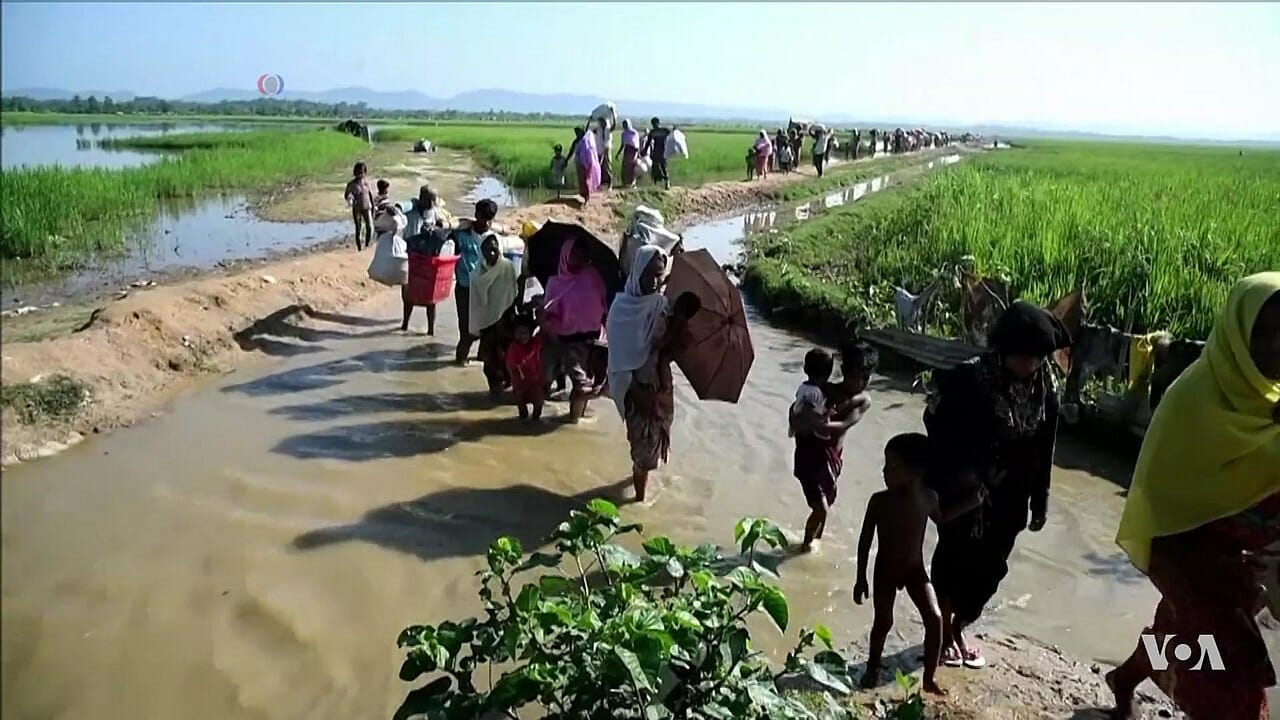
Rohingya refugees entering Bangladesh after being driven out of Rakhine State, 2017. Wikipedia Commons


2. The Historians' craft and the State of the Field of Rakhine Studies

Historians and political scientists who seem to value access to a country more than historical questioning took Rakhine and Bamar Buddhist chronicles and their historical claims at face value and wrote materials that validated much of the Rakhine Buddhist fiction that resulted. And I do not mean to be insulting by calling it fiction, because I believe that at some level, all history is fiction, imagined, and constructed, because it has to be. We cannot talk about the subject until we have imagined it, until we have made a discursive construct that allows us to have something to have a history about. And this has been the nature of debate—some scholars pander to religious communalists claiming only things Muslim are fiction and anything Buddhist is fact, because Buddhists hold the power. And these scholars, without admitting what all historians know or should know, is that the Buddhist Rakhine historical record is a political invention, created to oppose the Bamars and then remobilised against the Muslims. If we are to really understand Rakhine, we need to consider everything that has been written, chronicles and secondary literature, as works of fiction that need to be heavily contextualised—we deal with the history of intellectual invention, not the history of DNA, a history of indigeneity. In my opinion, any historian who claims that Buddhist Rakhine are the indigenous population of Rakhine is performing professional malpractice and is either so profoundly stupid as to not understand the nature of the historian's craft or maliciously indifferent to the responsibilities that come with calling oneself a historian.

As I have stressed, history is a project of intellectual invention, a creative process that makes use of facts and constructions in a new way that is meant to explain why something has happened. I have no doubt that people often genuinely believe what they argue historically, unaware of the creative process of which they are a part. It is in our nature to invent when we tell and then believe it when we have told it. It is not that we have more facts that make us more confident that we know the past but the increasing flurry of images that accompanied the rise of modern history as a discipline since the end of the 19th century. Before, everyone imagined the past as a series of events coloured in by their own imagination. So, for a few thousand years, Julius Caesar could be a million different people, even during the centuries after Shakespeare brought a version of Caesar to life. The still camera and then the motion picture camera started to bring an end to all of that. We could not imagine an Abraham Lincoln to look any other way than he was depicted in well circulated photographs. And it was a constant introduction to the same episodes about Lincoln that made us all feel the same Lincoln. But it was the photograph that made him seem as real as a memory from our own childhoods. We then find it increasingly difficult to think of Lincoln any other way, a Lincoln has been locked into our brains. I can definitely say I knew the Lincoln of Steven Spielberg's biopic long before it was ever made. I knew the Hitler in Downfall long before that movie was made. I did not know the Django in the Quentin Tarantino movie. Media can be an ugly or an empowering, liberating tool in shaping our historical imaginaries.

How did most Bamars in their mindscape imagine the Rohingya? Most Bamars had never seen a Rohingya when they coloured them in. Instead, they used what had been depicted as Muslims. Terrorists. Rapists. Invaders. They had only the extremists now, particularly those in control of Myanmar state media, who gave them the images to fill in the colours. These fictions make the history they have been given in scrawls more real. When these Bamar colour in the Buddhist narrative of Rakhine they do not see the Rakhine as they are but as they are imagined to be in Mandalay. They are imagined to look and dress and speak and act like other Bamars. But some of us who know Rakhine personally know they do not. This is why memes are so powerful and so dangerous when maliciously distributed among people who do not have actual exposure to a people or evidence of their past. It is an easy thing to take the dates and chronologies and fill in the gaps to form a history of a continual threat to Myanmar Buddhism by the Muslims. All you need is a social media account.

But I would propose going further and argue that when Bamars look at the Rohingya they imagine them through the history of colonialism. For Bamars, the Muslim in Rakhine must be coterminous with the beginning and end of colonial rule. That history. British history. British Indian History. Something that exists between 1824 and 1948. And the Rohingya because they are not in this view part of the colonial Muslim group, must instead be something later. Whatever they are, the Rohingya must be post-1948 and neither Bamar nor colonial. The Rohingya suffer in these histories in two ways because as Muslims in Myanmar they are doomed in some conversations as being colonial and in other conversations they are doomed as Rohingya. And, again, as Rohingya they were not included in Bamar or Rakhine chronicles and are thus ahistorical.

Both elements of Bamar constructions of these people are in fact wrong. It is not the chronicle that is evidence. The chronicle is the fiction. The data in them we do not know directly. It is the documentary – written or oral — fragment that we can no longer read or hear directly that is the evidence. And we can never use chronicles as evidence but only as Buddhist Rakhine thinking about evidence. By the way, this is true of later colonial-era censuses as well—they are not really evidence of any thing, aside from an example of British thinking about evidence. I have to say that, astonishingly, as historians we have pretended our work is a science when it is not. We are after history as understandings of "the past" rather than "the past" itself. The closest we get at to what actually has happened is if we accept our findings to be a kind of archaeology of the past. As we must always fill in the gaps with the guesswork that is history, we must always accept that history never provides answers only questions, it is not revelatory but only creative in nature, and it never justifies the politics of the present however much it is claimed to do so. This is why I stress that history must never be surrendered to those who would use it to do so and it should be the primary objective of any historian to reject the contemporary political abuse of history, just as much today in Myanmar as it was in Europe of the 1930s and the former Yugoslavia of the 1990s.

Dr. Michael W. Charney (SOAS)

This is a modified version of a talk given by the author at The International Conference on Protection and Accountability in Burma on 9 February 2019 at Barnard College, Columbia University.

[1] Immigration & Refugee Solicitor and the Plaintiff in the Crimes Against Humanity Case against Aung San Suu Kyi, High Court of Australia, comments made on 8 February 2019 at The International Conference on Protection and Accountability in Burma.


  1. Immigration & Refugee Solicitor and the Plaintiff in the Crimes Against Humanity Case against Aung San Suu Kyi, High Court of Australia, comments made on 8 February 2019 at The International Conference on Protection and Accountability in Burma.
Posted by Michael Charney

A native of Flint, Michigan, Michael Charney is a full professor at SOAS, the University of London, in the Centre for International Studies and Diplomacy (School of Interdisciplinary Studies) and the School of History, Religions, and Philosophies, where he teaches global security, strategic studies, and Asian military history. He received his PhD from the University of Michigan in 1999 on the subject of the history of the emergence of religious communalism in Rakhine and has published a number of books on military history in Southeast Asia and the political and intellectual history of Myanmar. He was a postdoctoral research fellow at the Centre for Advanced Studies at the (National University of Singapore) where he researched religion and migration, was a project professor at the Institute for Advanced Studies of Asia at the University of Tokyo, and has spent most of the last two decades at SOAS, where he was elected to the Board of Trustees in 2016. He is a regular commentator in the media on events in Myanmar.


India: Release Detained Myanmar Asylum Seekers

Source HRW, 28 July

Ensure Prompt Access to UN Refugee Agency for Protection

A Myanmarese man looks towards the Indian side at the India-Myanmar border in Mizoram, India on March 20, 2021.  © 2021 AP Photo/Anupam Nath

(New York) – Indian authorities should immediately free all detained Myanmar asylum seekers, Human Rights Watch said today. The authorities should investigate the deaths of two women who had fled Myanmar and died in custody in Manipur state from Covid-19 in June 2021.

Since Myanmar's military coup on February 1, tens of thousands of Myanmar nationals have fled the country to escape the violent crackdown. Approximately 16,000 Myanmar nationals have crossed into India in the four bordering states – Manipur, Mizoram, Nagaland, and Arunachal Pradesh, the media have reported. Those fleeing include parliament members, civil servants, military and police officials, and civil society and human rights activists. Most are in hiding, afraid of being arrested. 

"People from Myanmar fleeing threats to their lives and liberty should be offered a safe haven in India, not detained and deprived of their rights," said Meenakshi Ganguly, South Asia director at Human Rights Watch. "The Indian government should uphold its international legal obligations and work with the UN refugee agency to ensure prompt access to international protection mechanisms."

In June, two women from Myanmar, Ma Myint, 46, and Mukhai, 40, died from Covid-19 in a district hospital in Manipur state. Ma Myint and Mukhai were among 29 Myanmar nationals arrested on March 31 under the Foreigners Act for entering the country without valid travel documents. They were later placed in judicial custody by the district court. On July 2, the Manipur-based group Human Rights Alert wrote to the state human rights commission alleging that government officials were not providing immigration detainees with food and adequate health care, and that detainees were dependent on the charity of local civil society groups for food.

Ma Myint and Mukhai were only taken to a hospital once their illness was critical, according to Human Rights Alert and both died within three days of being admitted. At least 13 other asylum seekers also contracted Covid-19 in detention in Manipur.

Since February, the Myanmar junta and security forces have responded with increasing violence and repression to the nationwide anti-coup movement. Security forces have killed over 920 people and arbitrarily detained an estimated 5,300 activists, journalists, civil servants, and politicians. In March, the Indian government condemned the violence in Myanmar at the UN Security Council and called for the release of detained leaders, but at the same time the government ordered northeast border states to check the flow of "illegal immigrants from Myanmar."

The chief minister of Mizoram state, which has had the greatest influx since February, wrote to Prime Minister Narendra Modi saying this directive was unacceptable and urged the national government to instead provide asylum to the refugees.

While Indian border guards have not pushed back any arrivals from Myanmar since the coup and several village councilors in northeast states have expressed a willingness to accommodate the refugees, the Modi government has provided no clarity regarding their status, local rights groups said. In addition, the office of the United Nations High Commissioner for Refugees (UNHCR) in India requires asylum seekers to travel to one of the agency's designated centers, none of which are in the northeast, to apply for refugee status. As a result, thousands of Myanmar nationals in India fleeing persecution remain vulnerable to arrest, detention, and possible return to Myanmar.

UNHCR Detention Guidelines, which draw on international law, say that government authorities may detain adult asylum seekers only "as a last resort" as a strictly necessary and proportionate measure to achieve a legitimate legal purpose based on an individual assessment. Legitimate justifications for detention should be clearly defined in law, and conform to reasons clearly recognized in international law, such as concerns about danger to the public, a likelihood of absconding, or an inability to confirm an individual's identity. Victims of torture and other serious physical, psychological, or sexual violence should, as a general rule, not be detained.

Refugees in the border states are largely dependent on civil society groups, who are providing support. Several groups have written to the national government asking it to provide humanitarian aid to the asylum seekers and ensure that specialized humanitarian agencies, including UNHCR, have unhindered access to them.

On May 3, the High Court of Manipur ordered safe passage for seven Myanmar nationals, including three journalists, to Delhi so that they could seek protection from UNHCR. "They fled the country of their origin under imminent threat to their lives and liberty," the court stated, adding "They aspire for relief under International Conventions that were put in place to offer protection and rehabilitation to refugees/asylum seekers. In such a situation, insisting that they first answer for admitted violations of our domestic laws, as a condition precedent for seeking 'refugee' status, would be palpably inhuman." 

Although India is not a party to the 1951 UN Refugee Convention or its 1967 Protocol, the international legal principle of nonrefoulement is recognized as customary international law binding on all countries. Nonrefoulement prohibits countries from returning anyone to a country where they may face persecution, torture, or other serious harm.

Since 2017, Indian authorities have repeatedly sought to return ethnic Rohingya to Myanmar despite serious allegations of crimes against humanity and genocide by the military. In March, Indian authorities in Delhi, Jammu, and Kashmir detained dozens of Rohingya with plans to deport them to Myanmar. In April, the Supreme Court rejected a plea to stop their deportation.

Many of the detained Rohingya say they hold identity documents issued by UNHCR and that they feared for their safety in Myanmar. Over a million Rohingya have fled Myanmar, primarily to Bangladesh, most of them since the military's campaign of ethnic cleansing that began in August 2017. The 600,000 Rohingya remaining in Myanmar's Rakhine State face severe repression and violence, with no freedom of movement, no access to citizenship, or other basic rights. Abuses against the Rohingya in Rakhine State amount to the crimes against humanity of apartheid and persecution, Human Rights Watch said.

Indian authorities say that they will deport irregular immigrants from Myanmar if they do not hold valid travel documents required under the Foreigners Act. But any forcible returns to Myanmar would violate the principle of nonrefoulement.

India's failure to provide fair asylum procedures or to allow UNHCR to make refugee determinations for those fleeing Myanmar because of the threat to their lives violates the government's international legal obligations, Human Rights Watch said.

"Prime Minister Narendra Modi needs to ensure that the Indian government meets its obligations under international refugee law," Ganguly said. "Indian authorities should treat those from Myanmar seeking refuge in India with dignity and provide them protection from further abuse."

Thursday, 29 July 2021

Citizenship in Myanmar brief in Burmese and English

OPINION - Myanmar’s twin curse of murderous military and cultist opposition

source AA, 29 June

The author is coordinator of the UK-based Free Rohingya Coalition, general secretary of Forces of Renewal Southeast Asia, and a fellow of the Genocide Documentation Center in Cambodia.

LONDON

The last few days saw heated debates and name-calling in Burmese-language social media between, on the other hand, national minority activists who are completely fed up with the ethnic majoritarian colonial mentality and on the other, political practices and the majoritarian democrats who treat Aung San Suu Kyi's words like holy scripture.

The trigger was a well-known Suu Kyi loyalist in the cabinet of the Zoom-based parallel National Unity Government, repeating on Facebook her historically inert, politically condescending, dismissive remark on the long-standing political demands and grievances that minorities have voiced since independence.

"State-building driven by the politics of (ethnic minority) demands will only result in the country marked by conflicts and contests (of interests). Only the politics of self-sacrifice (by all groups) will lead to respective gains and national fulfillment," wrote an influential NUG "cabinet minister," Lwin Ko Latt.

These were the words of political wisdom infamously dispensed by the NUG's patron Aung San Suu Kyi – then in office as Myanmar state counselor or de facto head of state – in response to the typical demands for group equality and administrative and political autonomy validly voiced by the country's national minorities.

For their part, national minority leaders from Kachin, Shan, Karen, and other communities then responded firmly, and with righteous anger, along the following lines: "We minority communities of resistance have nothing more to give or sacrifice for the Union. For 70 years since independence, we have long been subjected to policies of political subjugation and ethnic repression by the central majoritarian unitary state controlled by the Bama or Myanmar majority, both generals and democrats."

Coupled with the mass hysteria with hashtags #HappyBirthdayMotherSuu #FlowerStrike – on display in the Burmese diaspora and inside Myanmar, around Suu Kyi's June 19 birthday, the flare-up over the Facebook post indicates a monumental obstacle to the emergence of federal democracy, the ultimate aim of the current nationwide resistance against the murderous military regime. Specifically, the Burmese majority's continued adherence to Suu Kyi's tried and spectacularly failed populist cultism with majoritarian colonialist features.

Three decades since Suu Kyi and the National League for Democracy's (NLD) emergence in 1988-89 as the most formidable democratic alternative to the country's military dictatorship, the country has been plagued by two types of political and institutional cancers, the murderous military and the ethnic majoritarian cultist NLD.

On one hand, the national armed forces, which Suu Kyi's father founded as a key instrument of liberation against British rule under the fascist patronage of World War II Japan, have become the primary source of pain, suffering, and national destruction.

On the other, the National League for Democracy, which Suu Kyi co-founded with the two strange bedfellows – left-leaning progressive Burmese intellectuals and former anti-leftist veteran commanders who served under the late strongman Gen. Ne Win – has stymied any development of properly democratic political culture, institutional practices, or public ethos.

I have written online and published extensively on what is accurately referred to as "the common enemy" of the people, namely the Tatmadaw and successive generations of military leaders. I have condemned the military, which has misruled the country for more than a half-century with its ruinous economic, social, and ethnic policies. And as a lone voice, I blew the whistle on the military-led genocide of Rohingya, even when doing so risked one's reputation and vilification as a "national traitor."

As a Burmese – and a Buddhist at that – who grew up in an extended military family, I was acutely aware of the rape, torture, and burning of ethnic minority villages that troops and officers had been perpetrating against our own national minorities a few decades before 1994 when the UN established the mandate for a special rapporteur on the human rights situation in Myanmar.

I am not alone in the realization as to the mass-murderous and criminal record of our national military. Both the NUG's patron Suu Kyi and her populist base knew of the crimes that the Burmese military was committing in minority regions.

And yet neither the millions of Suu Kyi supporters nor Suu Kyi herself has shown any appreciable indignation or opposition to the military's grave crimes in international law – particularly against non-Bama ethnic communities.

Amid global condemnations of the Myanmar genocide and the UN's official findings, Suu Kyi – and millions of her ethnic Bama supporters – closed ranks and stood with the perpetrators. The national slogan then was "We Stand With You" (Mother Suu), as she traveled to The Hague to serve as "the Agent of Myanmar" in The Gambia vs Myanmar genocide case at the International Court of Justice several months before the COVID-19 pandemic in the first week of December 2019.

Her unconscionable stance on Myanmar's international crimes against Rohingya culminated in her appearing as the agent of Myanmar defending the genocide allegations at the court. Deservedly, she was roundly and universally condemned by the very media that had a huge role in the manufacturing of Suu Kyi as an inspiring global icon.

And yet the majoritarian Burmese electorate continues unabated to express their unconditional reverence for Suu Kyi – bordering on absolutist "Mother-Suu-can-do-no-wrong" devotion, in spite of the global condemnations of their leader and her well-documented absence of empathy for thousands of Rohingya rape victims, insensitive dismissal of minorities' political grievances, and mindless demand for their "sacrifices" for the Union (of Myanmar).

This cancerous cultist trait is pervasive across rural and urban divides throughout the majority-dominated regions of Myanmar. It is widespread among both the educated or "the great unwashed," as well as the Burmese diaspora worldwide.

Suu Kyi loyalist Lwin Ko Latt is not alone in his show of mindless devotion to the leader. Aung Myo Min, union minister for human rights in the parallel National Unity Government, himself joined in the mass hysterical act of well-wishing the genocide defender only two weeks after the Zoom-based government's issuance of a pro-Rohingya policy, undoubtedly out of political expediency.

Millions of Burmese people in Myanmar and around the world, including those with advanced Western educations such as doctors, engineers, academics, writers, poets, etc., have over the last three decades placed blind faith in Suu Kyi's leadership, integrity, and policies even as she has categorically failed morally, intellectually, politically, and strategically.

Almost 20 years ago in 2004, the nationally acclaimed US-exiled poet and ex-prisoner of conscience, the late Saya U Tin Moe, a good friend of my late parents from Mandalay, angrily lashed out at me at the Bi-Annual Burma Studies Conference at Northern Illinois University in the US city of DeKalb. As we sat down for coffee, he rebuffed my criticism of Suu Kyi for her sanctions policy orthodoxy and cultist leadership, saying: "I have absolute faith in Daw Suu. If she said jump, I will leap off a cliff!"

On June 22, in their popular podcast Now & Then, Heather Cox Richardson and Joanne Freeman noted historians from Boston University and Yale University, respectively, dissected the historical phenomenon of cult politics with a focus on QAnon in the present-day US. They also briefly touched on the rise of fascist leaders such as Hitler and Mussolini in terms of cults and governments.

The Myanmar-relevant takeaway from their deeply learned podcast discussion is a psychological symbiosis between "the disposed" who want salvation and cult leaders, who are typically believed to have the necessary answers to their problems, or salvation.

The mass hysteria around Suu Kyi's birthday is the clearest indication of deeply entrenched cultist neo-totalitarian thoughts, mental habits, and political behavior among her populist base. Additionally – and disturbingly – the birthday hysteria only confirms how pervasively indifferent this base is to democratic ethos, international law, and normative principles of human rights.

In sharp contrast to the country's military – which by definition is a command-totalitarian institution, like every military – a proper democratic political party, conservative or liberal or progressive, is expected to foster debate, dialogue, and deliberations within the party as well as in the political life of a nation at large.

Over the last three decades, Myanmar has been cursed by two types of neo-totalitarian institutions – the murderous military under various dictators in generals' uniforms and the National League for Democracy party, which Suu Kyi ruled as a strong woman. Even in detention at the age of 76, and with no prospect of holding any public office or leading any party, Suu Kyi has cast a long shadow over Myanmar's national politics.

This is Suu Kyi's lasting gift to Myanmar and her dark legacy from which society will reel for decades.

*Opinions expressed in this article are the author's own and do not necessarily reflect the editorial policy of Anadolu Agency.

Thursday, 17 June 2021

Bangladesh blast western countries for $24b bank guarantee to Myanmar

Source TheFinancialExpress, 6 June

Bangladesh on Sunday blasted western countries for providing $24 billion bank guarantee to Myanmar, which is accused of conduct genocide against the Rohingya community and other ethnic minority people.

'They talk big on human rights issue but what they are doing is contradictory to their policy. Seven banks are providing $24 billion guarantee to Myanmar and these banks are from the western countries who are very vocal against human rights violation' Bangladesh Foreign Minister told newsmen in the afternoon.

It is shocking and you the media should raise its voice on this issue, said he.

Meanwhile, Bangladesh on Sunday urged the international community that it will shift another 80 thousand Rohingyas to Bhasanchar within the shortest possible time.

It also urged the international development partners and organisations including the UNHCR to be more active to ensure all inhabitable arrangements and fundamental rights for the Rohingya people forcibly displaced from Myanmar.

Prime Minister's Principal Secretary Dr Ahmad Kaikaus made the call at a meeting with ambassadors, high commissioners and heads of delegations of various international organisations held at the Prime Minister's Office, said a spokesperson of the PMO.

Dr Ahmad Kaikaus presided over the meeting that was convened to discuss the Rohingya issue.

The meeting was informed that the government has taken initiative to shift more 80,000 Rohingya refugees staying at various camps in Coxs Bazar to Bhashanchar within the shortest possible time.

In this regard, the meeting was also informed that more than 18,000 Rohingya people have already been taken to Bhashanchar, while process are on to shift the remaining refugees soon.

At the meeting, the Principal Secretary said, the government is doing everything possible to ensure all basic needs of the Rohingya including better liveable places for them.

Besides, ambassadors and high commissioners of various countries including USA, UK, Japan, Australia, France, Canada and Netherlands as well as heads of delegations of international organisations like European Union and UNHCR joined the meeting.

PMO Secretary Tofazzal Hossain Miah and secretaries concerned were also present in the meeting.

mirmostafiz@yahoo.com

Is Myanmar heading for a civil war as armed groups target junta?

Source TRT, 1 June

Myanmar's National Unity Government, a body claiming to be the legitimate administration, is warning the country is on the brink of civil war. According to a former UN special envoy, at least 58 armed groups have formed since the military coup in February. Ronan Lee from Queen Mary University Law School weighs in.

watch link (here)

The real crimes of Myanmar's Suu Kyi and the farce of her trial

Source AA, 28 May
OPINION - The real crimes of Myanmar's Suu Kyi and the farce of her trial

The author is coordinator of the UK-based Free Rohingya Coalition, general secretary of Forces of Renewal Southeast Asia, and a fellow of the Genocide Documentation Center in Cambodia

LONDON 

This past Monday, the State Administration Council of Myanmar, the military regime, aired on state TV the still images of the detained National League for Democracy (NLD) leader, Aung San Suu Kyi, as she appeared in a closed-door courtroom, sitting alongside her two NLD deputies, in the dock.

There is absolutely no question about the farcical nature of this trial of the deposed Myanmar state counselor by the regime that has committed -- and continues to commit -- all the gravest crimes in international law, as the UN International Independent Fact-Finding Mission (2016-18) had emphatically noted. Among the charges against her are the illegal import and possession of walkie-talkies for her security details, breaking the COVID-19 regulations, corruption and most ominously, breaking the State Official Secrets Act.

Alas, the irony should not be lost that the State Official Secrets Act was the charge, Suu Kyi herself, used to defend the arrest and prosecution of Wa Lon and Kyaw Soe Oo, the two Burmese and Rakhine journalists with Reuters, who attempted to report on the summary execution of 10 Rohingya villagers in the midst of the genocidal purge of over 740,000 Rohingya. Suu Kyi told the world that her government was taking legal action against the duo, not because they were journalists doing their job, but because they revealed what was considered state secrets. The two went on to win the Pulitzer Prize for their investigative reporting and were released by Suu Kyi's government under worldwide pressure.

The images of Suu Kyi sitting in the dock had been imagined by others -- but not on trumped-up charges or at a Kangaroo court, but on Myanmar's international state crimes for which the Burmese leader does bear responsibility.

"I want to be a judge in your trial, Aung San Suu Kyi," angrily declared Shirin Ebadi, the renowned UK-based human rights defender from Iran.

The occasion was the international conference on Myanmar genocide held at the French National Assembly, the parliament, in Paris. Ebadi's anger at Suu Kyi's indifference to the plight of the genocide victims in Bangladesh refugee camps was palpable for those of us in the hall, when she delivered the keynote address before the audience made up of Rohingya refugees, Speaker of the National Parliament of Bangladesh Shirin Sharmin Chaudury, French parliamentarians, and international activists and scholars.

As the main founder of the Nobel Women's Group, Ebadi knew and met, her "Sister Laureate" at the group's meeting of which Suu Kyi was a very much welcome member. Ebadi and other laureates, such as Northern Irish peace activist Mairead Maguire and American political activist Jodi Williams actively campaigned for Suu Kyi's freedom during the 15 years of on-and-off house arrests.

Of course, the Iranian had in mind Suu Kyi's complicity in the atrocity crimes committed against Rohingya by the latter's partners in power, the Burmese military generals. In their closed-door meeting with the Burmese sister that took place in New York City in 2013, the American laureate and anti-landmine campaigner, Williams, attempted to raise her concerns about the persecution of the Rohingya, and Suu Kyi's stance -- denial of the gravest crime of genocide and the defense of the perpetrating military.

Suu Kyi shot down the conversation instantly, in a callous tone, "What about them?" according to a friend of mine who was at the meeting and witnessed the exchange.

Several years later, Sir Geoffrey Nice, the prosecutor in the trial of Slobodan Milosevic in the International Criminal Tribunal on the former Yugoslavia, co-authored an op-ed in Foreign Policy, A Genocide in the Making, where he, and co-author, Francis Wade, wrote: "Suu Kyi [as the nation's popularly mandated leader] should know that inactivity in the face of genocidal actions can carry moral, legal, and even criminal responsibility."

Yanghee Lee, the former special rapporteur on the human rights situation in Myanmar (2014-2020), who looked to Suu Kyi as an inspirational Asian woman icon, told UK's Channel Four News, emphatically, that the Myanmar state counsellor should face justice at the International Criminal Court, or any other ad hoc international UN tribunal, for the official role she played in the Myanmar genocide. Lee told me that the Nobel laureate pointedly unveiled a threat of entry visa refusal when they last met, face-to-face, in Suu Kyi's office in Naypyidaw: "[Y]ou know, if you keep pushing this UN [Human Rights-Up-Front] line, you won't be able to come here again."

The Myanmar laureate's culpability in the state's international crimes by her countless genocide denials on numerous occasions, both in opposition and in office -- and her hostilities toward UN human rights bodies and local human rights defenders and journalists, has been amply noted and roundly condemned worldwide, thanks to the frontpage coverage by the mass media, that turned on the very icon which it helped manufacture, over a few decades.

Against this backdrop, it is deeply troubling that the parallel government, named the National Unity Government (NUG), continues to keep Suu Kyi as its patron-saint, in absentia.

Myanmar's anti-coup public wildly supports and holds unrealistic expectations of NUG as the sole legitimate body that will seek world recognition, material and financial support from states and non-state actors and communities. Besides Suu Kyi, NUG has lesser mortals whose deeds and words were documented to be a part and parcel of the military-led genocidal process of 2016 and 2017, who now play leading roles, either officially, as Cabinet members, or from behind-the-scenes.

Perhaps most troubling of all, some among the old NLD card-carrying rank and file members, have begun to undertake fanatical and violent acts against anyone who opposes both the murderous coup regime, and the old NLD leaders and anti-Rohingya officials and activists, sitting on the front bench of the NUG. On May 25, one anti-genocide and anti-NLD/NUG Myanmar activist named Bhone Pyi Zone Min became the first casualty of what looks like a hate crime: in his sleep, he was stabbed seven times to death by a fanatical NLD/NUG follower, according to his friends who posted the details of the motive and the kill.

The Myanmar Spring, or New Revolution, led on the streets by Generation Z, or the youth of Myanmar, is ultimately aimed not simply at restoring the tyranny of the racist majority with Suu Kyi as the Mother of the Nation, but to rebuild a new, inclusive society, where Rohingya too, will have their full and equal citizenship.

The deeds and words of the NUG and its supporters, who continue to act as if they are old wine in a new bottle, do not bode well for either the social revolution for an inclusive society, or the violent political revolution, with the objective of totally dismantling the dictatorship, including its instrument of terror -- the armed forces.

Sunday, 23 May 2021

Purge genocide culprits from democratic leadership: Myanmar

Source AA, 8 May

Hesitating to take stand against Rohingya genocide is costing $1B to National Unity Government and blocks its global recognition


The author is coordinator of the UK-based Free Rohingya Coalition, general secretary of Forces of Renewal Southeast Asia, and a fellow of the Genocide Documentation Center in Cambodia

It was excruciatingly painful for me to watch the four-minute question and answer between US Congressman Brad Sherman and Kyaw Moe Tun, Myanmar's pro-democracy permanent representative to the UN during the virtual hearing, entitled the Unfolding Crisis in Burma hosted by US House of Representatives Committee on Foreign Affairs on May 4.

Excruciating because I as a Myanmar activist in exile so wanted the National Unity Government (NUG) – for which the Myanmar envoy was speaking in the hearing – to gain political recognition as the true representative of the people of Myanmar from one of the world's most influential legislatures, and yet the NUG representative failed spectacularly to make the case on behalf of the 54 million people.

Specifically, Congressman Ben Sherman, a member of the host sub-committee – and his colleagues – wanted assurances that the NUG has a clearly defined policy of inclusion about Rohingya's right to nationality and the restoration of equal and full citizenship. Rohingya were Myanmar people residing in Arakan or Rakhine state whose citizenship was stripped off in different phases, both legally and violently, by successive Myanmar governments since the late 1970s.

Instead of addressing the congressional concerns satisfactorily, the Burmese career-diplomat fumbled. He repeated the same tired national mantra of verifying Rohingyas for citizenship eligibility in accord with the 1982 Citizenship Act, a legal instrument designed by the military dictatorship of General Ne Win to specifically exclude and dis-entitle Rohingyas from full and equal citizenship.

The result was catastrophic. Congressman Sherman took to Twitter and wrote: "See my questioning of Burma/Myanmar dissent @UN Amb. Kyaw Moe Tun. He speaks eloquently against the coup, but like many democracy advocates from Burma gives disappointing answers regarding #Rohingyas."

Sherman's colleague on the sub-committee Congressman Ted Lieu (Democrat from California with a large social media following) chimed in with his disapproval of the NUG's non-committal approach to the genocide survivors.

"UN found the prior government in Myanmar engaged in the ethnic cleansing of the Rohingya with the genocidal intent. An estimated over 25,000 dead and 18,000 women and girls were raped. The new National Unity Government does not include any Rohingya. We cannot support it until that is changed," he wrote on Twitter.

Costly affair

This is an enormously costly failure which many Burmese at home and in the diaspora watched live. Politically and financially, it has in effect cost the country's textbook revolutionary movement aimed at ending not just reversing the coup of Feb. 1, but 60-years of the military's stranglehold on politics, society, and economy.

Besides the congressional committee's refusal to recognize the NUG as the true representative of Myanmar, the NUG ambassador's blunder made it impossible to hope for the release of $1 billion Myanmar government funds which US President Joe Biden froze with an executive order in the US banking. The presidential move was aimed at depriving the military regime access to funds that have slaughtered over 750 unarmed citizens, detained over 4,000 activists, jailed four-dozen journalists, and forcibly abducted an unknown number of people. This is the $1 billion that could be released to the NUG to address the financial needs of the anti-coup and pro-democracy movement.

For the last three months since the civil disobedience movement was initiated by doctors and nurses in government hospitals, hundreds of thousands of state employees across various ministries – such as transport, telecommunications, public health, finance, education, and so on have forgone their salaries, chose to be evicted from government housing and embraced economic hardship. They are in dire need of material support.

In addition, there is a massive need for humanitarian assistance as the country has seen a sharp increase in the number of refugees from Karen, Shan, Chin, Mon, Kachin, Taang, and other minority communities who are feeling – as I write – daily and nightly airstrikes and heavy artillery fire by Myanmar coup regime. The low-intensity civil war since the coup took place on Feb. 1 has morphed into an all-out conflict between the Burmese military and the multi-ethnic society at large, including those in the formerly cease-fire zones of Western, Northern, and Eastern Myanmar.

Also, the release of $1 billion Myanmar government funds and the political recognition by the US could very significantly enable the NUG to properly support the open-aim of building and forming a people's defense force. Judging from the social media sites and public discussions Myanmar's public opinion is overwhelmingly for defeating and dismantling the Tatmadaw, or the national armed forces as it has been terrorizing the entire civilian population, with blanket impunity.

Formation of self-defense force

Consequently, the Committee Representing Pyi Htaungsu (Parliament) or CRPH has openly invoked the (universal) right to self-defense while the NUG has announced the formation of an organized self-defense force called People's Defence Force – May 5 as the alternative to "the terrorist military," as Ambassador Kyaw Moe Tun put it.

To his credit, Ambassador Kyaw Moe Tun made historic contributions to the cause of Myanmar's democratic struggle against the terrorist military which he rightly characterized as "the existential threat" to the country and her people, when he gave a principled and defiant virtual address to the UN General Assembly on Feb. 26.

But the legacy of the Myanmar genocide cannot be shoved under the rug for the sake of majoritarian democratic struggle.

He and the NUG as the interim government with widespread popular mandate needs to come to terms with the fact that the National League for Democracy government led by Aung San Suu Kyi, now in detention for three months, along with her puppet President Win Myint, was verifiably complicit in the country's genocide.

Therefore, the NUG and the Committee Representing Myanmar parliament (CRPH) – all in exile or Myanmar regions under the control of ethnic armed organizations – need to make a clean and radical break from the NLD leadership's dishonorable – and some would say, criminal past, as far as the international law. They need to do so fast as "time is of the essence".

Painfully, the old guards in the NLD who co-founded and led the NLD since its founding in 1989 have proven themselves to be anti-Rohingya racists. As to be expected, virtually every important NLD leader, from Suu Kyi and Vice-Chairperson Tin Oo to successive NLD spokespersons and lawyers, contributed to the poisoning of Burmese public mind with their public and official exclusionary sentiments and views regarding Rohingyas as an integral ethnic community of the Union of Burma or Myanmar.

Equally important, the iconic 8.8.88 generation leaders of the student uprisings who now drum up popular support for the National Unity Government, for instance, Min Ko Naing, were involved in identity-destruction of the Rohingya as a group.

NLD vice chairperson's dubious credentials

According to his two-volume autobiography, NLD Vice-Chairperson Tin Oo, a retired general led the earliest wave of deportation – though small in number – of the undocumented Bengali (then East Pakistanis) and Rohingya across the borders into East Pakistan in the late 1950s. NLD leader was then a Lt-Colonel with the rank of the regional commander of All Rakhine Troops based in Sittwe.

After the first well-reported bouts of organized violence against Rohingyas broke out in June and October 2012, the NLD vice-chair went on to publicly deny the ethnic identity of Rohingyas on a Burmese language service of the Radio Free Asia, an official broadcaster for the US government.

On her part, Suu Kyi officially asked the UN and other external actors active in Myanmar affairs not to use the term Rohingyas because it was "an emotive term" – (as opposed to a real and objective ethnicity!)

Genocides are identity-based group destructions – including mass killings and mass deportation and displacement. NLD leadership – and its denialist stance that Myanmar military was not committing genocide – from the brazen denial of Rohingya identity and the group's basic right to self-identify to the final systematic destruction of Rohingya community's physical existence, sustained through chronic waves of terror and violence.

In what my scholar colleague Natalie Brinham and I call "the slow-burning genocide", Myanmar military has long used the state's judiciary, mass media, education, immigration, and religious affairs ministries, as well as the national legislature, both the rubber-stamp parliament of the old dictatorship and the semi-democratic legislature since 2010.

When the NLD assumed state power in 2015, its leadership took the reins of both the executive branch – save the three-security-related ministries – and all state and national legislatures. In power, the NLD leaders used the commanding heights to deny Myanmar's long-standing exclusionary policies with the genocidal intent with regards to Rohingyas as a group and defend the military's vicious campaign of terror in 2016 and 2017.

Defending genocide

At the International Court of Justice in December 2019, both Suu Kyi as foreign minister and state counselor, and Kyaw Tint Swe, minister in charge of state counselor's office acted as agents in the historic Gambia vs Myanmar genocide case.

Not only did Agent Aung San Suu Kyi officially deny the well-documented allegations of the genocidal purge of Rohingyas in 2016 and 2017, including mass rape and slaughter, she also mis-framed the premeditated destruction of the unarmed Rohingya civilian population in nearly 400-villages as simply a case of a sovereign state, defending itself from "terrorist attacks" by Rohingya militants.

Ambassador Kyaw Moe Tun was himself very much involved in the NLD government's genocide denial. In September 2018, he was the highest-ranking Myanmar representative to the Human Rights Council who questioned and dismissed the damning findings of the UN International Independent Fact-Finding Mission, which became the main evidentiary base for Gambia's genocide case at the ICJ.

The presence of the old NLD executives in the new National Unity Government whose active complicity in the genocide – for instance, Dr. Win Myat Aye – is an insult to the injury of Rohingya victims. It is also a direct affront to many Burmese who have woken up to the fact that they have been brainwashed and lied about the genocidal persecution of one of Myanmar's integral ethnic communities.

NUG and CRPH are providing Myanmar's Spring Revolution the much-needed political and policy leadership, and have taken many bold and principled steps, for instance, the abolition of the military's anti-democratic Constitution of 2008.

The two decisive steps towards rectifying the past genocidal wrongs would be to first, remove the old NLD executives whose complicity is indefensible and inexcusable and second, scrap the 1982 Citizenship Act – created as the legal instrument of genocidal exclusion which targeted Rohingyas population albeit in a coded way.

It would be a great tragedy for the NUG – and more importantly, Myanmar's unfolding revolution – if NUG allows NLD leadership's past genocide complicity to become the revolution's Achilles' heel. As a revolutionary front, NUG must make bold and principled decisions.

* Opinions expressed in this article are the author's own and do not necessarily reflect the editorial policy of Anadolu Agency.