Friday, 4 November 2016

Myanmar's State Crime against Rohingya: Beware of Dogs, and Aung San Suu Kyi's "rule of law"

Source maungzarni, 03 Nov


Beware of Dogs, and Aung San Suu Kyi's "rule of law". "The problem in Rakhine state is extremely delicate and care is needed in responding. The Myanmar government is responding to the issue of Rakhine state based on the principles of the rule of law", Aung San Suu Kyi was quoted in this 3 Nov 2016 Reuters article. 


I was with her on the Rule of Law Roundtable at the London School of Economics in June 2012. There she refused to address the issue of our country's genocidal persecution of Rohingya minority people in Western Burma. And I was preassigned by the chair of the roundtable Professor Mary Kaldor to address the unwelcome Rohingya question from the floor. So, when Aung San Suu Kyi barks "rule of law" in connection with the genocide of the Rohingya it got me worried – very worried. For she is "not a human rights defender, but a politician" through and through. She has made this abundantly clear in many an international fora and media interviews. 

But her "rule of law" in Burma is deeply criminalistic, not different from the laws of the Third Reich (Hitler's Germany). No genocide can be addressed "through the principles of the rule of law". I am not sure if Aung San Suu Kyi is intellectual dishonest or simply naïve when she said the "delicate" matter is handled through the rule of law principles. 

It is imperative that activists and human rights defenders understand the criminal nature of Aung San Suu Kyi's 'rule of law' mantra, when pushed in the context of a state that is, in both its nature and modes of operations, CRIMINAL.

What type of government or state is a criminal?

When the State breaks its own laws

When the State fails to ensure human rights or breaks international law

When the State behaves in a way that the people think is wrong and the people resist, protest or sabotage and by doing so define what types of state behaviour are criminal

RULE OF LAW FOR ACTIVISTS vs 'Rule of law' by Repressive Rulers

Two insightful quotes may be in order: one by the late Thomas Bingham, an eminent British judge who held the position of Britain's Chief Justice, and a white South African anti-apartheid activist and world renowned novelist the late Nadine Godimer.

"The hall marks of a regime which flouts the rule of law are, alas, all too familiar: the midnight knock at the door, the sudden disappearance, the show trial, the confession extracted by torture, the gulag and the concentration camp, the gas chamber, the practice of genocide or ethnic cleansing, the waging of aggressive war."

- Lord Bingham 2010.

"The greatest veneration one can show the rule of law is to keep watch on it, and to reserve the right to judge unjust laws and the subversion of the function of the law by the power of the state. That vigilance is the most important proof of respect for the rule of law."

- Nadine Gordimer.

Aung San Suu Kyi's mantra "rule of law" is extremely dangerous in the Burmese context where the State is the biggest criminal. 

Empirically, Burma is ruled by the same old repressive Tatmadaw (army) military regime, with the pretty facade of Aung San Suu Kyi, backed by outside investors and institutions including the United Nations and 'liberal' regimes such as USA and UK, or EU. 

Here are the 3 ways to understand 'rule of law':

Who uses the term "Rule of Law"?

What do they mean by "Rule of Law"?

Doctrinal. Law is understood as a set of rules that is fundamentally unchangeable and unchallengeable. It exists outside of those us and outside of those in power. Activists use existing national or human rights law to challenge those in power or tweak existing laws. (From inside the existing legal framework).

Oppressive. Law is understood as a method by which the state oppresses the masses. The only way to stop it being used against us is for activists to overthrow those in power.

Changeable The way law is produced, understood and practiced can be challenged and changed by activists from outside of the legal system as well as inside. People can make, legitimise, challenge and change laws based on their own collective morals.

===========

"Rule of Law" is sometimes understood as making sure that existing national laws are implemented correctly according to the law and that those in power should follow the existing laws as well as others. (Doctrinal)

"Rule of Law" is a concept used by the state to legitimise its laws so people in authority can maintain their power. (Oppressive)

"Rule of Law" is a idea which can be redefined by the people. Rule of Law is used to make sure that people in authority are put in check and that law is fair and equitable – this includes the laws themselves, the legal systems and the way law is practiced. (Changeable)

========== 

Principles for the Rule of Law

a) Equality – Everyone should be equally subject to the law, including those in power, who should be tried in the same courts as anyone else. Everyone should receive equal benefit from the law including, for example, those who are not citizens should still be able to seek justice if they are victims of crime.

b) Clarity and Predictability- The law should be clear and predictable so it cannot be used for the wrong reasons, such as extorting money from people or silencing protest. People in power should not be able to use too much discretion when applying the law because discretion can be used for benefit of individual officials or government.

c) Exercise of Power – the law should not be used to oppress. The powers of those implementing laws should be kept in check to prevent them from using their powers unfairly for benefit of themselves or state organisations.

d) Access to justice and fair trial – everyone should have access to a fair and impartial trial and to good legal advice. This applies even if you are poor, or from a minority group, or if you are not a citizen, or if you are an activist.

e) Law should protect human rights and comply with international law to make sure that laws are not created for the sole benefit of state organisations. For the sake of the Rohingya victims of Myanmar genocide, Aung San Suu Kyi urgently needs to be reminded of what the late Martin Luther King Jr pointedly said, "remember that everything Hitler did was legal" (in accord with the Nazi Laws).

Author: Zarni. Credit for the background research on the rule of law goes to Ms Natalie Brinham, Economic and Social Research Council PhD scholar in Law, with the International State Crime Initiative, Queen Mary University.

ASEAN MPs Call for Probe into Rights Abuses in Myanmar

Source Tempo


ASEAN MPs Call for Probe into Rights Abuses in MyanmarA woman walks among debris after fire destroyed shelters at a camp for internally displaced Rohingya Muslims in the western Rakhine State near Sittwe, Myanmar May 3, 2016. REUTERS/Soe Zeya Tun

TEMPO.COJakarta - ASEAN Parliamentarians for Human Rights (APHR) today urged the Myanmar government to conduct a thorough and impartial investigation into reports of abuses by security forces against civilians in northern Rakhine State. The network of regional lawmakers also called on the Myanmar military to allow aid workers and independent journalists access to affected areas in order to provide humanitarian assistance and document developments.

"The reports coming out of Myanmar's Rakhine State are alarming and demand a credible investigation. At the same time, all authorities must take urgent action to prevent further violations and fulfill their responsibility to protect the rights of all civilians," said APHR Chairperson Charles Santiago, a member of the Malaysian Parliament.

"We remain deeply concerned, however, that as a result of the lack of government oversight of security forces, effective systems are not in place to protect civilians or support their chance of seeing justice served."

Reports of extrajudicial killings, arbitrary arrests, sexual violence, and destruction of homes and property have emerged in the weeks since a coordinated attack on three border guard posts in Rakhine State killed nine police officers on 9 October. The subsequent alleged abuses by security forces have reportedly targeted Rohingya villages in Maungdaw Township, near the border with Bangladesh. Condemning all acts of violence, APHR stressed the importance of adherence to the rule of law.

"The loss of any life is a tragedy, and Myanmar authorities should certainly investigate and bring to justice the perpetrators of the attack on police posts. But that effort cannot come at the expense of the safety and well-being of innocent civilians. Security forces in Rakhine State must uphold the rule of law by ensuring that their operations are limited in scope and do not target civilian populations," Santiago said.

At least 13,000 people, including members of both Rohingya and Rakhine communities, are estimated to have fled their homes as a result of operations by security forces in the aftermath of the 9 October attack. Severe restrictions on access to northern Rakhine State, where the majority of the country's Rohingya population lives, have made it difficult for independent groups to verify information coming out of the area.

"Myanmar government officials have denied outright that rights violations are occurring. But the lack of access makes these claims impossible to verify and severely undermines their credibility. Allowing independent monitors and journalists to access the area would therefore be in the interest of Myanmar authorities, as well as the local population," Santiago said.

The Myanmar government has reportedly extended invitations to select diplomats to visit areas in northern Rakhine State beginning today. APHR cautioned that this should not be seen as a substitute for a thorough investigation of alleged abuses, but expressed hope that the invitation might soon be followed by a widening of access for all groups, including journalists and aid workers.

Regional role

Parliamentarians urged regional partners, including ASEAN, to support the Myanmar government in its investigation of alleged abuses, where necessary, and to play a proactive role in resolving existing tensions in Rakhine State.

"Ongoing violence could force increasing numbers of Rohingya to leave Myanmar, and many could end up caught in a web of human trafficking and further abuse. ASEAN has a moral duty to act to prevent this," Charles Santiago said.

"Just a few weeks ago State Counsellor Aung San Suu Kyi welcomed ASEAN as a productive partner in resolving the situation in Rakhine State. ASEAN should make clear that it is ready and willing to step into that role, recognizing that what is going on in Rakhine State has the potential to directly affect other member states, as we saw with the regional boat people crisis in 2015," said Eva Kusuma Sundari, Vice Chair of APHR and a member of the Indonesian House of Representatives.

During the ASEAN Inter-Parliamentary Assembly (AIPA) meeting in Naypyitaw on 30 September, State Counsellor Aung San Suu Kyi discussed the situation in Rakhine State and called for regional support in resolving it, saying: "We are working to build understanding, harmony and trust between communities while standing firm against prejudice, intolerance, and extremism. In doing so, we ask for the constructive support of our regional neighbors."

Despite the State Counsellor's request, APHR noted that the recent developments highlight the problematic status of Myanmar's security forces, who remain out of the direct control of the civilian administration as a result of the military-drafted 2008 constitution.

"The constitution grants the military complete autonomy and no civilian oversight," Sundari said. "The current situation lays bare the profound problems with this arrangement and further emphasizes the need for constitutional reform and democratic accountability. The struggle for democracy and human rights in Myanmar is far from over. ASEAN must be ready to support Myanmar on the path toward genuine democracy."

Wednesday, 26 October 2016

A Memorandum to Burmese Embassy in Canberra, Australia

Source ABRO, 24 Oct

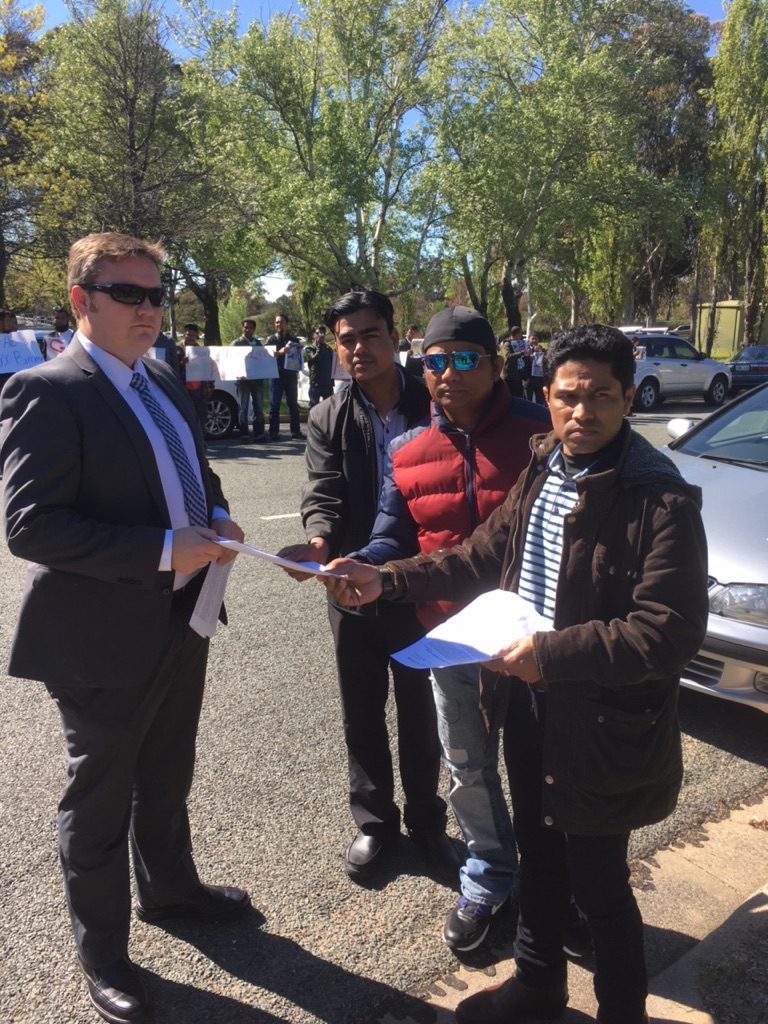
Today, we staged a demonstration in front of Burmese embassy in Canberra in the present of Australian Federal Police (AFP).


It was started from 9.30am and taken one hour long by reading 3 pages of statement by Habib and slogans by Min Min


Demonstration was joined by about 60 Rohingyas collectively from Melbourne and Sydney.


Usually, No staff from the embassy came out to take our memorandum but it was given to an AFP officer who will be handing over to the embassy..
...........................
our memorandum is as below:

We, ABRO would like to raise serious concern over recent arbitrary mass killing and slaughtering about 100 Rohingyans and ongoing arrests and force confession from Maungdaw township, keeping the Rakhine (Arakan) humanitarian crises alive, allowing to carry out genocidal attacks and various operations, vigilant racial attacks, continuously locking down about 150,000 Rohingyas and Kamans in ghetto type concentration camps across 42 locations and confining the rest about a million in their villages from June 2012, mass destruction of historical evidences and religious buildings, forceful expulsion, blocking aid and food supply, prohibit livelihood and compelling to die from starvation, denying their right to have rights such as medicare, education, relocation and movement, seizing and destroying residential documents and forcing to accept foreigner identity and not allowing to recourse under new citizenship act. .

After recent attacks carried out by unknown armed gangs on border police in Kyiganbyin, police outpost in Kotankauk, and local police office in Nhakhuya where equal members of causality occurred from both sides, the government forces instantly taken intentional steps of retaliation to annihilate the Maungdaw township resident Rohingyans from 9 Oct 2016 under the so call 'Land Clearing Operation' (Nay Myay Chin Linn Yay).
In this operation, about 100 Rohiongya involving women, children and elderly people from 11 different locations were closely shot dead, slaughtered in cool blood by military and security forces. Many of those taken away by security and military forces were also found in a mass grave with their hands tied that cleared how they been brutally killed. Additionally, gang rapes of teens by those taken away by authorities, looting goods and cash, extortion, expulsion from villages and blocking of food supply, are also recorded.

An estimated about 5,000 people have been displaced and now shelter-less after about 700 houses and livestocks in Wabaik hamlet of Kyiganpyin village, Kyet Yoe Pyin village tract, Nga Sa Kyu village tract and Ngan Chaung village tract, were burn down by security and military forces.
Despite the government officially denounced the armed gang insurgent for attacks and torching of houses, it actually government forces who shot civilians and torching of houses that were captured in the photos.


Despite Ms. Suu Kyi told its authorities to deal those arrestees by lawfully and requested not to compete by forces between government forces and armed groups, it is practically different on the ground. Her government does not enhance her authorities to act lawfully, nor taking action onto officials those involved in arbitrary and lawless killings, and for committing physical abuses.
Yet, Ms. Suu Kyi did not confirm the attacks but her presidential office's official statements and Burmese news agencies widely spreading reverse information by linking the attacker armed group with non-existing foreign group and fabricating false news, evidences and implicating Rohingya community.

It has been over four years now Rohingyas and Kamans of Rakhine (Arakan) state are totally excluded from Burma and trapped into the worst part of human tragic such as APARTHEID, SLAVERY & RACISM, EXTERMINATION.. For decades, Rohingyas have been oppressed, victimized and terrorized by the both government authorities and extremist Rakhine people that been recorded commonly in 1942, 1949 1967, 1978, 1991,1994/95, 2002 and the latest state sponsor genocide began from June 2012.
From 8 of June 2012, total destruction across (13) different townships of Arakan state, reached at (97) mosques, about (23,000) houses from (95) villages, killing thousands Rohingyans and Kamans and nearly 200,000 people displaced of whom about (110,000) people are in 13 to 15 camps of Sittwe (Akyab) city and the rest about (65,000) those from other 8 regions in 26 camps are in aid workers unreachable areas, and number of arbitrary detention reached at least 12,00 Rohingyas and Kaman muslims mainly from Maungdaw, Buthidaung and Sittwe townships.
In Burma there are so many organizations including Red Cross Society, Healthcare clinic but all are puppet bodies of terror government and not delivering services for Arakanese muslims. While Rakhine children are freely attending the government schools, the Rohingya youths those teaching Rohingya kids, distributing rations, Rohingyan language support workers, providing medical assistance in the camps, are instantly targeted by local authorities. So, many Rohingya youths have continued to flee into neighbouring countries. Government authorities pretend unable to interfere in local matters and also instantly blocking aid delivery and medical treatment for displaced Rohingya and Kaman victims..

The ousted Thein Sein government pretended to be uncontrollable and allowed to spread across central Burma therefore the attacks carried out in 26 locations of 8 different states that destroyed thousands of houses, killing hundreds of people, displaced more than 20,000 people.
Despite the Thein Sein government has characterized the events as 'communal violence, it was a well plan and the government's involvement and contributions into the crisis were very obvious.
The latest target on Rohingya in Maungdaw township from 9 Oct 2016, is actually another propaganda to divert international attention on genocide and atrocities committed by government forces.

As we aware, the current central ruler of NLD has been following the same footpaths and tactics of the past regimes that keep routinely attacking of ethnic minorities such as Chin, Karen, Kachin, Shan and Rohingya.
When there are double numbers of government armed forces presenting in minority areas, and still carrying out attacks, the minorities lost hopes and the number of armed ethnic group from repression is yet to be grown in the future because it is only option to protect their respective own people and lands from aggressive military operations, tyrant abuses and genocide. However sadly, the people who are protecting own people from genocidal attacks are branded as insurgency or guerilla by central ruler government and Burmese news agencies.

Historically, the past government and now latest NLD, all of them have actually no strategy for peace, nor taken workable steps to bring peace and build trust with ethnic armed groups, But they are records of breaking ceasefire agreements and aggressive and offensive attacks thru waging wars and physical tortures over civilians that account for crimes against humanity.
The fact is that, the late NLD government's failure or not yet marched forward to achieve genuine cease fire, reconciliation with minorities and restoration of genuine federal democracy system. But, NLD re-conciliated with military and kept her military in power so that minority areas and their issues kept under military control.
NLD leader Ms. Suu Kyi forgiving military generals' the past crimes and now again favouring through achieving lifting blacklist of its generals.

We strongly urge Ms. Suu Kyi who is above the president of the country and led the NLD government and its authorities to uphold its afore said rules of laws and respect the dignity and rights of the entire population regardless of race, religion and colour and to ensure a free, fair and equal justice system is available to all.
NLD leader Ms. Suu Kyi has not yet condemns it militarily attacks on minorities, not yet achieved release of a single muslim political prisoner and yet to outline its plan on minorities.

NLD government must also install laws and orders to equally guarantee safety and security of the entire people of Burma. The NLD government must immediately halt all forms of ongoing persecution, oppression, restriction, segregation and vigilante attacks against minority groups; particularly the Rohingya and Kaman from Arakan state of western Burma.
The NLD government must take immediate action to prevent ongoing campaigns of racial hatred organised by radical groups, such as the ultra-nationalist Buddhist group MaBaTha (969) Association, which is supported by some politicians, ex-generals and their family members, along with some Yangon-based Rakhine people.

We are also disappointed to see NLD government and its authorities are forcing Rohingya and Kaman people to accept foreigner identity, seizing and destroying their residential documents and not allowing to recourse to become new citizenship even under 1982 citizenship act.
Practically, it is not the 1982-citizenship laws that stripped off citizenship but the authority who are intentionally reluctant to access the Rohingya's historical existence and ancestral evidence that prove primary evidence earlier than prior to 1824. The fact is that after British occupation of Arakan in1824, the repatriated Rohingya war victims of 1784 and 1794 Burman king invasion of Arakan, were miscounted as British era settlers by central rulers.
Like in 1978 and 1992, after drove out of Rohingyans and Kamans from their ancestral homelands, the authorities tactically started collection of data and those forcefully repatriated under bilateral agreement were branded as Bengali so it could be accounted by exclusion of Rohingya into national census as a creation official evidence for national population history.

We also would like to urge the UN and its member countries including countries those have business ties with Burma to join together in taking effective actions onto Burma's central ruler NLD government and it authorities to abide by domestic and international laws.

We, ABRO therefore demands the following:
1) UN to use force to restore peace and stability in minority areas including in Arakan state.
2) UN to use force to immediately suspend blockage of food and aid supply and grand special power to aid agencies to enable to supply food and aid on the ground freely.
3) UN to effectively pressurise onto central ruler government to immediately lift all kinds restrictions.
4) UN to monitor central ruler NLD government and its armed forces to abide by domestic and international laws.
5) To stop forcing and pressuring of Rohingya and Kaman to accept foreigner identity.
6) Immediately release of muslim political prisoners from central Burma and thousand of Rohingya prisoners mostly detained in Sittwe Central Jail, Buthidaung Jail and many other who are detained in police lock-up and military camps.

Thankfully,
ABRO

For more information, please contact;

Russel : 0438 524935 (Melbourne)
Habib: 0406 310077 (Melbourne)
Mohammed Amin: 0411 456400 (Melbourne)
Shujawuddin: 0411 378204 (Brisbane)
Sayad Kassim: 0423 764858 (Sydney)
Mohammad Sadek: +(60) 16 3094599 (Malaysia)
Maung Kyaw Nu: +(66) 98 842 0459 (Thailand)

Kyaw Soe Aung: +(1) 414 643 8001 (U.S.A)

Monday, 17 October 2016

Myanmar Genocide of Rohingya People enjoys Double-Impunity

Source maungzarni, 13 Oct


Myanmar - this time under Aung San Suu Kyi's leadership has launched another wave of attacks - security forces killing innocent Rohingya men, children and women. This act of killing members of the Rohingya group enjoys what I call 'double impunity":

first, the impunity from the genocidally racist society at large including "pro-human rights" NLD rank and file, as well as the top leadership of Aung San Suu Kyi; and second, the international impunity as in UN dropping its watch on the Rohingya persecution

Aung San Suu Kyi has shifted her position, rather grudgingly, on the Rohingya persecution only because - as she herself has said it on CNN interview with Zakaria - 'the issue is what the international community focuses on (she means 'fixated" or 'fussed over'), implying that she does not consider this an issue that merits her attention, on its own right.

I simply cannot conceive of a scenario wherein the persecution - at this genocidal level - will be ended, without any strong external intervention, something that will simply not happen.

Historically, no genocide is ended by the internal social forces - because these forces are typically part of the genocidal process.

We have a Catch-22 in Burma, and the Rohingya will continue to be destroyed from their existential foundations.

The Burmese generals are cleverer than Hitler and the Nazis. They set the process of destroying the targetted victim community in motion almost 4 decades ago, and they let it simmer, they let it spike, they let it plateau and they are now revving it up.

The latest framing of the issue of "extremism" 'terrorist attacks", and the frenzied racist "Buddhist" public gets whipped like Pavlovian experimental animals howling and barking in support the regime's killing of innocent Rohingya - men, women and children, burning down whole villages, firing rocket launchers into Rohingya villages.

Bangladesh has sealed off its Burmese-Bangladesh borders, closing off any safe passage to safety for the fleeing Rohingya. To control the public outrage among the Muslim populations in Bangladesh Bangladeshi government has effectively censored the news coverage of the latest wave of killings of the Rohingya in Burma.

The night gets darker and longer - with no morning rays on the horizons for these poor helpless souls.

This is the kind of world we live in. Maybe the world has never been enlightened or kind or intelligent.

Save Rohingya from annihilation

by Admin, 


Save Rohingya from annihilation


We, the undersigned Rohingya organisations express our serious concern on the continued military and police crackdown on the civilian population in Northern Arakan.


Since 9 October, under the pretext of looking for attackers, the Myanmar military and police forces have been indiscriminately killing the Rohingya, torching and plundering their homes and villages. Two mass graves were found and about 100 Rohingya civilians were extra-judicially killed that included old men, women and children. At least 5 Rohingya villages were set ablaze destroying many houses or whole villages.


The grave situation has caused many Rohingya to flee their villages. An estimated 5000 Rohingya have been internally displaced causing great humanitarian disaster. Due to curfew order and blockade, there is an acute shortage of food, medicine, and other essentials. The situation is exponentially worsening. It is a violation of international law and Geneva Convention.


Whilst these crimes against humanity have been manifestly committed by the joint armed forces with impunity, the authorities, as a part of an evil design, are spreading lies to the media that "Bengalis" -- a racial slur in reference to the Rohingya people—are burning down their own houses to leave the international community in a state of confusion.


We are disappointed by the recent statement of the EU and request them to make an objective assessment of the situation on the ground and help the victims of human rights violations on humanitarian grounds.


We also request the State Counsellor Daw Aung San Suu Kyi to intervene into the matter and put an end to the military crackdowns on the civilian population.


In the face of the current humanitarian disaster, we urge upon UN with the international community:


(a)  To provide full protection to the helpless Rohingya community in Northern Arakan;

(b)  To provide the victims with necessary humanitarian assistance, including healthcare;

(c)  To investigate the whole extent of the event and bring those responsible to justice.


Last not least, we are a peace-loving people believe in peaceful co-existence. And we demand a peaceful resolution to the crisis.


Signatories;

1.      Arakan Rohingya National Organisation

2.      Burmese Rohingya Organisation UK

3.      Bradford Rohingya Community in UK

4.      Burmese Rohingya Community in Denmark

5.      Burmese Rohingya Association Japan

6.      Burmese Rohingya Community in Australia

7.      Canadian Burmese Rohingya Organisation

8.      Rohingya Arakanese Refugee Committee

9.      Rohingya Community in Germany

10.  Rohingya Community in Switzerland

11.  Rohingya Community in Finland

12.  Rohingya Community in Italy

13.  Rohingya Community in Sweden

14.  Rohingya Organisation Norway

15.  Rohingya Society Netherlands

16.  Rohingya Society Malaysia


For more information, please contact:


Tun Khin (Mobile):                  +44 7888714866

Ko Ko Lin (Mobile):                +880 1726068413

Nay San Lwin(Mobile):            +49 69 26022349

Sunday, 25 September 2016

Rohingyas in Malaysia – the undocumented people

Source aseantoday, 25 Sept


banner-1

September 25, 2016

In Malaysia, 50,000 Rohingyas live a life of no way forward and no way back. Rohingyas continue to be denied citizenship rights in Myanmar. Thus, they have little means or reason to return. However, for the large majority living in Malaysia, life is also one of uncertainly and anxiety.

Editorial

The Rohingya people are a group of Muslim minority from the Rakhine State of Myanmar. Since 1982, Myanmar has denied them citizenship and deprived them of their basic rights. This resulted in an increasing number of Rohingyas leaving Myanmar to make a life elsewhere. Malaysia is a popular choice given the large Muslim population, relatively high standard of living and developed economy.

One third of the 150,000 refugees registered with the United Nations High Commissioner for Refugees (UNHCR) in Malaysia are Rohingyas. Although registration provides Rohingyas with an identification card and meagre benefits, it does not allow holders the right to work, health care or education. Registration is also not always viable for those living outside of the capital city Kuala Lumpur, where the office is located. Many do not make the journey, as they fear arrest or extortion as well as the difficulty of travel, communication and documentation. Advocacy groups claim the number of registered Rohingyas is in fact a small portion of a much larger unregistered body currently living in Malaysia.

Registered or not, a lack of protection and policy has left Rohingyas in a state of limbo in Malaysia. A report by the UNHCR describes Malaysia as a "country of asylum only in the loose sense of the term." Generally, Malaysia only provides basic rights to asylum seekers and does not provide resettlement. Rather, international governmental institutions, like UNHCR, transfer refugees to other countries for permanent resettlement.

While Rohingyas are often no longer at risk for deportation, they are subject to arrest, detention and extortion. They are also formally restricted from employment opportunities, and their children are unable to attend national schools.

Refugee or Illegal Migrant?

Malaysia is neither a signatory to the UN Convention of Refugees, nor does it have any intention of becoming so. Refugees or asylum seekers are treated the same as illegal migrants, who are accused of coming to Malaysia for economic opportunities. Refugees are restricted from integrating into Malaysian society or accessing fundamental services.

The lack of work opportunities forces many to take riskier forms of unofficial employment, putting them at the mercy of their employers. Rohingyas can be subject to late or non-payment of wages, dangerous working conditions and immigration raids. Without an income and with limited access to public services, fundamental rights like education, health and accommodation become unobtainable.

Many counties with the means to provide permanent resettlement are either handling other refugee populations or are unwilling to do so. Australia is generally opposed to taking in refugees. Much of Europe is overwhelmed with refugee populations, and North America is not conducive for foreigners or migrants. If Malaysia is waiting for the UNHCR to find countries accepting of the Rohingyas, they may be waiting a while.

Can Malaysia Handle This?

Therefore, what can be done? Refugee International calls on the Malaysian government to recognise the Rohingyas' asylum status, issue work permits, provide alternatives to detention and allow access to education and health care. While these seem like obvious and reasonable demands, the implementation is by no means simple.

Many Malaysians fear the provision of 'benefits' will encourage illegal migrants to seek asylum or continue to encourage irregular arrivals. Many countries possess similar fears, including the Australian Liberal Party's government, who argued for a 'strong' refugee policy.

Balancing the local labour's demands and the right of employment for asylum seekers will always be a difficult task. This is especially true in a country where wages, particularly in unskilled occupations, are fairly low. However, Malaysia already utilises an enormous amount of foreign labour in its construction, manufacturing and domestic services sectors. In 2015, the World Bank reported that Malaysia had 2.1 million legal foreign workers in the country. Most of these came from Indonesia, Nepal, Bangladesh, Myanmar, India and the Philippines.

Thus, finding a way to utilise Rohingyas without encouraging illegal migration is the best way forward. On multiple occasions, the Malaysian Government has proposed this exact strategy, but plans have never come to fruition. Part of overcoming these challenges will be establishing a system to assess the status of asylum seekers.

Something needs to be done sooner rather than later. Rohingya children are being born in Malaysia to Malaysian-born Rohingya mothers. These second and third generation Malaysian-born Rohingyas are effectively stateless, as they are not eligible for residency or citizenship in Malaysia or Myanmar. This is strikingly similar to the plight of Palestinian refugees living in Lebanon, Syria, Egypt and Jordan. Today, many third or fourth generation, second-country born Palestinians do not have permanent residency or citizenship in their country of birth, even if the original refugees were in fact economic migrants.

Citizenship and identity are two issues which will have to be further grappled with in the future. With every new Malaysian-born generation of Rohingyas, it becomes increasingly clear that they are no longer just 'Rohingyas' or Myanmarese.

Ultimately, this situation is a chance for Malaysia to prove its maturity as a nation and live up to its reputation as a tolerant country. Malaysia is in a prime position to take leadership of this issue and enhance its global credentials.

Wednesday, 7 September 2016

Annan meets with Rohingya communities in Myanmar IDP camps

Source vidalatinasd, 7 Sept

Former UN secretary general Kofi Annan (C) arrives at Thet Kel Pyin Muslim IDP (Internally displaced person) camp during his visit to Rakhine State near the capital of Sittwe, western Myanmar, 07 September 2016. Kofi Annan, who chairs the advisory commission of Rakhine State, which was formed on 23 August 2016, is on a six day visit to Myanmar to aid in the resolution of religious and ethnic conflict in the state. EPA/NYUNT WIN
Former UN secretary general Kofi Annan (C) arrives at Thet Kel Pyin Muslim IDP (Internally displaced person) camp during his visit to Rakhine State near the capital of Sittwe, western Myanmar, 07 September 2016. Kofi Annan, who chairs the advisory commission of Rakhine State, which was formed on 23 August 2016, is on a six day visit to Myanmar to aid in the resolution of religious and ethnic conflict in the state. EPA/NYUNT WIN 

Sittwe, Myanmar, Sep 7 (efe_epa). — Former UN secretary general Kofi Annan on Wednesday visited local communities in Myanmar's western Rakhine State as part of his sixday trip to investigate the human rights situation facing the Rohingya Muslim minority, an epa journalist reports.

After yesterday flying into Sittwe, the capital of Rakhine, Annan today went to the Min Gan and Thet Kel Pyin IDP (internally displaced person) camps, which are home to about 3,000 and 6,000 Rohingyas, respectively.

In both camps he briefly met with local leaders and refugee representatives, who told the former UN chief about their living situation and difficulties.

Hundreds of people in the camps came out to greet and see Annan and his entourage.

He also visited the Aung Mingalar Muslim quarter of Sittwe, where he met with local residents and community leaders.

The Ghanaian diplomat received a chilly welcome in Sittwe yesterday, when protesters came onto the streets denouncing his visit and held signs with such messages as "No outsiders' intervention in our Arakanese internal state issue" and "No to foreigners biased (take) on our Rakhine State affairs."

Annan, as chair of the advisory commission examining solutions to the ethnic and religious conflicts in Rakhine, is scheduled to meet with Myanmar President Htin Kyaw and military leader Min Aung Hlaing on Friday, and hold a press conference in Yangon before he leaves the country on Saturday, the Myanmar Times newspaper reported.

The Rohingya, a Muslim people from Rakhine State, have faced discrimination and violence for years and make up the majority of that state's 120,000 IDPs, according to the United Nations High Commissioner for Refugees (UNHCR).


Wednesday, 31 August 2016

Myanmar: Investigate death and alleged rape of Rohingya woman

AMNESTY INTERNATIONAL  PUBLIC STATEMENT  
Index: ASA 16/4723/2016 30 August 2016   
Myanmar: Investigate death and alleged rape of Rohingya woman   

The Myanmar authorities must ensure a prompt, independent, impartial and effective investigation into the death and alleged rape of a Rohingya woman. The alleged refusal by the police to investigate the case, and to bring those responsible to justice is a violation of their human rights obligations and sends the message that crimes against Rohingya, including  unlawful deaths, rape and other crimes of sexual violence, will continue to go unpunished.   
 
On the morning of 18 August 2016, Raysuana, a Rohingya woman in her mid-twenties, was found unconscious in a ditch close to a military compound, named locally as Bandula Hall, in Sittwe, the capital of Rakhine State. According to local sources, Raysuana's body was found by military personnel, however, instead of taking her directly to a hospital, they called leaders from nearby Thet Kay Pyin village and asked them to come and pick her up. The village leaders then took her to Thet Kay Pyin clinic, where clinic attendants discovered Raysuana was bleeding from her vagina and mouth, and had bruises and swelling on her back. She died later that evening, at around 7:45pm.   

Local police, called to the clinic, reportedly refused to open an investigation saying that it would be "too complicated" given that she was found close to a military compound. Instead, they ordered villagers to bury her body, which they did the following day. According to credible sources no post-mortem examination was carried out.  

Amnesty International calls on the Myanmar authorities to immediately initiate an investigation into the death and alleged rape of Raysuana, ensuring that it is independent, impartial and effective. The results should be made public. All those suspected of being responsible must be brought to justice before independent, civilian courts, in proceedings which meet international standards of fairness and which do not impose the death penalty. Should any of the suspected perpetrators be members of the Myanmar security forces, they should be immediately suspended from duties.    

Amnesty International also calls on the authorities to secure the crime scene and ensure the safety of any witnesses and those reporting information about the incident. Amnesty International further calls on the authorities to launch an inquiry to into allegations that the police refused to open an investigation into this case; and if this is the case, to institute disciplinary or other measures against those responsible. The authorities must also provide effective remedies and reparations to Raysuana's family.   

Thet Kay Pyin village is located in an area of Sittwe which is home to tens of thousands of people, mainly Rohingya, who remain displaced four years after violence swept Rakhine State in 2012. The Rohingya and other Muslims living there face severe restrictions on their freedom of movement, and are effectively segregated from neighbouring communities. Because of these restrictions accessing medical care, in particular life-saving medical treatment, can be very difficult.  

Raysuana's case take place in a wider context of human rights violations against the Rohingya, including unlawful killings, torture and other ill-treatment and arbitrary arrest at the hands of the security forces. Independent and impartial investigations into such allegations are rare and suspected perpetrators are seldom held to account.   

The case also highlights wider concerns about rape and other crimes of sexual violence against ethnic minority women, which have been well-documented by women's organizations in Myanmar. In its 2016 Concluding Observations, the UN Committee on the Elimination of Discrimination against Women (CEDAW Committee) expressed concern about the "wide spread impunity enjoyed by perpetrators of such violence" and called on the Myanmar government to "expedite the investigation and prosecution of crimes of sexual violence perpetrated by the military and armed groups".  

Ongoing impunity which allows human rights violations to go unpunished only serves to perpetuate the cycle of abuse. The authorities must ensure perpetrators are not shielded from accountability and ensure that victims and their relatives lodging complaints and seeking redress do not face reprisals.

Wednesday, 10 August 2016

“Burma’s Rohingya Need International Help Now More Than Ever”

Source Huffingpost, 10 Aug
by Tun Khin

Earlier this year the United Nations published a report 'Rohingya Muslims and other minorities in Myanmar', which concluded that human rights violations against us could amount to crimes against humanity.

The report also stated that the government of Burma needed to take urgent action to end the anti-Rohingya policies of past governments. The response of the NLD led government and rest of the international community was silence. Once again, evidence of violations of international law have been provided, and once again no action has been taken. Our suffering goes on.

Worse, the day after the UN report was published, European Union diplomats based in Burma announced that in response to a demand by Daw Aung San Suu Kyi to avoid using the word Rohingya, they would also not use the word Rohingya when talking about Rohingya people.

The denial of our ethnic identity is an integral part of the discrimination that we face. Nationalists and the government administration under former President Thein Sein have deliberately and tactically escalated controversy over the use of the name Rohingya as part of their campaign to say we are not an ethnic group in Burma and don't belong there. They called us Bengali instead, claiming we are immigrants from Bangladesh. Instead of standing up to these people and their lies, Daw Aung San Suu Kyi has said because the name is controversial, diplomats should call us 'Muslims from Rakhine state'.

This is seen as a victory by nationalists. Rather than being pacified by this so-called compromise, they are now demanding the Burmese government officially call us Bengali. Not calling us Rohingya has encouraged them. In effect, the government of Burma and European Union have sided with racists and nationalists rather than with the oppressed and vulnerable.

My people are dying in the camps where they fled to four years ago after they fled mobs burning their homes and villagers. They are dying in part because the new government has kept in place severe restrictions on delivery of aid. In towns and villages my people live in poverty and fear, afraid of attack or arrest at any time. My people are denied the right to travel around the country, are denied citizenship, and denied the right to vote. We are denied access to healthcare. Our children are denied access to higher and university education. We had so much hope in an NLD government, but so far, since they came to power, things have continued to get worse, not better.

Daw Aung San Suu Kyi says her government needs time and space to deal with this issue. As Rohingya we understand that there is much hatred against us in Burma. Fully addressing this will take time. But in the short term restrictions on aid can be lifted, action taken against those inciting hatred and violence, and the process of reforming the 1982 citizenship law which is at the root of depriving us of so many of our rights, could be started. My people are dying and suffering so much, we don't have time. We need action now.

At the same time, violations of law don't get much more serious than crimes against humanity. Yet having concluded that these crimes might be happening, no action is being taken by the UN or government of Burma. Imagine if a police force said a murder had been committed, but we are not going to investigate it. That's the equivalent of what the United Nations are doing now.

At a time when there is so much hope for so many others in Burma, this is our most desperate hour. Pressure needs to be placed on the NLD led government to lift government restrictions on humanitarian aid to the Rohingya still living in squalid camps four years after being forced to flee their homes. Daw Aung San Suu Kyi must be made to live up to her previous statement that the discriminatory 1982 citizenship law should be reviewed. And the United Nations must establish an international investigation into human rights violations against my people. Next month's UN General Assembly sessions are the opportunity to do this.

Report after report have concluded that multiple violations of international law are being committed against the Rohingya. No government can say they don't know what is going on. It is to their shame that they allowed it to carry on.

"Tun Khin is President of Burmese Rohingya Organisation UK and Leading voice of the Rohingya in Exile."


Muslims Charged in Rangoon for Alleged Citizenship Violations

Source Irrawaddy news, 10 Aug

The government compound in Rangoon's Thingangyun Township, seen on Tuesday afternoon. (Photo: Myo Min Soe / The Irrawaddy)The government compound in Rangoon's Thingangyun Township, seen on Tuesday afternoon. (Photo: Myo Min Soe / The Irrawaddy)

RANGOON — Immigration authorities have charged six Muslim residents of Rangoon's Thingangyun Township under the 1982 Citizenship Law for allegedly traveling from other regions without government approval and failing to return their "white cards" last year, according to their defense lawyer.

The six were among 23 residents of Ward-3 in the township who were held at local government offices on Monday after members of the Myanmar Patriotic Monks Union—a hardline Buddhist nationalist activist group—threatened local Muslims and pressured township authorities to scrutinize whether they were officially registered as living in the area.

Nay Phone Latt, who represents the township for the National League for Democracy in the Rangoon Division Parliament, told The Irrawaddy that he was aware of local Muslims, some holding "white cards," who had failed to present adequate citizenship documentation to local authorities. He said that some might have come from Lashio in northern Shan State.

"White cards" are documents denoting "temporary citizenship" that were canceled by former President Thein Sein in February 2015, with bearers obliged to return them to local officials.

According to a report by Voice of America, the Patriotic Monks Union began its campaign against the resident Muslims after a local quarrel between a Buddhist young man and a Muslim young man fatally escalated.

The mother of the Buddhist young man reportedly tried to intervene but was stabbed. She died on August 4 after contracting a lung disease, pneumoconiosis, at the hospital. Police are still searching for the assailant. This incensed the Patriotic Monks Union, who decided on retribution against the local Muslim community at large.

On Tuesday, out of the 23 people held at local government offices—purportedly for their own safety after receiving violent threats from the Patriotic Monks Union—seven were unconditionally released, 10 were fined and six were charged with being in violation of Articles 62 and 63 of Burma's 1982 Citizenship Law, according to the Muslim defense lawyer, who asked not to be named out of fear for his safety.

The lawyer told The Irrawaddy, "Everybody knows who is behind the scene. A group is interfering in the government's work."

"The hands of Ma Ba Tha members are behind the curtain," he said, referring to Burma's most prominent Buddhist nationalist association, which is not formally linked to the Patriotic Monks Union.

Articles 62 and 63 of the citizenship law contains provisions against holding "cancelled" documents for "naturalized citizenship"—a category distinct from "temporary citizenship" as formerly denoted by white cards, which is not mentioned in the 1982 law. Penalties include prison sentences of 10-15 years, and fines of up to 50,000 kyats (US$42).

The Irrawaddy visited the offices of the Thingangyun Township administration, but immigration officers and those from other departments would not confirm the charges.

The township police commander, Thet Naing Htun, merely answered, "Everything is fine and we released all of them."

Outside the township court on Monday, around 100 members of the local Muslim community gathered to publicly present a variety of documents purporting to prove the legal residence of those being scrutinized in the township. About 20 police were positioned outside government offices, bearing rifles.

Photographs of the scene were circulated on social media, accompanied by inflammatory statements to the effect that the assembled Muslims were "insulting local authorities" and "disobeying court regulations."