Wednesday, 19 June 2013

Double Standard: Burma Imprisons Two Muslim Women for Sparking Okkan Unrest

Source Irrawaddynews, 18 June

A young Muslim boy runs through the ashes of his village in Kyawe Poan Lay, Okkan township, which was razed by a Buddhist mob in May. (Photo: JPaing / The Irrawaddy)

RANGOON— A Burmese court has imprisoned two Muslim women for sparking communal violence earlier this year in the town of Okkan, near Rangoon, in the latest conviction of minority Muslims while Buddhist suspects have yet to face trial.

The two women were blamed for sparking the violence in April after they were involved in an altercation with a Buddhist monk that angered local Buddhists, leading to anti-Muslim rioting in the city about 100 kilometers from Rangoon. One Muslim man was killed and nine were injured in the unrest, while 81 homes and a mosque were burned to the ground.

"The court gave them a sentence of two years each in prison and hard labor on June 5," an official from the court in Taik Kyi Township, where Okkan is located, told The Irrawaddy.

Burma has seen clashes between Buddhists and Muslims in several states this year, but so far only Muslims have been imprisoned. Muslims make up only about 5 percent of the country's 60 million or so population.

In Okkan, the violence erupted on April 31 after a Muslim woman bumped into a novice monk, spilling his food and breaking his alms bowl. The woman and the monk were detained by the police following the incident, and both were released about two hours later after the woman apologized.

But when they left the police station, another Muslim woman grabbed the young monk and shook him, accusing him of lying to the police. This prompted both Muslim women to be detained. A mostly Buddhist crowd gathered outside the police station and began destroying Muslim properties in neighborhood.

The two women were charged with offending religion in Buddhist-majority Burma. An article of the country's penal code prohibits people from engaging in "deliberate and malicious acts intended to outrage religious feelings of any class by insulting its religion or religious beliefs."

As of last month, a total of 39 suspects were reportedly in police custody for their alleged roles in the rioting.

"We are summoning witnesses and still investigating the case," an officer at Okkan's police station told The Irrawaddy, adding that he did not have the authority to disclose the exact number of suspects still in detention.

Before the rioting in Okkan, inter-communal strife between Buddhists and Muslims broke out last year in west Burma's Arakan State. The violence spread this year to central Burma and east Burma—with clashes in the town of Meikhtila, then in Okkan, and mostly recently in Lashio. In total, more than 200 people have been killed and more than 150,000 people—mostly Muslims—have been displaced.

In the unrest this year, the government has convicted more than 10 Muslims but no Buddhists.

In east Burma's Lashio Township, a Muslim man was sentenced to 26 years in prison last week after an incident in late May which sparked an outbreak of anti-Muslim violence that left one person dead and displaced about 1,400 Muslim residents. He was convicted of attempted murder, voluntarily causing grievous harm and two drug-related charges.

In the central Burma town of Meikhtila, the Muslim owners of a gold shop and an employee were sentenced in April to more than a decade in prison after a dispute with a Buddhist customer in March sparked anti-Muslim riots that left at least 43 people dead and destroyed hundreds of homes. Last month, seven Muslim men were also imprisoned for the death of a Buddhist monk during that unrest.

In both cases, most of the remaining suspects under investigation are Buddhists. Seventy-four suspects in custody in Meikhtila have been charged with the destruction of property and murder, while 44 suspects in Lashio have been detained but not yet charged, according to regional authorities.

Kyaw Khin, chief secretary of the All Burma Muslim Federation, told The Irrawaddy that he had no comment on the convictions of those who were guilty.

"If they are guilty of the crime, they should be punished fairly—no bias against religion and race," he said.

"But as of now, all the people who have earned imprisonment are minority Muslims. So I have to ask, where are the majority [Buddhist] people who committed the crimes of looting, rampaging, arson and killing during the riots?"

Kyee Myint of the Myanmar Lawyers' Network called on the government to ensure equal treatment for suspects of all religions.

"At the moment, they are just playing a game of politics to please the Buddhist majority," he said.

"But don't worry: They are going to sentence Buddhists who were involved in the riots very soon."

British Minister calls on international community to work together to tackle Burma’s forgotten crises

Source gov-uk, 18 June

UK humanitarian support is making a difference in Burma but more needs to be done by the international community

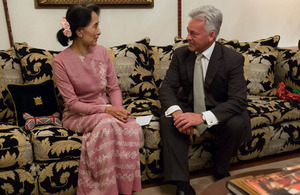
Development Minister Alan Duncan meets Aung San Suu Kyi. Picture: Tim Mitzman

Greater efforts must be made to help vulnerable people at risk from flooding and disease in Burma's Rakhine and Kachin States and support peace talks to resolve Burma's inter-communal conflicts, Development Minister Alan Duncan has said on a visit to Burma.

In Burma, Alan Duncan met senior ministers in the Burmese government, Daw Aung San Suu Kyi, ethnic leaders and civil society groups to discuss how the UK can help to support peace talks to resolve Burma's inter-communal conflicts and help with the country's continued development.

During a visit to Rakhine, one year on from the start of violence that has seen 140,000 mostly Rohingya Muslims displaced from their homes, the minister saw how British support has already helped to combat the effects of monsoon rains by providing urgently-needed clean water, sanitation facilities and nutritional feeding for infants for more than 80,000 people.

Alan Duncan said:

The situation I have seen in Rakhine today is getting desperate. The monsoon rains have started with some families still living in tents, exposed to the elements and at serious risk of flooding and disease. The plight of those in Kachin is equally worrying. Humanitarian agencies in both Kachin and in Rakhine are doing what they can, but it is simply not enough and sustained access is critical.

UK humanitarian support is making a difference and we are actively looking at what more we can do, but now the international community must wake up to these forgotten crises and come together to find lifesaving support and a lasting solution.

The communities too must also work together towards a peaceful resolution. In particular, the Rohingya people must be allowed freedom of movement and freedom to work. No country can end aid dependency if some people are locked out of jobs and growth.

The Minister also raised the plight of the 80,000 people in Kachin who still cannot return home as a result of violent conflict. The UK is currently the largest bilateral humanitarian donor to Kachin State.

Notes to editors

  • British support to Rakhine now totals £6.4m. £4.4m announced in May 2013 is providing:
    • nearly 80,000 people with access to safe drinking water and improved sanitation facilities
    • malnourished children aged 0-59 months with treatment for acute malnutrition in rural camps
    • hygiene kits to nearly 40,000 people.
  • British support in Rakhine is being delivered by a consortium led by Save the Children, along with Solidarites, Action Against Hunger (ACF) and the Consortium of Dutch NGOs
  • The UN's current Rakhine response and preparedness plan needs US$80 million to meet the needs of 115,000 displaced people until the end of June. The plan was 83 per cent funded as of 13 June, with $14 million still urgently needed to implement camp management, water and sanitation, and other activities to help people survive the monsoon season.
  • In December 2012, the UK announced an additional £1.5 million of humanitarian support for people displaced by the conflict in Kachin. This takes the total support provided to £3.5m with the UK the largest bilateral humanitarian donor to Kachin State.
  • The UN's Kachin response is currently funded with US$ 13.9 million (27.4%) of the $50.9 million it needs to meet people's humanitarian needs.
  • There has been recent progress towards an ending of hostilities between the Kachin Independence Organisation (KIO) and the government. Political dialogue will be essential if the plight of those affected by generations of conflict is to be improved.
  • Last week, the first UN international aid convoy for almost a year was able to deliver humanitarian assistance in non-government controlled areas in Kachin state. Regular and sustained access for more humanitarian aid is needed to all areas of the state.
  • The UK is one of the largest bilateral donors to Burma, with a programme of over £180 million from 2011 – 2015. This is focussed on areas such as health, education and wealth creation, as well as humanitarian aid to those affected by conflict.

Sunday, 16 June 2013

Rudderless & Drowning in Tears: The Rohingyas of Myanmar

Source ipcs,

Within Myanmar there appears to be a decisive state policy designed in the interest of the government, military junta, Buddhist Rakhine, nationalist parties and other ethnical factions. With the 1978 'ethnic cleansing' propaganda targeted against the Rohingya community, Myanmar, has witnessed one of the most devastated large-scale sectarian strife's in history. Albeit, political pressure, Myanmar, till today, maintains its ideological fancy in its inhumane treatment exhibited towards the Rohingya. This national venture whilst supported by other Buddhist nations predominantly of Burman and Rakhine majority groups has left the Rohingya community a dismantled lot. However, it was only until 2009, when a worldwide coverage of the plight of the Rohingya vehemently spurred the international community in providing immediate reprieve to the issue. Within the larger framework of social dynamics in Myanmar, this brief focuses on the ethnic conflict affecting

What has been the internal perceptions of the Rohingya conflict within Myanmar? And what has been the response of the international community so far? Will the Rohingyas continue to remain as, what has been termed by the UN - one of the most persecuted minorities in the world?

I
The Boat People: Rudderless & Drowning in Tears

The Rohingyas identify themselves as the native settlers of Myanmar backed to the 7th century and disregard all literature that propagates them as illegal migrants. For them, they are the native settlers who are being persecuted due to their varying linguistic and cultural traits.

The Rohingya highlight their grievances by advocating the atrocities directed towards them. They re-emphasize that they have been clustered into forced labour with their lands confiscated by the Myanmarese Army. Their freedom of movement restricted; impermissible marriage within their community without prior official approval that is further accustomed with a heavy fee. With no access to higher education or employment opportunities, 20% of Rohingya are malnourished wherein their life enhancing options are extremely fatal. Due to their statelessness, most countries are reluctant to consider the Rohingyas as refugees and often label them as economic migrants. Moreover, they are quite frequently forcibly pushed back by the neighbouring states, being considered as socio-economic and security threats, as and when they navigate across seas seeking refuge in these countries.

For the Rohingya, the conflict is not a mere struggle to reduce the widened ethnic disparity gap, there is mounting evidence that suggests the government opposes the community due to the perceived threat of an economical-strain propaganda which has directed further revulsion towards the Rohingya populace. While the Rohingya fear the government of eventually propagating a human genocide against them, thus, wiping off their core existence in the near future. Therefore, they emphasize an urgency of international humanitarian intervention sought with an aim to promoting awareness among cross-transnational borders about their current ordeal. Although, the international media in 2012, played a crucial role in garnering attention to the grave plight of the Rohingya, it is generally skewed towards emphasizing the perceived unsympathetic role played by Bangladesh and Thailand in turning back genuine refugees, and criticizes the country's overall approach towards the accommodation of vulnerable individuals.

The Rohingya identify the conflict as a massive human rights violation. They believe the claims of the state government and other pre-dominant Buddhist factions are unsubstantial as they have birthrights in the state. Urging for justice at the earliest, the Rohingya seek support from regional organizations as well such as the OIC, ASEAN etc to help provide them with basic sustenance rights from within the state. They question the Muslim solidarity when it comes to issues and perpetual conflicting violence administered against other Middle Eastern states or even Non-Middle Eastern Muslim states. The Rohingya languish their Muslim counterparts of not providing significant heed to their plight considering them as followers of Islam as well. Juxtaposing such reasoning to their varying linguistic characteristic.

The Rohingya issue has historical foundations, but it has only received global attention in the recent years, whenever it has contributed towards destabilizing either existing or emerging power configurations in the region. The interest in the new influx of Rohingya into Bangladesh, a trend that continues to date, is connected to the broader politics of Burma's democratic 'opening'. The new refugees are fleeing bloody clashes between the Muslim Rohingya and Rakhine Buddhists in Burma's remote but resource-rich Rakhine State. Their desperate escape from the present circumstances depicts their anxiety in the hope of a better future. Armed gangs from both communities have killed dozens, burned down several villages, and displaced tens of thousands of people.

The Rohingya plight has embarrassed the state and the international community who pin for a seamless transition of Myanmar to democracy through the reforms being pushed forward by Burmese president Thein Sein and supported by Aung San Suu Kyi. Inside Burma, Given these circumstances, it is little wonder that the international obligation to protect the Rohingya is often sidelined in favour of economic and geo-strategic considerations. A timely look to help us awaken to the reality of our stupor and apathy towards the Rohingya voices is essential. But unfortunately, the impetus for humanitarian action often comes more from the dictates of realpolitik than it does from the state itself.

II
Internal Perspectives: The State and Other Majority-Minority Groups

What has happened recently is just more of a symptom of a long history of discriminatory treatment toward the Rohingya. With the 1982 Citizenship Law, the then military ruler Ne Win stripped the Rohingya of their citizenship. The government, particularly the military junta, has handled this situation badly for decades, encouraging a perception that the Rohingya are stateless, and making little effort to integrate them or resolve this problem in a sustainable way.

Aside from being stateless, the Rohingya are subject to a rule, embedded in marriage licenses, that they are only permitted to have two children. They lack access to health care, food, and education and are subject to forced labour and travel restrictions. The religious dimension of the Rohingya problem is also particularly troubling, since the military junta over the past 20 years particularly emphasised Buddhism as the religion of the 'true' Burmese people.

The current government of President Thein Sein, which has been lauded for implementing political and economic reforms over the last year, has also come under criticism for continuing the junta's discriminatory policies towards the Rohingya. The Rohingya were given voting rights in Myanmar's landmark 2010 elections, with the promise of citizenship if they voted for the military regime's representatives. Citizenship, however, is still not restored. The plight of the Rohingya has yet to be made an integral part of any reconciliation program involving ethnic groups, which is a dismaying warning sign.

More disturbing is the fact that even some pro-democracy dissidents from Myanmar's ethnic Burman majority, refuse to acknowledge the Rohingya as compatriots. Pro-democracy organisations are of the view that the Rohingya are not a Burmese ethnic group, and that the root cause of the violence largely comes from across the border and foreign countries. Their nationalist stance further adds that countries that criticise Myanmar for its refusal to recognise the Rohingya should respect the country's sovereignty. They are not alone in this position.

Thein Sein has said that the violence in Rakhine, known as Arakan State in British colonial times, was fuelled by dissatisfaction harboured by different religious and ethnic groups and the desire for vengeance, warning that it could scuttle his reform agenda which is key to lifting of international sanctions. Thein Sein's reform plans include negotiations with armed ethnic groups fighting for autonomy. However, even the new democratic reforms have not altered the perception of the Rohingya with President Thein Sein suggesting in July 2012, in the wake of this violence, that he would not recognise the Rohingya or their rights and wished to turn over the entire ethnic group to the UNHCR. Buddhist monks, contrary to the teachings of the Buddha, staged anti-Rohingya marches in September to declare their support for the president's proposal.

In mid-June 2012, in the name of stopping such violence, the government declared a state of emergency. But it used its border security force to burn houses, kill men and evict the Rohingya from their villages. In July 2012, the Myanmar government did not include the Rohingya minority group - classified as stateless Bengali Muslims from Bangladesh since 1982 - on the government's list of more than 130 ethnic races and thence, the government stated that the Rohingya had no claim to Myanmar citizenship.

As state-sanctioned abuses against the Muslim community continued, Thein Sein urged neighbouring Bangladesh to take in the Rohingya. In the process, Thein Sein attempted to hand over the group to the UN refugee agency. Interestingly, later in October 2012, In an assurance to the international community, he refurbished his stance by stating his government will consider resolving contentious rights issues facing the Muslim Rohingya minority, including the possibility of providing them citizenship. Thein Sein also said the government was prepared to look into the resettlement of tens of thousands of Rohingyas displaced by months of deadly communal violence with Rakhine Buddhists in western Rakhine state during 2011-12. It has been the clearest indication yet that the government is moving to address the plight of the Rohingya. Curiously, the move came ahead of US President Barack Obama's historic visit to Burma, the first by a sitting American president.

Human rights activist, head of opposition and NLD leader, Aung San Suu Kyi, has also been criticised for failing to speak out. Aung San Suu Kyi has taken a neutral stance, despite earlier pleas from the EU to take a stand on the issue. The parliament's Rule of Law Committee - chaired by Aung San Suu Kyi - and ethnic leaders to discuss steps to prevent new clashes between Muslim Rohingya and Buddhist Rakhines requested the government to clearly define its citizenship policies, maintain transparency in its efforts to secure the region, and to act in accordance with Myanmarese law, thus washing its own hands off the citizenship issue. Interesting to note here is, that although the Committee spoke about bringing the violence to an end, it made no specific mention of the Rohingya themselves. Rather, it seemed to pass the onus to do so largely on the government.

In conclusion, it seems the State under President Thein Sein has changed its stance over the issue although whether these measures will remain sustainable is yet to be seen. It cannot be undermined that the purpose of this change in perception has widely been viewed as a move to engage more with the outside world and build confidence on Myanmar's democratic reformation, rather than an ideological shift in the people's perception of the Rohingya. Aung San Suu Kyi's telling silence and diplomacy on the issue further problematizes the crisis.

III
External Interpretations: The UN, ASEAN, OIC, EU, Thailand, Bangladesh, and the US

The UN has faced many impediments in its efforts to provide relief and aid in the affected zones. Besides being sometimes denied access to these regions, they incur hostile attitudes towards them. The reality is that the Rohingya are a hated minority in the state, and therefore, any agency helping them is going to incur local hostilities.

Thein Sein's statement in July 2012, finding it impossible to accept the Rohingyas as their ethnic nationals was rejected by the UN High Commissioner for Refugees. Later, before President Obama's visit in November 2012, Thein Sein took a new stance on the issue, which has since allowed the UN and its agencies to largely gain access to the affected zones.

The suffering of the Rohingya in Myanmar's Rakhine state also led then ASEAN Secretary-General Surin Pitsuwan to make a statement and predicting that the Rohingyas could become radicalized and the entire region destabilized. The ASEAN fears that if the Rohingya become radicalised, the area risks becoming a zone of violence, which could damage cooperation in ASEAN and East Asia. The ASEAN has been focusing on providing humanitarian engagement to help defuse the humanitarian fallout from the Rohingya crisis. It has offered to work closely with the Myanmar government and the UN in the same way that this tripartite arrangement effectively provided relief to the victims of Cyclone Nargis in 2008. However, Myanmar has rejected the offer.

In August 2012, the Organisation of Islamic Cooperation (OIC) condemned the Myanmar authorities for the "violence" against Rohingyas and the denial of the group's citizenship, and vowed to bring the issue to the United Nations General Assembly. It announced before the summit that it had received a green light from Myanmar to assist displaced Rohingya. It said Myanmar gave its agreement following talks in the capital Yangon between a delegation from the pan-Islamic body and President Thein Sein on the "deplorable humanitarian situation in Rakhine state." The delegation assured Thein Sein that Islamic humanitarian organisations were willing to provide aid to all residents of the strife-torn state. The Myanmar government, however, later reversed the decision following protests by Buddhist monks and laymen. The Myanmar government even blocked the OIC from opening an aid office to assist displaced Rohingya due to the violence in Arakan state.

Several protests took place in Iran in 2012, condemning the attacks and called on other Muslim states to take a "firm stance" against the violence. In Pakistan, too, protests against the anti-Muslim riots were lodged by various political parties and organisations, who called for the government, the UN, the OIC and other human rights organisations to take notice of the killings and hold Myanmar accountable. In Saudi Arabia, the Council of Ministers of Saudi Arabia also condemned the "ethnic cleansing campaign and brutal attacks against Myanmar's Muslim Rohingya citizens" and urged the international community to protect "Muslims in Myanmar". Further, King Abdullah ordered $50 million of aid sent to the Rohingya, in Saudi Arabia's capacity as a "guardian of global Muslim interests".

In 2009-10, Thailand's military was accused of towing hundreds of Rohingya out to sea in poorly equipped boats with scant food and water after they tried to flee Myanmar, a charge Thailand "categorically denied" back then. The accusations had surfaced after nearly 650 Rohingya were rescued off India and Indonesia, some saying they had been beaten by Thai soldiers. Hundreds of the boat people are still believed to be missing at sea. The case had raised the profile of the group's struggle at that time.

However, a change in policy was visible in the aftermath of the Rohingya-related violence in 2011-12. Thailand's ''help on'' policy was introduced to replace the ''pushbacks'' campaign, which had previously led to the deaths of hundreds of boatpeople. Under the ''help on'' policy, the Thai Navy and onshore paramilitary volunteers intercept the Rohingya boats in open waters to provide passengers with food, water, medical assistance, and mechanic help if required. But they will not allow the boats to land in Thailand. Additionally, in November 2012, Thailand also provided US$100,000 in humanitarian aid to the Myanmar government to assist victims of violence in Rakhine state, a paradigm shift from its previous stance on the issue.

According to an editorial in Open Democracy, there is a dichotomous portrayal of the Rohingya as both victim and problem by countries such as Bangladesh and Malaysia, which acknowledge that there is a problem but are engaged in a stalemate with regard to solutions. Each is unwilling to act first, for fear of attracting still more Rohingya. They call for a "holistic" or "regional" solution, which largely underscores the position that Myanmar must concede that the Rohingya are citizens of the country, and therefore, should welcome all Rohingya back, regardless of the fact that they may have been born and brought up in Bangladesh or Malaysia. Intriguingly, in Malasyia, the UNHCR is allowed to register the Rohingya but not to protect them as refugees.

There is a narrative of convenience, in the case of Bangladesh, where a small number (less than 30,000) of Rohingya are recognised as refugees, and a much larger group (over 300,000) who share the same characteristics are viewed as economic migrants. After deliberations between the two countries, the erstwhile junta-led Myanmar government took back most of the 1991 refugees leaving about 28,000 who still live in UN-run refugee camps on the Bangladesh side of the border. However, since 1992, Bangladesh has also refused asylum to them.

Already, such fears have aroused anti-Rohingya sentiment among some Bangladeshis, and initially Bangladesh's government tried to force the refugees back without assisting them. It increased border security in response to the riots. Numerous boat refugees, escaping from the riots into the bordering territories of Teknaf and Cox Bazaar in Bangladesh by crossing the Naf River in their rickety wooden trawlers, were turned aside by the Border Guard. About 1500 Rohingyas were returned from Bangladesh by their border guard forces despite pressure from the HRW and UNHRC. The Bangladesh government, citing high population pressure on the existing limited resources in an impoverished region, refused to take in these refugees and asylum seekers. It was only after some villagers risked arrest by sheltering refugees in their homes that the government began to offer humanitarian aid, before sending them back on their boats.

Other countries, particularly those that do not have to deal with large numbers of Rohingya arriving unannounced on their shores, acknowledge that the Rohingya are victimised by Myanmar; and also, that receiving countries fall short of their protection obligations. This narrative seemingly says the right things, but is not loud, forceful or timely. The West, including the EU, United Kingdom and the US, whilst remaining "deeply concerned" by the situation and calling for "all parties to exercise restraint, added that they would continue to watch developments closely. Myanmar has become a destination for capital investment now that the US, the EU, and Canada have accepted the government's narrative of democratic transition and have largely lifted the economic sanctions they began applying after 1988. It is crucial to highlight here that these measures did not prevent China, India, South Korea, Thailand, Singapore, and multinational oil companies from doing business with the Myanmarese. The US, EU, and the UK have welcomed Myanmar's first steps toward democratisation, but have also set down conditions for strengthening ties, including an end to ethnic violence. Increasingly, however, this has not impeded the countries from indulging in economic ties with the nation.

This juxtaposing narrative finds its roots in several factors. One is that the West does not want to be viewed or portrayed as meddling in the internal affairs of the country. A connected reason may be a reluctance to step in and share responsibility. Taking a strong stance on the issue would make it obligatory to take prompt actions under international human rights law and the doctrine of responsibility to protect (R2P). There is more rhetoric at play here, which shrouds the deeper realpolitik agenda behind these countries' foreign policy agendas vis-à-vis Myanmar. Geo-political and economic strategies with regards to China, which has dominated the Myanmarese economy for several decades now, are of primary concern to the West.

Myanmar is considered the last frontier market of a world. In a scenario of several economic crises, the desperate search for new resources, markets, and spheres of influence, Myanmar's "opening up" and democratisation process has been a welcome change. Therefore, in a quest for fulfilling self-interests, sanctions (which were considered hardy leverages to direct the reforms process) are being rapidly lifted and international obligations to step in to protect the most vulnerable have sadly been relayed to nothing but rhetoric.

IV
Conclusions

Not only does the exclusion of the Rohingya pose a threat to the process of national reconciliation, it also poses a serious security threat and economic loss. Due to the state's denial to gainfully employ them, the youth remains in a state of frustration and is ripe for indoctrination by militant outfits. They are also vulnerable to human trafficking all over the Southeast Asian region. The cost of not handling this issue is much higher than the government of Myanmar has so far estimated. Considering that their concentration is in the Rakhine state, Kyakphue and Sittwe being two of the cities with a comparatively high Rohingya population, it might impact Myanmar's investment prospects adversely.

Rakhine state has an international border with Bangladesh, access to the Bay of Bengal and consequently, all the countries in the BoB region, including India and the offshore oil and Natural Gas blocs where major exploration work by international companies is being carried out. In fact, Kyakphue port is the origin of the oil and gas pipelines being built by China National Petroleum Corp. that connects it to the Yunnan province. Therefore, having simmering tensions in the state may not be in the best interest of the country as that affects the safety of institutional infrastructure that supports investments.

It is important for Myanmar to be seen as a stable state. It will perennially have to contend with the fact that it is one of Asia's most ethnically diverse states, and therefore, people are watching to see how the government handles the tensions. The first step is for Aung San Suu Kyi and the Myanmar government to acknowledge that the Rohingya exist.

The continued clashes have consistently raised concerns about the fragility of Myanmar's democratic reforms process. It is crucial, in this regard, to contextualise Brad Adams, Human Rights Watch's Asia director views on the issue whilst developing a roadmap ahead. He asserts that so much justified excitement about Myanmar's reforms and emergence could imply that the chances of the Rohingya issue being taken seriously will be even lower than usual. He adds, and this could well be a moot point, that, "If the atrocities in Arakan had happened before the government's reform process started, the international reaction would have been swift and strong. But the international community appears to be blinded by a romantic narrative of sweeping change in Burma [Myanmar], signing new trade deals and lifting sanctions even while the abuses continue." Therein lies the dichotomy of a people in crisis, which must be expeditiously addressed in times to come.

References

Huda, Sadaqat Mirza. 2013. "The Rohingya Refugee Crisis of 2012: Asserting the need for Constructive Regional & International Engagement." South Asia Journal. New Jersey: p.47.

http://www.independent.co.uk/voices/comment/the-rohingya-of-burma-are-on-the-edge-of-disaster-why-wont-the-world-act-8513536.html

http://www.wfp.org/content/pushed-burma-stateless-rohingya-flee-boat

'Persecuted Burmese tribe finds no welcome in Bangladesh', The Guardian, U.K., 7 August 2012 and 'Nowhere to Turn: Rohingya People Feel Violence in Myanmar, Unwelcome in Bangladesh' International Business Times, U.S.s, 9 August 2012

https://twitter.com/rohingyavoice

http://globalvoicesonline.org/2012/06/16/understanding-the-violence-in-western-myanmar/

Lallah, Rajsoomer. 1999. "Situation of Human Rights in Myanmar." Commission on Human Rights. 55th Session. The United Nations.

http://www.google.com/hostednews/afp/article/ALeqM5j_x2afxfntqJUV3PuaTz6Jy12_Yg

http://www.aljazeera.com/pressoffice/2013/03/20133210535530465.html

http://www.rfa.org/english/commentaries/east-asia-beat/rohingya-06122012225150.html

Wednesday, 12 June 2013

JI slams UN silence on Muslim genocide in Myanmar

Source thenewspk, 12 June

LAHORE

JAMAAT-e-Islami Ameer Syed Munawar Hasan has strongly condemned the criminal silence of the United Nations, other world bodies and international media on the genocide of Myanmar Muslim minority and said these institutions were only watching the interests of non-Muslims and aggressive powers.

In a statement on Tuesday, he called upon the Muslim world and the UN to convene an urgent meeting of Security Council to save Myanmar Muslims from extinction. He also called for an emergency meeting of OIC to take up the issue and warn Myanmar rulers of strong reaction if it did not give up its unholy designs against its Muslim minority.

Munawar Hasan appealed to the nation to express solidarity with oppressed Myanmar Muslims by joining JI protest on Friday, June 14. JI Ameer said tens of thousands of Myanmar Muslims had been murdered inside their homes and mosques during the last several months but the champions of human rights have shut their ears to their cries because in their eyes, the Muslims had no rights at all.

The Roohangya Muslims who had been living in Myanmar for centuries were being ejected from their houses by force and their houses were being burnt along with the dwellers in order to cause harassment.

The Myanmar rulers had also slapped several tough conditions for Muslim minority to continue living there, including that they must not give birth to two babies per family, not purchase properties exceeding some limit and not to engage in violation of 'laws' against the Buddhist majority.

He said it was shameful that Muslim rulers, who were morally bound to come to help of the oppressed brethren in Myanmar, were acting as agents of Islam's enemies.

Meanwhile, JI Ameer Syed Munawar Hasan and Secretary General Liaqat Baloch have condemned brutal police baton charge on people in Faisalabad protesting over prolonged outages, and said this was something unpardonable. In a statement, they said people who were being denied their basic needs had the democratic right to protest and the attempt to crush them through state machinery was condemnable. JI leaders appealed to the masses to lodge peaceful protests and refrain from violence and damaging the state property as this would harm their just cause.

Earlier, JI Deputy Secretary General Dr Farid Ahmed Piracha said the federal budget of new government would be its first test and would show how far the rulers kept their election promises. He expressed hope that PML-N government would fulfill its promises and raise the minimum wages for workers to Rs 18,000 as promised, and also raise salaries and pensions reasonably.

Monday, 10 June 2013

Myanmar, Muslims and Ethnic Cleansing

June 09, 2013 | Mohammad Rasool Shah

Myanmar, Muslims  and Ethnic Cleansing

'Ethnic Cleansing' is a shameful phenomenon which is used to show a situation when a majority forces the minority to either leave the area or turn themselves like them. In some cases, when religion is not involved, this aim is achieved either by forcing the majority to leave the area or finish their existence by carrying out a mass genocide. In old times, when borders were not much clear and large areas were ruled by a single king or emperor, different ethnic or religious groups used to live in the same area and there was not present much intense feeling of these differences but most of the modern states are formed on the basis of single and dominant identity of a group on the basis of ethnicity, race or religion and it left all the minorities in danger who were different from them. It is a sad fact that, in today's democratic and brightened era, such perceptions are both accepted and practiced.

Burma or Myanmar is a country in south-east Asia with borders with China, India, Thailand, Laos and Bangladesh. Burmese Buddhists make the majority of the country while there are present minorities who have migrated from the neighboring countries many centuries ago and these minorities with different ethnicities and religions have lived here for many generations and many centuries and it dates back to the time when the borders kept moving with the conquests of rulers.

The military Junta came into power in 1962 after a military coup and was penalized with strict military and economic sanctions by the world powers. Since 2011, when the military started relinquishing more of its control over the government, and released the prominent human right activist, Aung San Suu Kyi, the relations of country started improving with the rest of the world, which also resulted in the visible improvement in the economy of the country. But ethnic cleansing is a sad fact that has taken many decades to have matured into a frightening monster.

The first evidence of 'ethnic cleansing' in Burma dates back to 1982 when a bill was passed against the ethnic minorities according to which some of the ethnic groups were not recognized as the citizens of Burma and they were termed to be 'illegal citizens' of Burma and were asked to leave the country and migrate to the lands where they originally belong. Along with some other ethnic groups, Rohingya Muslims of eastern Rakhine state became its targets. But the history shows that Rohingya Muslims lived here even in 15th Century and they have lived for many generations in the area.

The law contained many strict rules that violated human rights laws and codes of democracy. According to the law, the ethnic minorities have to carry a pass to travel to even a closer area, they have to take a permit for marriage and after getting married, they have to sign a commitment to have no more than two children.

The recent killings of Rohingya Muslims in Burma, that reached to the international media, even with strict ban on media by the military government, erupted in 2012 when Rakhine Buddhists attacked the houses and businesses of Rohingya Muslims, killing more than thousands and forced hundreds and thousands of them to leave their houses and flee to the neighboring Bangladesh. After the matters got worse there, the military imposed emergency rule, allowing the military to administer the area. But the military and police have been accused of targeting Rohingya Muslims through mass arrest and arbitrary violence. The conditions got worse and more and more Muslim villages and businesses were turned into ashes and thousands were raped in horrendous massacres. A number of monks' organizations that played vital role in Burma's struggle for democracy have taken measures to block any kind of humanitarian assistance to the Rohingya community.

Now, the Rohingya Muslims represent the worst 'stateless' group of the world with two hundred thousand living in Bangladesh and many more have fled to other parts of the world while remaining in the country are still the 'illegal' residents in the land of their forefathers.

On the other hand, it is also sad that international media has not given due importance to the situation and the real story of massacre and human right violations have not been brought to the knowledge of public. It may be due to the policy of media groups or due to the strict control of military that restricts the access of media to the area.

It was lauded that Burma's government have taken measures that restored democracy and started a new era of constitutional changes that lead the party of Aung San Suu Kyi to power in the elections held in 2012 and was followed by a number of positive steps that can lead the country towards democratic stability and economic prosperity but the recent ethnic riots leave behind many question marks on the true intentions of the government and a peaceful and stable future of the country.

When the Myanmar government considers its open and democratic form of government, they must address one of the most barbaric remnants of their recent past, ethnic cleansing taking place in their midst, and right the wrongs done to the Rohingya population.

We wish the Rohingya to know that they are not alone. We hope to help share their plight with the world, in the hope and faith and trust that when the world knows of their suffering, it will no longer turn its back on their persecution. We simply add our voices to the humble demand made by Rohingya people; that their rights as our fellow human beings be respected, that they be granted the right to live peacefully and without fear in the land of their parents, and without persecution for their ethnicity or their form of worship.

We ask the world to not look away, but to raise its collective voice in support of the Rohingya. In these days of public diplomacy, the citizens, civil societies, NGOs, private investors and business community have a vital role to play in the context of democratic reforms, human rights and development around the globe. We must use this voice.

We, the Afghans make a strong appeal to the Myanmar government. You must amend the infamous 1982 law, and welcome the Rohingya as full citizens of Myanmar with all attendant rights. In doing so, you will end the possibility of radicalization of the Rohingya and channel their energies for the development of Myanmar. You will remove the impetus for extremism and terrorism being generated by the current mistreatment of this vulnerable minority. A strong, stable and democratic Myanmar is not only in the interest to the countries of the region, but will serve the cause of global peace and stability as well.

A government must in the end be judged by how it protects the most vulnerable people in its midst, and its generosity towards the weakest and most powerless. Let not the good work of this government be clouded by the continuing persecution of the Rohingya people. Otherwise, the dreams attached with a democratic government and hopes and fruits expected of this natural and effective way of government will never be achieved and the region will keep burning in the fire of poverty, radicalism and ethnicity.


Read more: http://www.outlookafghanistan.net/topics.php?post_id=7580#ixzz2Vs3N2RU0

Sunday, 9 June 2013

Burma's Killing Fields: The Hidden War on Rohingya Muslims and Tribal Peoples [VIDEO SPECIAL]

Source ibtimes, 7 June
 
See the link
 
IBTimes UK investigates the hidden genocide currently occurring inside Burma. (Reuters)

Religious violence in Burma between the Buddhist majority and other ethnic groups, such as the Rohinga Muslims, has existed for decades if not centuries. However over the last 12 months what's been classed by both Amnesty International and Human Rights Watch as a wave of ethnic cleansing has been sweeping across various townships in the Rakhine state on the country's west coast.

The United Nations estimates are that around 140,000 people have fled widespread oppression and brutal violence to makeshift refugee camps, with many dying unnecessarily. But while the international community has praised President Thein Sein for his steps towards improving democracy in Burma, they have turned a blind eye to the growing violence and persecution against the Muslim minority in the country.

In an exclusive documentary short, IBTimes UK investigates the hidden genocide currently occurring inside Burma.

Mark Farmaner, director of Burma Campaign UK

  • FOLLOW IBTIMES
  • Google Plus

Mark Farmaner, Director of Burma Campaign UK. (IBTimes UK)

Mark Farmaner is director of London-based human rights organisation Burma Campaign UK. He explains how the government has dealt with the country's multi-ethnic makeup since independence in 1948.

"Burma is a predominantly Buddhist country but it is not [an entirely] Buddhist country. It is made up of many different ethnic groups, many ethnic minorities and many different religions," he says.

"This is what goes to the root of why there has been a dictatorship and human rights abuses and incidents like what is taking place in Rakhine state and Kachin. The vision of the central government of Burma since independence has been that Burma is a Burmese Buddhist country and they try to impose and 'Burmanise' the rest of the ethnic minorities and religions in the country."

Martine Flokstra, emergency aid worker at Médecins Sans Frontières

Martine Flokstra, Emergency Aid Worker at Médecins Sans Frontières. (IBTimes UK)

Martine Flokstra has been in Burma for the past few months as part of the work done by Médecins Sans Frontières, which has been providing aid and healthcare in the country for the last 22 years.

Speaking via Skype, she says: "The majority of people are still living in makeshift camps, meaning straw, wood, rice bags and plastic sheeting, on rice paddies and areas which are prone to be flooded".

"There are people starting to flee during the night to other camps because they were very afraid for the upcoming rain and storms."

Gianluca Mezzofiore, foreign correspondent for IBTimes UK

Gianluca Mezzofiore, Foreign Correspondent for IBTimes UK. (IBTimes UK)

IBTimes UK exclusively revealed the sinister actions of 45-year-old Buddhist Monk Ashin Wirathu who, fresh from serving a nine-year jail term for inciting anti-Muslim prejudice, has crept back into the spotlight after sending his sermons of hate around the world through social media.

Foreign correspondent Gianluca Mezzofiore explains that the videos form part of an apartheid-like campaign in the country.

"His videos have been uploaded on YouTube and followed by thousands of people. The videos encourage people to boycott Muslim businesses and communities," he says.

"In these videos he warned Buddhists against Muslims, accusing them of raping Buddhist women. He claims that they've taken over, they're too rich, and that through their mosques they're planning foreign influence on the country."

Tun Khin, president of Burmese Rohingya Organisation UK

Tun Khin, President of Burmese Rohingya Organisation UK. (IBTimes UK)

Tun Khin is a Rohingya Muslim from Burma and president of London-based Burmese Rohingya Organisation UK. He condemns the inaction of western government to impose sanctions on Burma and says that it is critical more aid is provided.

"Well firstly, the international community have to take action immediately to provide humanitarian aid in all the areas of Rakhine. Other Rohingya are facing a restriction of movement. They can't buy food, they can't go to hospital. They have to provide humanitarian aid to protect the Rohingyas," he says.

"Secondly the international community has to support the UN Commission of Inquiry. Crimes against humanity and ethnic cleansing is taking place in our country against the Rohingya's. There needs to be justice and accountability to bring those perpetrators to justice."

Zoya Phan, Burmese political activist

Zoya Phan, Burmese Political Activist. (IBTimes UK)

Zoya Phan knows the reality of extreme violence and fear. She's Burmese-born and from the Karen ethnic group. As a young girl, she and her family were forced to flee from vicious attacks on the village she called home.

She tells IBTimes UK that Britain and the rest of the international community need to be more forthright in their condemnation of Thein Sein's current regime of religious persecution, and hopes that one day a fair and equal multi-cultural society in Burma can be established.

"I can't believe that the British government and the rest of the EU countries turned a blind eye against this situation in Burma and prioritised trade and investment," she says.

"What we need to see in Burma in the future is where everyone can have freedom of expressions. Not just some people in central Burma but everyone, regardless of our race, our ethnicities, our gender, our religion. Everyone is equal and should be treated equally."

Watch the full feature video here

undefined

IBTimes UK's documentary news shorts feature is online TV at its best. High-quality reports and investigations, interviews with key players and in-depth analysis give unparalleled insight into the big global stories of the day.

Thursday, 6 June 2013

3 Rohingya Killed in Clash with Burma Police

Source Irrawaddy news, 5 June

RANGOON — Several women villagers from Burma's Rohingya minority have been shot dead in a confrontation with security officials, police and activists said Wednesday.

A police officer in Mrauk-U Township in western Arakan State said Wednesday that three women died in the village of Parein, where they were part of a crowd that defied efforts to relocate them from the housing in which they have been living since their original homes were burned by Buddhists in a wave of sectarian clashes last year.

The officer from the Special Branch political police, who asked not to be identified because he was not authorized to release information, said two men and two women were injured.

A website covering Rohingya news, Rohingya Blogger, said four women were shot dead and five other villagers wounded in the Tuesday confrontation, which broke out when workers from another township came to unload wood to build new dwellings. It said that when Parein villagers sought to stop the unloading, they began quarreling with police, who opened fire on them.

The police officer said some in the Rohingya crowd carried knives, sticks and slingshots.

Several hundred people were killed and about 140,000 fled or lost their homes in Arakan State last year in two waves of sectarian violence that targeted mostly members of the Muslim Rohingya community. While the conflict seemed contained at the time, communal violence spread this year to central and northeastern Burma, with Muslims again targeted as several dozen people were killed.

The violence threatens to undermine the political and economic reforms undertaken by President Thein Sein, who came to power as an elected chief executive in 2011 after almost five decades of military rule.

The government's failure to effectively tackle the problem also risks shaking the confidence of Western countries, which have rewarded Thein Sein's reforms by lifting sanctions that were applied against the previous repressive army regime.

The latest incident took place just ahead of a regional meeting in the Burma capital Naypyidaw of the World Economic Forum, which will be attended by hundreds of business leaders and opinion-makers from around the world and is meant to showcase the positive changes made under the new government.

Similar though not fatal confrontations over relocation of Rohingyas were reported last month, when officials sought to move reluctant residents from camps thought to be vulnerable to damage from an expected cyclone. In the end, Cyclone Mahasen veered away from Burma, causing no damage. But aid workers note that many of the camps, almost all of which shelter Muslim Rohingyas, have inadequate shelter, medical care and other basic services.

Monday, 3 June 2013

Buddhists battle Muslim minority as Myanmar convulses

Source post-gazette, 2 June

LASHIO, Myanmar -- When a huge mob of Buddhist thugs crawled on the roof of Ma Sandar Soe's shop, doused it with gasoline and set it ablaze, the Buddhist businesswoman didn't blame them for burning it to the ground despite seeing it happen with her own eyes.

Instead, her wrath was reserved for minority Muslims she accused of igniting Myanmar's latest round of sectarian unrest.

"This happened because of the Muslims," she declared, sifting through charred CDs in the ruins of her recording studio.

As Myanmar grapples with its transition to democracy, its Muslim minority is experiencing its perils in vivid, bloody fashion. Hundreds have died since last year as victims of sectarian strife.

In the country's latest round of Buddhist-Muslim violence, swarms of Buddhist men roamed Lashio's crumbling streets last week, armed with rocks and sticks and machetes. Before police and army troops stepped in, anarchic crowds had torched scores of Muslim-owned shops, sending plumes of black smoke into the sky. By the time it all ended, at least one person was dead and the town's Muslim community cowered in their homes in fear.

Ma Sandar Soe's studio fell victim because it sat in the shadow of the mob's main target -- Lashio's mosque. As orange flames leapt from the ashes, she explained her rationale for pointing the finger at Muslims: The Buddhist mob was provoked by reports that a Muslim man from out of town tried to burn a Buddhist woman alive. The woman survived, badly burned, and the man was arrested.

But the roots of anti-Muslim sentiment in Myanmar, also called Burma, are far deeper and more complex than any single incident in any single town.

"There is a deep, underlying prejudice there. Even when Buddhists say they have Muslim friends, they call them 'kalar' and other derogatory terms," said Mark Farmaner of London-based Burma Campaign UK, a democracy promotion group. "That prejudice is easily exploited, and it's a cancer that is now spreading."

"Successive military regimes have implanted the dislike of Muslims in the mind of the general public and enacted ad hoc and de facto discriminatory restrictions," said Sai Latt, a doctoral candidate at Canada's Simon Fraser University who has written extensively on Muslims in Myanmar.

Myanmar society has been in a state of flux since a nominally democratic government came to power in 2011 after almost five decades of harsh military rule. A liberalized economy has accompanied the political changes. And the advent of democracy has enabled hate speech to flourish.

"There are so few sanctions now on those who provide contrarian or critical or indeed radical ideas about how society should be structured," said Nicholas Farrelly, a research fellow at Australian National University. "There is this awakening of different sentiments; some of those are very progressive and democratic, in other cases they are profoundly reactionary and or authoritarian in spirit."

Into the breach has stepped a phalanx of well-organized Buddhist monks. Aside from their religious standing, their credibility derives from historically playing a vanguard role in politics -- once upon a time against British colonial rule, in more recent decades against military dictatorship.

Describing themselves as nationalists, their sermons no longer target the powerful, but instead play on deep-seated fears of the darker-skinned outsiders, Muslims of South Asian heritage who allegedly pose a threat to racial purity and national security.

Preaching all over the country, even in areas with no discernible Muslim populations, monks belonging to the radical Buddhist movement called 969 urge Buddhists to boycott Muslim businesses and not to marry, sell property to or hire Muslims. They accuse Muslims of rape, terrorism and other depredations. The group's graffiti, T-shirts and stickers are seen everywhere -- including Lashio.

Some suggest the anti-Muslim campaign has covert official backing, perhaps from hard-liners seeking to weaken President Thein Sein and his reform agenda.


Read more: http://www.post-gazette.com/stories/news/world/buddhists-battle-muslim-minority-as-myanmar-convulses-690034/#ixzz2VCzha1y4


Why Myanmar's Rohingya are forced to say they are Bengali

Source csmonitor, 2 June

Ethnic Rohingya in Myanmar who are being held in squalid camps and even beaten have been told there's one way out: identify themselves as Bengali.

By Jared Ferrie, Correspondent / June 2, 2013

  • undefined

An internally displaced Rohingya woman holds her newborn baby surrounded by children in the foreground of makeshift tents at a camp for Rohingya people in Sittwe, northwestern Rakhine State, Myanmar in May 2013.

Gemunu Amarasinghe/AP

It was just after 3 a.m. when the police kicked in Zia Ul Haq's door, then handcuffed and dragged him to the nearby railway tracks. Then the beatings began.

Police with batons struck him and nine other Rohingya Muslims in handcuffs on the head and back, says Zia Ul Haq and three witnesses, some of whom also claim to have been beaten. "If you say you are Rohingya we will beat you," the officer told him. "You have to say you are a Bengali."

To do so would be to deny what Zia Ul Haq and hundreds of thousands of other Muslims in western Myanmar's Rakhine State consider to be their ethnic identity. Instead of "Rohingya," the government and state authorities refer to them as "Bengali," a term suggesting they are illegal immigrants from Bangladesh.

The May 6 raid by dozens of police and soldiers represents the dark side of Myanmar's celebrated transition to democracy: The government continues to take a heavy-handed approach to resolving longstanding tensions between ethnic groups, a situation that's worsened with looser controls over online speech.

The United Nations says close to 140,000 Rohingya remain displaced after clashes with the ethnic Rakhine Buddhist population drove them from their homes last year. The government has elected to keep them living in apartheid-like conditions, segregated from the Rakhines, in camps they are not allowed to leave for their own security. The government's plan for eventual resettlement requires a registration process under which Rohingya are designated as "Bengali." But many Rohingya are refusing to be registered even if it means they might be resettled from the squalid temporary camps where they now live.

"The Myanmar government's response to Rohingya displacement has been guided by segregationist policies that perpetuate inter-communal tensions," said Melanie Teff of Refugees international in a May 30 statement to launch a critical report on the government's treatment of Rohingya.

Most Rohingya, even those whose families have been in Myanmar – also known as Burma – for generations, are denied citizenship under a 1982 law that renders them stateless. Human Rights Watch accused security forces of failing to prevent – and in some cases participating in – atrocities against Rohingya during clashes last year with the state's ethnic Rakhine Buddhist population.

Violence last June and October left at least 192 people dead, mostly Rohingya. Sittwe's former population of about 73,000 Rohingya has now dwindled to 5,000 people confined in one neighborhood, guarded by security forces. The vast majority of displaced Rohingya are still living in temporary camps.

Three stage plan

The Rohingya men arrested May 6 were apparently detained in connection to a protest over a government registration program that required them to state their identities as Bengali

Zia Ul Haq and the nine others were released just before dawn. But four more villagers were shackled and driven an hour to the Rakhine capital Sittwe, where they were detained at a police station without charge for 10 days in abject conditions.

"I got only water, no food," says Fazil Ahmad.

Officers at the police station and the district police headquarters denied all knowledge of the arrests. But another officer, who refused to provide his name, said the villagers had been brought in for questioning about an April 26 demonstration at a camp for displaced Rohingya during which a soldier was injured.

The Rohingya were protesting a registration process which the government was carrying before implementing a resettlement program.

Building temporary shelters is part of a three-step plan to resettle the displaced, says Hla Han, the state minister for development affairs. Afterwards, it will create jobs in industries like fishing and agriculture, then permanently resettle the displaced in locations to be determined in talks between ethnic leaders, government officials, and aid groups.

Hla Han declined to offer a timeline for the plan.

"We need to take time, we can't say exactly," he says. "Even the first stage is not settled yet."

Denial of identity

As part of the government's resettlement plan, officials were to go to camps to compile a list of displaced people and where they were from. But the list required Rohingyas to identify themselves as "Bengali." When officials tried to survey displaced people in camps around Theak Kae Pyin village, protests broke out with women and children chanting, "We are Rohingya."

Hla Han says a soldier suffered a concussion after being hit in the head by a stick. A border police officer and a civilian official suffered bruises, he says.

Aung Kyaw Win, an administrator elected to represent several villages including Nga Pon Gyee and Nga Pon Shay, says the police told him they conducted the raid after hearing that protest organizers were hiding there.

But Fious Ahmad says he was never questioned about the protests while being held in jail without food, a bed, or even a blanket to sleep on.

"I don't know why the police seized me," he says in an interview outside Nga Pon Shay's mosque a day after his release. "The police said to me, 'Say you're Bengali.' I told them, 'Yes, I'm Bengali.' But the police beat me anyway."


Saturday, 1 June 2013

Right-wing Buddhist leading the campaign to force Muslims out of Burma says he wants his group 'to be like the English Defence League'

Source dailymailuk, 31 May

  • Venerable Wirathu is leader of Burma's '969' campaign to boycott Muslims
  • He was jailed for nine years in 2003 for inciting anti-Muslim violence
  • Says he wants to be like EDL who 'protect the public without violence'

  • The Venerable Ashin Wirathu, who was jailed for nine years in 2003 for inciting anti-Muslim violence, is leader of Burma's so-called '969' campaign

    Right-wing Buddhist: The Venerable Ashin Wirathu, who was jailed for nine years in 2003 for inciting anti-Muslim violence, is leader of Burma's so-called '969' campaign to boycott Islamic businesses and bring an end to inter-marriage with Buddhists

    The English Defence League might be the last place you would expect a devout Buddhist monk to turn for inspiration.

    But a right-wing spiritual leader in Burma has revealed how he wants to copy the EDL in his bid to rid his country of its Muslim minority.

    The Venerable Ashin Wirathu, who was jailed for nine years in 2003 for inciting anti-Muslim violence, says the hardline nationalist party should be applauded for 'not carrying out violence, but protecting the public'.

    His comments come a week after more than 1,000 EDL members marched on Downing Street in a protest over the killing of Drummer Lee Rigby in nearby Woolwich, swilling beer, chanting anti-Muslim slogans and clashing with anti-fascist activists. Thirteen people were arrested.

    Now, orange-robed Wirathu, who leads Burma's so-called '969' campaign to boycott Islamic businesses and bring an end to inter-marriage with Buddhists, says he wants his gang members to be more like the EDL.

    According to The Times, Wirathu said: 'People give me various names: The Burmese bin Laden, the bald neo-Nazi.

    '[But] do you know the English Defence League? We would like to be like the EDL. Not carrying out violence, but protecting the public.'

    The '969' group was behind last month's riots that saw intense clashes between its members and Muslims that left 43 people dead in the city of Meiktila.

    And only yesterday, hundreds of Buddhist men on motorcycles waved iron rods in a northeastern town in Burma before setting fire to a Muslim-owned cinema in the latest incident to spill over from simmering religious tensions in the country.


    Radical monks, prejudice fuel Myanmar violence

    Source Yahoonews, 1 June
    • A man rides a motorcycle near a burned building that housed an orphanage for Muslim children in Lashio, northern Shan State, Myanmar, Thursday, May 30, 2013. Many Buddhists and Muslims stayed locked inside their homes and shops were shuttered after two-days of violence in Lashio town, near the border with China, the latest region to fall prey to the country's spreading sectarian violence. (AP Photo/Gemunu Amarasinghe)
      View Photo

      Associated Press/Gemunu Amarasinghe - A man rides a motorcycle near a burned building that housed an orphanage for Muslim children in Lashio, northern Shan State, Myanmar, Thursday, May 30, 2013. Many Buddhists …more and Muslims stayed locked inside their homes and shops were shuttered after two-days of violence in Lashio town, near the border with China, the latest region to fall prey to the country's spreading sectarian violence. (AP Photo/Gemunu Amarasinghe) less

    LASHIO, Myanmar (AP) — When a huge mob of Buddhist thugs crawled on the roof of Ma Sandar Soe's shop, doused it with gasoline and set it ablaze, the Buddhist businesswoman didn't blame them for burning it to the ground despite seeing it happen with her own eyes.

    Instead, her wrath was reserved for minority Muslims she accused of igniting Myanmar's latest round of sectarian unrest.

    "This happened because of the Muslims," she declared, sifting through charred CDs in the ruins of her recording studio.

    As Myanmar grapples with its transition to democracy, its Muslim minority is experiencing its perils in vivid, bloody fashion. Hundreds have died since last year as victims of sectarian strife.

    In the country's latest round of Buddhist-Muslim violence, swarms of Buddhist men roamed Lashio's crumbling streets this week, armed with rocks and sticks and machetes. Before police and army troops stepped in, anarchic crowds had torched scores of Muslim-owned shops, sending plumes of black smoke into the sky. By the time it all ended, at least one person was dead and the town's Muslim community cowered in their homes in fear.

    Ma Sandar Soe's studio fell victim because it sat in the shadow of the mob's main target — Lashio's mosque. As orange flames leapt from the ashes, she explained her rationale for pointing the finger at Muslims: The Buddhist mob was provoked by reports that a Muslim man from out of town tried to burn a Buddhist woman alive. The woman survived, badly burned, and the man was arrested.

    But the roots of anti-Muslim sentiment in Myanmar, also called Burma, are far deeper and more complex than any single incident in any single town.

    "There is a deep, underlying prejudice there. Even when Buddhists say they have Muslim friends, they call them 'kalar' and other derogatory terms," said Mark Farmaner of London-based Burma Campaign UK, a democracy promotion group. "That prejudice is easily exploited, and it's a cancer that is now spreading."

    "Successive military regimes have implanted the dislike of Muslims in the mind of the general public and enacted ad hoc and de facto discriminatory restrictions," said Sai Latt, a doctoral candidate at Canada's Simon Fraser University who has written extensively on Muslims in Myanmar.

    Myanmar society has been in a state of flux since a nominally democratic government came to power in 2011 after almost five decades of harsh military rule. A liberalized economy has accompanied the political changes. And the advent of democracy has enabled hate speech to flourish.

    "There are so few sanctions now on those who provide contrarian or critical or indeed radical ideas about how society should be structured," said Nicholas Farrelly, a research fellow at Australian National University. "There is this awakening of different sentiments; some of those are very progressive and democratic, in other cases they are profoundly reactionary and or authoritarian in spirit."

    Into the breach has stepped a phalanx of well-organized Buddhist monks. Aside from their religious standing, their credibility derives from historically playing a vanguard role in politics — once upon a time against British colonial rule, in more recent decades against military dictatorship.

    Describing themselves as nationalists, their sermons no longer target the powerful, but instead play on deep-seated fears of the darker-skinned outsiders, Muslims of South Asian heritage who allegedly pose a threat to racial purity and national security.

    Preaching all over the country, even in areas with no discernible Muslim populations, monks belonging to the radical Buddhist movement called 969 urge Buddhists to boycott Muslim businesses and not to marry, sell property to or hire Muslims. They accuse Muslims of rape, terrorism and other depredations. The group's graffiti, T-shirts and stickers are seen everywhere — including Lashio.

    "Many within the government and those close to the government share anti-Muslim sentiments and fears," said Sai Latt. "Many believe 969 is only an economic nationalist movement. They don't seem to see that 969's economic nationalism is actually a crime — spreading hate messages — that is implanting hate that prompts deadly clashes."

    Some suggest the anti-Muslim campaign has covert official backing, perhaps from hard-liners seeking to weaken President Thein Sein and his reform agenda.

    "The violence is well-organized and appears to be a continuous campaign to spark fires across the country, creating instability, which would suggest it has the backing of political forces," said Benedict Rogers of London-based Christian Solidarity Worldwide, which promotes religious tolerance.

    "However, conspiracy theories must not be used as an excuse to ignore the deeper issues within society," he said. "If there was no prejudice within society, it would be much harder to orchestrate this violence."

    Muslims are not major power brokers in Myanmar, but in any given town, some strike high commercial profiles, and they are often seen by many Buddhists as members of a wealthy merchant class. One of Lashio's most prominent hotels, for example, a six-story building that sits on a hilltop, is owned by a Muslim businessman who also runs cinemas and other shops that were ransacked this week by mobs.

    The violence against Muslims first erupted a year ago on the distant southwestern coast, but it has since spread to the country's central heartland, to the outskirts of the largest city, Yangon, and now, with the riots in Lashio, to the hilly northeast along the Chinese border.

    Not all monks have taken part in 969, and some say it is only a small and extremist element that doesn't represent Buddhist religion as a whole. Some prominent monks, including Gambira — who helped lead the so-called Saffron uprising against the military in 2007 — have also openly criticized the movement.

    In Lashio, where more than 1,200 displaced Muslims are taking shelter in one of the city's main Buddhist monasteries, monk Pannya Sar Mi says the mobs who attacked Muslim shops this week were "terrorists."

    "What happened here isn't about Buddhists or Muslims," he says. "It's about bad people doing bad things."

    However, Pannya Sar Mi pointedly refused to criticize 969, saying he doesn't know much about it.

    Thein Sein's administration has been heavily criticized for not doing enough to protect Muslims, but in Lashio the army's intervention appears to have stemmed further violence, indicating authorities may have learned from past riots. They deployed trucks of troops throughout the city and security forces cracked down hard on mobs. At least 25 men were arrested, one of whom was dragged from a checkpoint by his hair.

    Muslims here have been shocked that the attack on one Buddhist woman by a Muslim man from out of town could spark such violence. The government issued a statement saying the assault was not religiously motivated, and there is some evidence suggesting the man suffered from mental disturbances.

    Nu Nu, a 19-year-old Muslim woman who was helping her brother load salvaged television sets from their charred electronics shop, said the hatred was hard to comprehend since there had been no open animosity before.

    "Most of this violence is against Muslims," she said. "But we don't understand it. We didn't do anything to them."

    A 29-year-old sister of the woman who was burned said she felt horrible that the attack on her sibling spurred citywide unrest. She declined to be identified for safety reasons.

    "I feel sorry for them," she said of Lashio's Muslim population. "Only the criminals should be punished. There should be no more victims. I don't want any of the good Muslims to be hurt."

    But, like Ma Sandar Soe, she said she understood the Buddhist outrage.

    As smoke rose from the wreckage of an entire corner of downtown, including the blackened hulk of a three-story building just a few steps from the surgical ward where her sister was recovering with severe burns across her face and body, she said, "In our country, the problems are always started by the Muslims."

    __

    Peck reported from Bangkok, Thailand. Associated Press writer Aye Aye Win in Yangon contributed to this report.