Saturday, 1 November 2014
17 Innocent Rohingyas Sentenced To Five Years Imprisonment With Hard Labor
Thursday, 23 October 2014
Increasing arbitrary arrests, tortures, detentions and killings in Maungdaw
The latest tactics of arbitrary arrests, tortures, detentions and killings of Rohingya innocent people at Maungdaw Township in Arakan State, with false and fabricated allegation has become the daily phenomenon of President Thein Sein's regime and his accomplices.
Since September last week, the BGP personnel arrested more than 100 Rohingya villagers (including Maulanas, Hafezi Quran, students. women and even minor boys ) with false and fabricated case in Maungdaw Township to take avenge who did not participate in so-called population data collection. However, the concerned authorities have been trying to frame case against them implicating with Rohingya Solidarity Organization (RSO), which was not existed in Burma many years ago.
Every night, the BGP personnel went to Rohingya villages and tried to arrest the villagers, so the Rohingya villagers are not able to stay in their homes because of arbitrary arrest of BGP. Some instances are as follows:
On October 18, at night, a group of BGP accompanied by some local Rakhine went to Singiri village of Lone Don village tract of Maungdaw north, and tried to arrest Rohingya villagers; but they failed as the Rohingyas villagers fled from the village. The BGP wants to arrest them because they did not take part in so-called population data collection.
Besides, the same night, they entered the Mezan Pru Arabic Madrasa, which has been closed since 2012, after the violence between Rakhine and Rohingya communities to comb people to arrest, but, none was found inside it.
In addition, the BGP also tried to arrest the villagers that went to Mosque for Ashr (night praying at 8:00pm ), but none was arrested because of fleeing from the scene sensing the presence of BGP personnel.
Again, on October 17, another group of BGP – more than 200 BGP personnel- went to Nyaung Chaung (Kadir Bill) village and arrested 7 villagers without giving any reason, but other villagers were fleeing from the village. The 7 arrestees were severely tortured by BGP personnel; of them one villager named Humaun Khobir (30), son of Yousuf is on critical condition. Now, he is taking treatment from local quacks. Nearly, all his teeth had been broken by the torture of BGP personnel. However, later, they all were released. They had been tortured by BGP intentionally.
On October 5, Farid Alam (35) hailed from Aung Zan village of Baukshu Pwe Yah village of Maungdaw north was arrested and killed by BGP personnel and thrown the dead body into river. He was arrested with false allegation of having links with RSO.
On October 9, a Maulana named Nazir (35), son of Jalal Ahmed, hailed from Kawar Bill (Kyi Kan Pyin) village of Maungdaw Township was arrested by BGP personnel from the road, at about 7:00 pm while he was going to his home from Kollizabaga village under Butkargonanah village track by bicycle. After arrest, he was severely tortured and was released.
On October 10, nine villagers including five Madrasa students were arrested by BGP from Maung Nama Gyi village of Maungdaw north. At present, they are detained at Hluntin Headquarters of Maungdaw 4 miles.
On October 13, four villagers including a 11-year old boy were arrested from Kwanthipin village of Maungdaw north by BGP personnel without giving any reason. They are identified as—-Hashim Ullah (19), Mohamed Allam (30), Farooq (22), and Sayed Alam(11).
On September 14: five villagers from Area No.5, twelve villagers from Balu Khali (Thee Chaung) village of Powet Chaung village tract, on September 20: seven villagers from Kyauk Hla Gaar village; 10 villagers from Kawar Bill, and on September 27: some villagers from Tolatoli, Wet Kin Rwa, Padaka Rwa Thai, Kalar Defa and Chon Gaung of Maungdaw north were arrested by BGP personnel.
The 1982 Citizenship Law was intentionally created by late Dictatorship General U Ne Win to exclude the Muslim Rohingyas from Burma citizenship, rendering them stateless and without legal and civil rights. At present, Burmese Central government, Arakan State government and Rakhine opposition party leaders are also influentially forcing the Rohingya ethnic minority to register as "Bengali" instead of as "Rohingya" in the current
National citizenship verification process statewide.
At present, the Burmese government calls for change with a proposed "Rakhine State Action Plan." Its means to attempt to address the Rohingyas only further institutionalizes its discrimination against them.
As a result, people are not sleeping in their homes getting out of their homes, watching the BGP personnel when they will come. The villagers in Maungdaw Township are passing their nights and days with fear.
When the Rohingya community will be freed from the yoke of Burmese government
Saturday, 18 October 2014
Thailand grapples with smuggling of Rohingya to its shores

From his patch of land, near the Myanmar port city of Sittwe, on which he grows vegetables to supply the Rohingya people living in nearby camps, the farmer can see and hear the waves of the Bay of Bengal.
The lean, bearded man in his 40s, burnt dark brown by the sun, asked not be identified - because he had seen too much, he said. His farm is on a route used by desperate Rohingya from nearby camps for internally displaced persons (IDPs) to leave the country and their hopeless situation in the camps.
Across Rakhine state on the western coast of Myanmar, some 140,000 Rohingya live in squalid IDP camps after being driven out of their homes by violent Rakhine mobs from 2012.
Periodically, he said, he would see Rohingya quietly poling boats down a creek next to his land, to get to the beach where they would board bigger boats for a risky journey, in the hands of people smugglers, for Malaysia via southern Thailand.
In Thailand, smugglers and traffickers await them in a well-honed routine, in which they are taken to camps in remote jungle terrain, and where prices are negotiated for their onward journey. By the time a Rohingya reaches Malaysia, he would have paid some 60,000 baht to 70,000 baht (S$2,700).
In this fashion, about 10,000 Rohingya are expected to arrive in southern Thailand through the October-March sailing season, a Thai official said on Monday.
Ranong province deputy governor Pinij Boonlert told local media, "We shall treat them in line with humanitarian principles, with respect for their human rights and international laws. But we will have to deport them."
Two days later, however, jolted by the discovery of trafficked Bangladeshis on an island, the tone of the Thais hardened.
Phang Nga province, like Ranong, is a hot spot for people smuggling and human trafficking. On Wednesday, Phang Nga governor Prayoon Rattanaseri told the media he had ordered local police to "follow the law to international standards".
Much of this emphasis on adhering to international standards in the country's fight against human trafficking possibly has to do with the United States' downgrading of Thailand to the lowest rank in its Trafficking in Persons (TIP) report in July. This ranking triggers cuts in certain US aid and exchange programmes, and withdrawal of US support in some multinational institutions.
Shortly after the Thai army seized power on May 22, junta chief and now Prime Minister Prayuth Chan-ocha placed combating human trafficking high on his list of priorities.
Thailand's handling of the rescue of the Bangladeshis, including making the effort to help them - and the arrest of two Thai traffickers in the case - has drawn rare praise from the New York-based Human Rights Watch.
Bangkok-based Phil Robertson, deputy director for Asia, told The Straits Times, "The district chief and… the ministry of social development and security did a great job." But with regard to general trafficking and smuggling, there was "clear connivance taking place for... people to go ashore and be taken to camps", he said. "Nothing happens there without local police and the authorities knowing about it."
Activist Chris Lewa of The Arakan Project cautioned that the trafficking and smuggling chain was long, and it was difficult to identify the key people.
But what is clear is the network has become an industry. "Bangladesh appears to be a new trend this year because of competition among brokers and smugglers as the syndicates are expanding," she said.
"Up to five, sometimes eight, cargo ships are queuing to embark people and they want to fill up the boats to maximise profit. Smugglers are coercing and forcing people aboard to fill up these cargo vessels."

This article was first published on October 17, 2014.
Get a copy of The Straits Times or go to straitstimes.com for more stories.
Monday, 13 October 2014
RAS & RCI Jointly held Demonstrations in front of UN (H.Q.) and Myanmar (Burma) Permanent Mission
The Rohingya American Society (RAS) based in Milwaukee, Wisconsin and Rohingya Concern International (RCI) based in New York City, USA jointly held demonstrations under the banner of "ROHINGYA KOM-RED GROUP" in front of the United Nations (H.Q.) and Myanmar (Burma) Permanent Mission to the United Nations in New York City on the date of September 30, 2014 (Tuesday) to protest against 1982 Myanmar (Burma) Citizenship Apartheid and Black Law.
The so-called 1982 Burma (Myanmar) citizenship law which enacted on October 15, 1982 by the previous military dictator and late General Ne Win effectively denied the basic fundamental human rights including social, religious, educational, political, health care, justice, and cultural rights of the Rohingya ethnic minority in Arakan-Burma (Myanmar).
Under this 1982 Citizenship Law, the Rohingya ethnic minority people were declared as" non-national" or" foreign residents." This law designated three categories of citizens (1) full citizens, (2) associate citizens, and (3) naturalized citizens. Unfortunately, none of the categories applies to the Rohingya people as they are not recognized as one of the 135 "national races" according to the military led current Burmese quasi-civilian government.
The 1982 Citizenship Law was intentionally created to exclude the Muslim Rohingyas from Burma (Myanmar) citizenship, rendering them stateless and without legal and civil rights. From the human rights aspects, this law violates the Universal Declaration of Human Rights (UDHR), the Convention on the Rights of the Child and international norms prohibiting discrimination of racial and religious minorities. It is a fundamental principle that everyone has a right to a nationality.
On the other hand, both level of Myanmar Central and Arakan State government as well as Rakhine ruling party leaders and ultra-nationalist Rakhine Buddhist monks are vigorously forcing the Rohingya ethnic minority who are residing in Arakan State to register as "Bengali" instead of as "Rohingya" in the current national citizenship verification process statewide. To force the Rohingya to accept the term as Bengali is to make them deny their citizenship as Rohingya in Myanmar despite the fact that the Rohingya have been living in Burma (Myanmar) for many centuries even before the date of 1823, the beginning of British colonial rule in Arakan.
The Rohingyas are already citizens by birth according to the 1947 Constitution, the 1947 Burmese Residence and Registration Act, 1948 Burmese Citizenship law, 1974 Burmese Constitution and the 1948 Burmese Independence Declaration according to the Nu-Atlee Agreement. Apart from this, the Rohingyas are also indigenous Burmese citizens according to the British Census of 1826, 1872, 1911, and 1974.
So, the 1982 citizenship law absolutely do not apply for Rohingya ethnic minority people as they are already the Burmese citizens as prescribed above Burmese national historical facts and British Census data and therefore, the protestors in the demonstrations call upon the Rohingya people to boycott and reject 1982 Burmese Citizenship law if Rohingya identity is denied and force the Rohingyas to accept Bengali ethnicity to make them stateless and foreigners on their native homeland of Arakan-Burma (Myanmar).
The protestors also demand the Government of President Thein Sein to immediately stop forcing the Rohingyas to register as Bengali and repeal the controversial and unjust 1982 citizenship law restoring the citizenship rights of the native Rohingyas of Arakan.
Mr. Mohiuddin (aka) Maung Sein, the President of RCI and Rohingya Kom-Red Group General Manager, Mr. Shaukhat Kyaw Soe Aung (aka) MSK Jilani, the President of RAS, Mr. Pual 'Adam" Carroll, the Director of Burma Task Force - New York Branch Office, Dr. Nora Rowley, a Medical Doctor and Burmese Rohingya Human Rights Activist - USA, a prominent American Muslim Attorney Mr. Mohammad Aziz, and Mathida Khatiza spoke in the demonstration event.
After demonstrations in front of UN (H.Q.) and Myanmar Permanent Mission to the United Nations in New York City, the protestors led by Mr. Mohiuddin (aka) Maung Sein, the President of RCI and Mr. Shaukhat Kyaw Soe Aung (aka) MSK Jilani, the President of RAS submitted a letter to UN Secretary General Mr. Ban-Ki-Moon through UN Security Agency and a letter to President Thein Sein through Myanmar Permanent Mission respectively.
They also met with Mr. Haoliang Xu, UN Assistant Secretary-General, UNDP Assistant Administrator and Director of UNDP Regional Bureau for Asia and the Pacific in front of the United Nations Building.
For Rohingya general public information and reference, some demonstration pictures and 2 letters are attached herewith Joint Statement in Microsoft and PDF format.
Sincerely,
(Media, Information & Publication Secretary)
Rohingya American Society (RAS)
Milwaukee, Wisconsin
USA.
Contact Telephones: (414) 712 6947, (414) 736 4273, (716) 544 1803, (414) 306 1751
Thailand holds 53 Rohingya migrants heading for Malaysia
Source Yahoo, 11 October
United Nations (UN) offices in Kuala Lumpur on July 16, 2014 (AFP Photo/Manan Vatsyayana)
Bangkok (AFP) - Thai authorities on Saturday arrested 53 Rohingya migrants and two suspected Thai traffickers en route to neighbouring Malaysia, an official said.
The migrants were found on a rubber plantation in Takua Pa district in the southern coastal province of Phang Nga, district chief Manit Phianthong told AFP.
"We got a tip-off from an informant that a trafficking gang would be transporting Rohingya people to Malaysia," he said, adding that the migrants came from Myanmar's western Rakhine state and Bangladesh.
Thousands of Rohingya -- a Muslim minority group not recognised as citizens in Myanmar -- have fled deadly communal unrest in Rakhine since 2012, mostly heading for Malaysia.
The migrants arrested Saturday were ferried onto the Thai mainland from a small island in the Andaman Sea, Manit said, adding that one of the arrested traffickers confessed he was part of a bigger gang.
"We are still looking for the real masterminds," said the official.
Twelve Rohingya migrants are thought to have escaped during the raid, he added.
Myanmar views its population of roughly 800,000 Rohingya -- described by the United Nations as one of the most persecuted minorities in the world -- as illegal Bangladeshi immigrants, and denies them citizenship.
They face travel restrictions, forced labour and limited access to healthcare and education.
Around 300,000 Rohingya have over the years gone to live in Bangladesh, which recognises only a small portion as refugees and regularly turns back those trying to cross the border.
Rights groups say the stateless migrants often fall into the hands of unscrupulous people traffickers.
They have also criticised Thailand in the past for pushing boats of Rohingya entering Thai waters back out to sea and holding migrants in overcrowded facilities.
Thailand said last year it was investigating allegations that some army officials in the kingdom were involved in the trafficking of Rohingya.
Friday, 10 October 2014
Myanmar Rohingya Muslims Beaten and Arrested for Refusing to Register as Bengali Immigrants
Amnesty says prisoner release ‘empty gesture’ as repression continues
![]() |
| Prisoner come out from the Insein Prison in Yangon, Myanmar, October 07, 2014. Photo: Hein Htet/Mizzima |
Amnesty International says the release of some 3,000 prisoners by Myanmar is essentially an empty political gesture as scores of peaceful activists are believed to remain behind bars.
The Myanmar authorities announced October 7 that the prisoners would be released in an amnesty, but none of the country's prisoners of conscience – activists detained solely for peacefully expressing their views – will be included in the release, notes the human rights organization.
"This is nothing but an empty gesture on the authorities' part," said Richard Bennett, Amnesty International's Asia Pacific Director in a press release. "The timing, so close to the ASEAN summit in Myanmar in early November, smacks of political opportunism."
He said that if the authorities were genuine about improving respect for human rights, they would follow through on the long-standing promise to clear the country's jails of the dozens of peaceful activists.
According to the human rights group, Myanmar's repressive laws continue to silence dissent and to target those who peacefully oppose the government.
"We are still receiving reports of human rights defenders, land rights activists, journalists, political activists and others being imprisoned for nothing more than expressing their opinions," Mr Bennett said. "As long as these detentions continue, amnesties like the one [October 7] do nothing to improve Myanmar's human rights situation."
Amnesty says that among the new prisoners of conscience in Myanmar in 2014 is Ko Htin Kyaw, the leader of community-based Movement for Democracy Current Force who is currently serving 11 years and four months in prison for his involvement in a series of peaceful protests and for making speeches and distributing leaflets critical of the government.
Wednesday, 8 October 2014
BGP killed a Rohingya Scholar in Northern Maungdaw
Myanmar Border Guard Police (BGP) tortured till to dead a Rohingya educated person hailed from Sector number two, Baukshu Phwe Yah Village tract, Aung Zan Hamlet in Northern Maungdaw.
On 3rd October 2014, Mohammed Farid @ Hla Htay (38 years), son of Badi Alam was arrested by a BGP team after his congressional (Jumma) Prayer and sent him to the headquarter of BGP without having any crime.
The culprit BGP personnel hit him up to dead to admit a false statement what they want as he had a contact with a foreign organization.
After being killed Mohammed Farid @ Hla Htay, the BGP sent his dead body to Maungdaw General Hospital Morgue for autopsy and made a death certificate mentioned that he was died of disease. Then the dead body handed over to the relatives. The BGP personnel guarded the corpse till to complete-bury in the cemetery of Ward number two , Maungdaw Township on 5th October, 2014.
Myanmar BGP and military personnel are arresting and brutally torturing many Rohingya religious and school educated persons from different villages of Northern Maungdaw since 27 September 2014.
Physicians for Human Rights Comments on Discriminatory Plan for the Rohingya
Physicians for Human Rights (PHR) today criticized a plan that would force many Rohingya to claim Bangladeshi origin as part of a strategy by the government of Burma to further isolate the minority group. Those who refuse to renounce their identity are reportedly being arrested, tortured, or sent to camps.
"Forcing the Rohingya, many of whom have lived in Burma for generations, to register as Bengali is yet another example of the persecution they face," said Andrea Gittleman, PHR's interim director of U.S. policy. "A 1982 law denies Rohingya full citizenship and equal protection, and this registration plan seeks to keep the Rohingya stateless. Denying members of an ethnic group citizenship and forcing them into internment camps is a crime against humanity."
Approximately 140,000 Rohingya have been forcibly displaced, are living in squalid conditions, and are in desperate need of humanitarian aid, including medical care.
According to news reports, Burma, also known as Myanmar, has confirmed it is finalizing a plan that would offer the Rohingya limited citizenship if they change their identity to Bengali, which indicates Bangladeshi origin. Rohingya leaders have told PHR that those who refuse to register as Bengali face arrest, detention, and torture.
Thursday, 25 September 2014
Rohingya American Society (RAS) condemns the forced Bengalization attempt of President Thein sein Government to helpless Rohingya
Wednesday, 3 September 2014
Young Rohingya Woman Chases Dream of Peace and Justice in Burma
RANGOON — Wai Wai Nu is a diminutive 27-year-old with pro-democracy activism in her genes and a quarter of her young life spent behind bars.
Activist Wai Wai Nu at her office in Rangoon. (Photo: Thin Lei Win / Thomson Reuters Foundation)
The former political prisoner is now working to end the persecution faced by her people, the stateless Rohingya Muslims in western Burma.
The mistreatment she and her family have suffered is just one example among many of abuse aimed at the Rohingya, a minority of around 1.33 million living mainly in Arakan State. Most are denied citizenship despite having lived in Burma for generations.
Wai Wai is one of Burma's brave, articulate and clear-sighted women working on countering the extremist views that tend to dominate the dialogue over religious intolerance and communal violence.
Whether the discussion is about the Rohingya or women's right to marry men of their choice, firebrand Buddhist monks and nationalists have successfully stoked Buddhist-Muslim tensions.
"Right now, the Buddhists are becoming more afraid of the Muslims and vice versa. Everybody feels insecure," she told Thomson Reuters Foundation in her sparsely-furnished office at the top of a six-story building in Burma's main city, Rangoon.
"There is little contact, trust or relationship between the communities at the moment so it's easy for an agent provocateur to incite riots and hatred."
Wai Wai's ambitions are long-term: peaceful co-existence of different groups in Burma, especially in her home state Arakan, also known as Rakhine, and an end to injustice.
"We would like Rakhine State to be a fair, developed and prosperous state for everyone, regardless of their race or religion," she said.
Her organization, Women Peace Network Arakan, conducts training to promote better understanding between the communities. She is also one of the few advocating for the rights of Rohingya women, who suffer multiple layers of discrimination.
Election to Imprisonment
Wai Wai was 18 and studying law when she was arrested in 2005. Her crime was to be the daughter of Kyaw Min, a Rohingya who was elected as member of Parliament in the 1990 elections, the results of which were ignored by Burma's military rulers.
A former state education official in Buthidaung in northern Arakan State, Kyaw Min was also a member of the Committee Representing the People's Parliament, a group of MP-elects from the 1990 vote led by Nobel peace laureate Aung San Suu Kyi.
The family had moved to Rangoon in the early 1990s after Kyaw Min faced repeated harassment from the authorities.
More than a decade later, the whole family was rounded up—Kyaw Min first, the rest two months later—and charged under state security and immigration laws. Activists say the junta wanted to silence Kyaw Min's championing of labor rights.
"Ever since I was young, I wanted understand law to make sense of the injustices that were occurring in the country," Wai Wai recalled.
"When we were jailed, my mother said, 'Well now is the opportunity to do so in a real, practical way,' so I guess I was lucky," she added, laughing.
The trial was held behind closed doors, without their lawyer, and the judge refused to listen to them, she said. Kyaw Min was sentenced to 47 years, and the rest of the family—the wife, two daughters and a son—got 17 years each.
"We were shocked into silence. My father was already 60."
"I remember turning to the judge and saying, 'Thank you for the sentence. Our grandmother lived a very long life so we will be ok.' I also told my dad not to feel bad," she said.
"I only burst into tears when I got back to my cell," she added, losing her composure for the first time and wiping tears from her eyes.
The Prison Years
Wai Wai spent seven years in Insein Prison, notorious for its harsh regime and squalid conditions.
She found the mental anguish of imprisonment the most difficult thing to deal with, and kept herself busy. One way was to talk to other female prisoners. Most were arrested for prostitution, running small-scale gambling businesses or drugs.
"They were very young. Some were even younger than me," Wai Wai said.
"They had to do these jobs because there is no other choice. Is it their fault they don't have opportunities?"
Hearing their stories turned her into a feminist and made her want to help marginalized women, she said. "I couldn't wallow in self-pity after meeting them. Insein Prison was my university about life."
Still, the privations of prison life left long-lasting scars on the family. Her father's health deteriorated and her sister contracted liver disease that almost killed her.
All the family members were released in January 2012, together with hundreds of other political prisoners, under the new government of President Thein Sein, which took power in 2011 and embarked on a series of political and economic reforms.
Conditions for the Rohingya in Arakan State, however, have only got worse.
Being Stateless
Kyaw Min won the 1990 elections as a Rohingya politician. The term has always been debated but it was not the political lighting rod that it is now, made worse after religious clashes in June and October 2012 left 140,000 people homeless, mostly Rohingya.
The government and ordinary Burmese use the term Bengalis, implying they are illegal immigrants from neighboring Bangladesh.
"The Rohingya used to lead dignified, respectful lives. They were not always stateless. My parents, grandparents and great-grandparents were citizens," Wai Wai said.
A citizenship law enacted in 1982 back-paddled history, took away the Rohingya's citizenship, and imposed restrictions on travel, education and jobs, she said.
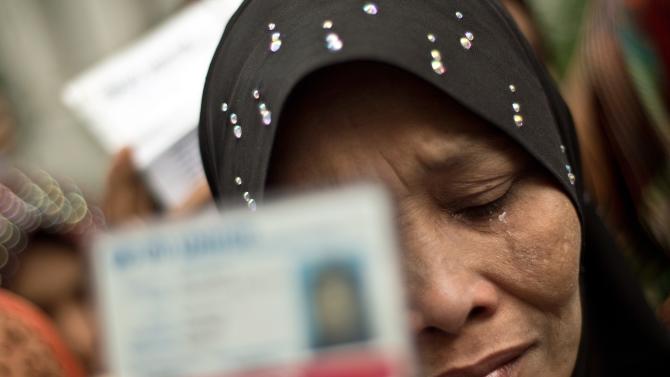
"Not having this little ID card affects the whole community. It allows the violation of basic human rights and takes away people's dignity and mental well-being," Wai Wai said.
On Sept. 15, the world's first forum on statelessness will open at The Hague, focusing on the estimated 10 million stateless people worldwide. Wai Wai hopes it will raise the issue of Rohingya.
"How is it that our fathers were in the government service and able to run in and win elections but that is no longer possible during our time?" she asked.
She blames the negative perception towards the Rohingya—which stereotypes the group as polygamous and criminal—on decades-old propaganda by the military.
The United Nations has said the Rohingya are "virtually friendless" amongst Burma's other ethnic and religious communities. Even human rights activists, including Aung San Suu Kyi, have failed to speak up on the Rohingya's behalf.
"We too sacrificed many things for the same cause—democracy—and we too are working towards a better future for our country," Wai Wai said.
"So it really hurts when human rights advocates say Rohingya shouldn't have rights.
"But then, our history has been erased by the junta so it's not their fault. It's the system's fault," she added.
Thursday, 28 August 2014
Forcibly collected population data in Maungdaw Township
Maungdaw, Arakan sate: Police and army accompanied by immigration forcibly collected so-called population data in Maungdaw Township including south and north, said Hakim from the locality. "On August 25, at Raja Bill village of Aley Than Kyaw village tract of Maungdaw south, the police and army along with immigration— forced the villagers to take part in so-called data collection."
The police officer of Aley Than Kyaw camp sent warrant letters to 38 villagers of Raja Bill village on August 24, for not coming to the camp for giving list in so-called population data collection. So, a group of police went to the village on August 25 to arrest them, showing the warrant letters, said a local elder preferring not to be named.
However, the police arrested five villagers and brought to their camp where they were threatened and forced them to give promise that they will participate in population data collection and also they have to organize other villagers. After that they were released, the elder added.
The police also said, "If the villagers do not take part in the population data collection, they will be jailed six months per each."
As a result, 11 families were participated in population data collection, but other family members fled away from the village to avoid harassment of the police. The police ordered to the rest villagers to come to the police camp within August 30, to take part in so-called population data collection, said a businessman from the locality.
Police forcibly collected population data from the following families:- Sayedur Rahman (70); Mohamed Hassan(55), son of Fazal; Moulvi Mohamed Rashid (40), son of Mogul; Habi Ullah( 40), son of Mahadu; Abdul Alim ( 45), son of Kala Meah; Abdu Salam ( 70), son of Fozu; Ms Zubaira Begum (35), Daughter of Kala Meah; two brothers Ismail (35) and Salamat Ullah (50), son of Fazal Ahmed and Habi Rahman (60), son of Abu Jalil, according to a village leader.
Besides, today ( on August 28), a group of police, army and immigration went to Naya Para ( Wra Thait) village of Powet Chaung village tract of Maungdaw north, and arrest 10 villagers including males and females as refusing to participate in population data collection, said Jasim ( not real name) from the village.
The arrested villagers are identified as— Ms Taslima (17), daughter of Jalal Ahmed; Ms Sanowara (20), daughter of Baila; Ms Monowara (18), daughter of Dila; Ms Yasmin (20), daughter of Serazul Islam; Ms Parmin (18), daughter of Mohamed Shoffi; Ms Yasmin (17), daughter of Mohamed Khasim; Saiful (45); Shomshu Alam (25); Ayub (30), son of Abul Khasim; and Moulvi Mohamed Sayed (70), he more added.
The village Administration officer Kamal Hussain, police agents—Mohamed Shoffi, Mohamed Ali and Islam gave full cooperation to the police to get population data collection. All the arrestees were handcuffed by police and some young girls were beaten up severely for closing doors of their homes, said a local youth preferring not to be named.
The village has 70 families and the police are able to collect census most of the families. They wrote "Bengali" in placed of "Rohingya"in the Form.
The Burmese government will announce that they are successful in collecting census in northern Arakan and the villagers willingly participated in the so-called population data collection, said a politician from Maungdaw who denied to be named.