Thursday, 25 September 2014
Rohingya American Society (RAS) condemns the forced Bengalization attempt of President Thein sein Government to helpless Rohingya
Wednesday, 3 September 2014
Young Rohingya Woman Chases Dream of Peace and Justice in Burma
RANGOON — Wai Wai Nu is a diminutive 27-year-old with pro-democracy activism in her genes and a quarter of her young life spent behind bars.
Activist Wai Wai Nu at her office in Rangoon. (Photo: Thin Lei Win / Thomson Reuters Foundation)
The former political prisoner is now working to end the persecution faced by her people, the stateless Rohingya Muslims in western Burma.
The mistreatment she and her family have suffered is just one example among many of abuse aimed at the Rohingya, a minority of around 1.33 million living mainly in Arakan State. Most are denied citizenship despite having lived in Burma for generations.
Wai Wai is one of Burma's brave, articulate and clear-sighted women working on countering the extremist views that tend to dominate the dialogue over religious intolerance and communal violence.
Whether the discussion is about the Rohingya or women's right to marry men of their choice, firebrand Buddhist monks and nationalists have successfully stoked Buddhist-Muslim tensions.
"Right now, the Buddhists are becoming more afraid of the Muslims and vice versa. Everybody feels insecure," she told Thomson Reuters Foundation in her sparsely-furnished office at the top of a six-story building in Burma's main city, Rangoon.
"There is little contact, trust or relationship between the communities at the moment so it's easy for an agent provocateur to incite riots and hatred."
Wai Wai's ambitions are long-term: peaceful co-existence of different groups in Burma, especially in her home state Arakan, also known as Rakhine, and an end to injustice.
"We would like Rakhine State to be a fair, developed and prosperous state for everyone, regardless of their race or religion," she said.
Her organization, Women Peace Network Arakan, conducts training to promote better understanding between the communities. She is also one of the few advocating for the rights of Rohingya women, who suffer multiple layers of discrimination.
Election to Imprisonment
Wai Wai was 18 and studying law when she was arrested in 2005. Her crime was to be the daughter of Kyaw Min, a Rohingya who was elected as member of Parliament in the 1990 elections, the results of which were ignored by Burma's military rulers.
A former state education official in Buthidaung in northern Arakan State, Kyaw Min was also a member of the Committee Representing the People's Parliament, a group of MP-elects from the 1990 vote led by Nobel peace laureate Aung San Suu Kyi.
The family had moved to Rangoon in the early 1990s after Kyaw Min faced repeated harassment from the authorities.
More than a decade later, the whole family was rounded up—Kyaw Min first, the rest two months later—and charged under state security and immigration laws. Activists say the junta wanted to silence Kyaw Min's championing of labor rights.
"Ever since I was young, I wanted understand law to make sense of the injustices that were occurring in the country," Wai Wai recalled.
"When we were jailed, my mother said, 'Well now is the opportunity to do so in a real, practical way,' so I guess I was lucky," she added, laughing.
The trial was held behind closed doors, without their lawyer, and the judge refused to listen to them, she said. Kyaw Min was sentenced to 47 years, and the rest of the family—the wife, two daughters and a son—got 17 years each.
"We were shocked into silence. My father was already 60."
"I remember turning to the judge and saying, 'Thank you for the sentence. Our grandmother lived a very long life so we will be ok.' I also told my dad not to feel bad," she said.
"I only burst into tears when I got back to my cell," she added, losing her composure for the first time and wiping tears from her eyes.
The Prison Years
Wai Wai spent seven years in Insein Prison, notorious for its harsh regime and squalid conditions.
She found the mental anguish of imprisonment the most difficult thing to deal with, and kept herself busy. One way was to talk to other female prisoners. Most were arrested for prostitution, running small-scale gambling businesses or drugs.
"They were very young. Some were even younger than me," Wai Wai said.
"They had to do these jobs because there is no other choice. Is it their fault they don't have opportunities?"
Hearing their stories turned her into a feminist and made her want to help marginalized women, she said. "I couldn't wallow in self-pity after meeting them. Insein Prison was my university about life."
Still, the privations of prison life left long-lasting scars on the family. Her father's health deteriorated and her sister contracted liver disease that almost killed her.
All the family members were released in January 2012, together with hundreds of other political prisoners, under the new government of President Thein Sein, which took power in 2011 and embarked on a series of political and economic reforms.
Conditions for the Rohingya in Arakan State, however, have only got worse.
Being Stateless
Kyaw Min won the 1990 elections as a Rohingya politician. The term has always been debated but it was not the political lighting rod that it is now, made worse after religious clashes in June and October 2012 left 140,000 people homeless, mostly Rohingya.
The government and ordinary Burmese use the term Bengalis, implying they are illegal immigrants from neighboring Bangladesh.
"The Rohingya used to lead dignified, respectful lives. They were not always stateless. My parents, grandparents and great-grandparents were citizens," Wai Wai said.
A citizenship law enacted in 1982 back-paddled history, took away the Rohingya's citizenship, and imposed restrictions on travel, education and jobs, she said.
"Not having this little ID card affects the whole community. It allows the violation of basic human rights and takes away people's dignity and mental well-being," Wai Wai said.
On Sept. 15, the world's first forum on statelessness will open at The Hague, focusing on the estimated 10 million stateless people worldwide. Wai Wai hopes it will raise the issue of Rohingya.
"How is it that our fathers were in the government service and able to run in and win elections but that is no longer possible during our time?" she asked.
She blames the negative perception towards the Rohingya—which stereotypes the group as polygamous and criminal—on decades-old propaganda by the military.
The United Nations has said the Rohingya are "virtually friendless" amongst Burma's other ethnic and religious communities. Even human rights activists, including Aung San Suu Kyi, have failed to speak up on the Rohingya's behalf.
"We too sacrificed many things for the same cause—democracy—and we too are working towards a better future for our country," Wai Wai said.
"So it really hurts when human rights advocates say Rohingya shouldn't have rights.
"But then, our history has been erased by the junta so it's not their fault. It's the system's fault," she added.
Thursday, 28 August 2014
Forcibly collected population data in Maungdaw Township
Maungdaw, Arakan sate: Police and army accompanied by immigration forcibly collected so-called population data in Maungdaw Township including south and north, said Hakim from the locality. "On August 25, at Raja Bill village of Aley Than Kyaw village tract of Maungdaw south, the police and army along with immigration— forced the villagers to take part in so-called data collection."
The police officer of Aley Than Kyaw camp sent warrant letters to 38 villagers of Raja Bill village on August 24, for not coming to the camp for giving list in so-called population data collection. So, a group of police went to the village on August 25 to arrest them, showing the warrant letters, said a local elder preferring not to be named.
However, the police arrested five villagers and brought to their camp where they were threatened and forced them to give promise that they will participate in population data collection and also they have to organize other villagers. After that they were released, the elder added.
The police also said, "If the villagers do not take part in the population data collection, they will be jailed six months per each."
As a result, 11 families were participated in population data collection, but other family members fled away from the village to avoid harassment of the police. The police ordered to the rest villagers to come to the police camp within August 30, to take part in so-called population data collection, said a businessman from the locality.
Police forcibly collected population data from the following families:- Sayedur Rahman (70); Mohamed Hassan(55), son of Fazal; Moulvi Mohamed Rashid (40), son of Mogul; Habi Ullah( 40), son of Mahadu; Abdul Alim ( 45), son of Kala Meah; Abdu Salam ( 70), son of Fozu; Ms Zubaira Begum (35), Daughter of Kala Meah; two brothers Ismail (35) and Salamat Ullah (50), son of Fazal Ahmed and Habi Rahman (60), son of Abu Jalil, according to a village leader.
Besides, today ( on August 28), a group of police, army and immigration went to Naya Para ( Wra Thait) village of Powet Chaung village tract of Maungdaw north, and arrest 10 villagers including males and females as refusing to participate in population data collection, said Jasim ( not real name) from the village.
The arrested villagers are identified as— Ms Taslima (17), daughter of Jalal Ahmed; Ms Sanowara (20), daughter of Baila; Ms Monowara (18), daughter of Dila; Ms Yasmin (20), daughter of Serazul Islam; Ms Parmin (18), daughter of Mohamed Shoffi; Ms Yasmin (17), daughter of Mohamed Khasim; Saiful (45); Shomshu Alam (25); Ayub (30), son of Abul Khasim; and Moulvi Mohamed Sayed (70), he more added.
The village Administration officer Kamal Hussain, police agents—Mohamed Shoffi, Mohamed Ali and Islam gave full cooperation to the police to get population data collection. All the arrestees were handcuffed by police and some young girls were beaten up severely for closing doors of their homes, said a local youth preferring not to be named.
The village has 70 families and the police are able to collect census most of the families. They wrote "Bengali" in placed of "Rohingya"in the Form.
The Burmese government will announce that they are successful in collecting census in northern Arakan and the villagers willingly participated in the so-called population data collection, said a politician from Maungdaw who denied to be named.
Wednesday, 20 August 2014
Saya Zahangeer stated the full speech of Rakhine state Chief minister
By Theing Hlaing 21 August 2014
Burma Times: Maungdaw, western Myanmar-Saya(teacher) U Zahangeer was invited in Burma Times wechat group on 15th Augsut. The Chairman of the Burma Times Media Mr. Osman moderated the session of holding talks concerning Rakhine state with well-versed Rohingya (teacher) U Zahangeer. He, Saya U Zahangeer stated completely about the meeting in which the Rakhine state chief minister appointed by President Thein Sein,Mg Mg Ohn, pleaded both Rakhine and Rohingya people to obey the current rules of the Union of the Republic of Myanmar.
An exclusive meeting was held by Rakhine state's new chief minister Mg Mg Ohn, two other concerned administrators, Rakhine elders, Rohingya MPs and Rohimgya Elders in Thiri Mingla Hall which is located in the center of the town of Maungdaw on Thursday, 14th August in the evening at around 4: pm.
At the very beginning of the meeting, he said that Majority is ethnic Rakhine Buddhists and Minority is ethnic Rohingya Muslims.
At the beginning of the meeting he introduced himself that I am not a public minister but I am the one who was appointed by the Myanmar president Thein Sein to dutifully carry out the national task in this Rakhine State so I became chief minister in this Rakhine State.
And he said that "I want to express a word that I am doing what was the Myanmar president ordered as well as I hoped that you will try to understand my speeches that what I said and think carefully what I urged and don't forget my speeches that it is not president ordered or announcement".
"We are making our country like international Democratic country. The democracy country can't stay alone and we have communication with all countries of this world, compromise with the international system and we must respect all the criteria of International. In the previous time, our country was in the poorest country declaration because we had done by one nation policy with our people without communicating other countries. So we remain in the lower part of this world. Now we are trying to be pure Democratic country with international system," said Mg Mg Ohn.
In our country, US President Obama had arrived last year to make strong relation with the United Nations. And our president Thein Sein had gone to the United State of America to in improve the bilateral relationship between USA and Burma. So our country is concerned to the world countries and we involved in the law of international Democratic countries. And we must respect international law but the Rakhine Buddhists thought that we don't want to compromise with international community.
Now we are obtaining international pressure from the world country. Pressure is two types—first is fearful and second is fearless. The international pressure is fearful for both Myanmar Government and its citizens. So the Rakhine citizens should understand about the Rakhine state's violence which is really interesting in the international media. This Rakhine state awful event became on this first step in the international eyes.
In the previous days, the international organizations had been driven out by the Rakhine Buddhists. So this kind of awful events occurred in Rakhine state got concerned in international affairs. I think these kinds of self-desires which trigger awful events should be stopped. And it is emphasized that the entire inhabitants of Rakhine state should refrain from involvement of creating tense situation as it is very important for the state. Peace is very important for the real Democratic country.
Another thoughtful fact is about UN organizations whether you like or not these organizations but you have to obey international law and you have no power to ignore the international system. The UN organizations are the most powerful and they are helping everywhere to every victims affected by war,psunami,Strom,natural disasters and so on. They can do everything what they want to bring peace in the ground. This is unacceptable performance of Buddhists Rakhine majority that you triggered violence against between INGOs. The Myanmar Government is facing many kinds of problems on a count of this unwanted immoral behavior of some Buddhists people.
When Rakhine Buddhists raised voices that we love our generations but it is not possible to love entire people of Rakhine State, he, Mg Mg Ohn told he thinks the above Speech of Rakhine Buddhists may bring disadvantages than advantages.
He urged Rakhine people that "avoid what you want to do and think carefully that what we should do".
In current situation, whatever the president or state minister does about these communities, should give precedence to public desire with international law through rules of law.
Nowadays I am hearing hate speeches about me in this Rakhine State. Whatever anyone say about me but I am making our country like full democratic country and I have no enemy in this Rakhine State. The Majority think that it's only concern of Myanmar Government and I think it concerns to all nationalities of Myanmar. If something occurs in the Rakhine State, it will be concerned for all of the people of Myanmar.
The old minister was very good but he didn't control his state so he resigned by his own decision from his seat.
Another interesting matter is there is many map in our particular state. I saw this Rakhine State's map in the wall of the president's Royal Room except all maps. Because president really interests the State of Rakhine!
Particularly, if it is said with example, when you want to develop your Rakhine State, you have to bring back your peace and If you want to improve your Maungdaw you must perform peaceful way. Peace can bring development and development can carry the peace of life. So both Muslims and Buddhists communities are very important to bring peace like before!
Many people had played with the flames and knives last two years but now I will handle it. And if a person tries to do anything to bring violence again I will not accept it at all.
Last Month, when I got an opportunity in the Pyay Thu Lutt Daw( Parliamentary house),my desire has been described that the education of Rakhine State where Many Rohingya have been banned to get normal Education since 2012.
In Maungdaw, Myanamr-Bangladesh border, thousands of Rohingya secondary students couldn't get opportunity to go the capital of Rakhine State for their education, said the State administrator.
Then, since2012-2013, many Rohingya University students and primary school students have been lost their education on account of the violence. In 2014,all Rohingya students have been facing educational crisis like 2012,2013 as well, explained by MP from Maungdaw constituency.
I intended I will show my desire to change this students' life in meeting of second Parliamentary House. In this 2014, many Rohingya students have obtained 3,4,5,6 distinctions in their favorite subjects so I would request on be half of them to get their suitable majors, the state minister said.
After concluded this meeting, at once, participated in another meeting with Rohigya elders including a former Rohingya MP U Kyaw Myint .
In this meeting, U Kyaw Myint asked about the historical evidence of Myanmar Government's citizenship card. He has his grandfather's card where it was prescribed as Rohingya and currently why I have to be accepted that name as Bengali.
"In this Maungdaw, ten percentage of population have checked by the MaKaPa(The branch of Immigration department). Why other 90 percentage ignore this inquiry and reject to the government's order? So I just want to say that all of you to obey and corporate with government. We need to check the population of Rakhine State i.e. how many people are in Rakhine State and what they want to survive in this current situation? So we need to update in the international media" Said the State minister.
Now one of Rohinbya MPs, U Myo Min raised his voice with public's questions saying that you are the father of Rakhine state, our honorable state chief minister, so I would like to express our public voices. Few days ago, I have visited d to the rural area about this populations list known as Alley Than Kyaw and I have met More than 200 Rohingya people in that village.
Why the whole Rohingya ignore to engage in population inquiry and I want to explain some public desire, said MPU Myo Min. '
At first Rohingya people think that Government makes us Bengali because Government is writing in the headlines of those population inquiry sheets like "IMMIGRATED BENGALI" so they dread official making Bengali instead Rohingya ethnicity.
Secondly,iIf we accept the name Bengali we know we will get temporarily white card according to the constitutional law of 1982.And we also know that we will never get the green card of Nationalities.
Thirdly, our religious school, Madrasah, Masjids( Muslim worshipping house) have been closed on a count of violence by the government since 2012 till now. Religious building is great place to make a perfect people. So our people concerned seriously as children are going to be uncivil due to lack of basic education day by day because Religious school or Masjids are closed, according to the statement of our religious elders from rural area.
The state minister replied that education question is pleasant for me because thousands Rohingya University student were banned to attend the state university. So I will go to the capital Naypyidaw in the next date of 18/19 then I will urge President Thein Sein about the education, by the way, you have to obey the rule of Myanmar government.
After displacing 200,000 and driven-out hundred thousands of Rohingyans and Kamans into foreign, what the government trying to set?
Remember this population list is neither Bengali nor Rohingya but we need the population list and you must compromise to succeed every role of government. If you all do this I hope everything will become normal such as religious building, school, Madrasa and we will try to open it all.
We are trying to withdraw the citizen cards in Maypon(a town from Rakhine State).fifty eight persons have been checked by the government among them All peoples can show the Burma evidence but some people can't show the Burma evidence.They will become a citizen who can show the evidence of Myanmar government according to constitutional law of 1982. If you believe me, believe my speeches and if you don't believe me then you ignore my speeches. I hope you all understand me to compromise with the government.
Tuesday, 19 August 2014
Pressed by Myanmar, foreign officials veer away from using name of Muslim minority group
By MATTHEW PENNINGTON
Associated Press
|
| FILE - In this June 25, 2014, file photo, a Rohingya refugee holds her daughter who suffers from a skin disease in their makeshift tent at Dar Paing camp, north of Sittwe, Rakhine state, Myanmar. Myanmar's downtrodden Rohingya Muslims have been denied citizenship, targeted in deadly sectarian violence and corralled into dirty camps without aid. To heap on the indignity, Myanmar's government is pressuring foreign officials not to speak the group's name, and the pressure appears to be working. U.N. officials say they avoid the term in public to avoid stirring tensions between Buddhists and Muslims. U.S. Secretary of State John Kerry voiced serious concern about the situation when he met with Myanmar leaders last weekend. (AP Photo/Gemunu Amarasinghe, File) |
WASHINGTON (AP) -- Myanmar's downtrodden Rohingya Muslims have been denied citizenship, targeted in deadly sectarian violence and corralled into dirty camps without aid. To heap on the indignity, Myanmar's government is pressuring foreign officials not to speak the group's name, and the tactic appears to be working.
U.N. officials say they avoid the term in public to avoid stirring tensions between the country's Buddhists and Muslims. And after Secretary of State John Kerry recently met with Myanmar leaders, a senior State Department official told reporters the U.S. thinks the name issue should be "set aside."
That disappoints Tun Khin, president of the activist group Burmese Rohingya Organisation UK. He said by not using it, governments are co-operating with a policy of repression.
"How will the rights of the Rohingya be protected by people who won't even use the word `Rohingya'?" he said.
Myanmar authorities view the Rohingya (pronounced ROH'-hin-gah) as illegal immigrants from Bangladesh, not one of the 135 officially recognized ethnic groups. Longstanding discrimination against this stateless minority, estimated to number 1.3 million, has intensified as Myanmar has opened up after decades of military rule. More than 140,000 Rohingya have been trapped in crowded camps since extremist mobs from the Buddhist majority began chasing them from their homes two years ago, killing up to 280 people.
Racism against the Rohingya is widespread, and some see in the communal violence the warning signs of genocide.
The United States has called on the government to protect them. When President Barack Obama visited Myanmar less than two years ago, he told students at Yangon University: "There is no excuse for violence against innocent people. And the Rohingya hold themselves - hold within themselves the same dignity as you do, and I do."
Yet neither Kerry this month, nor top human rights envoy Tom Malinowski during a June visit, uttered the term at their news conferences when they talked with concern about the situation in Rakhine state, where sectarian violence is perhaps worst. Buddhist mob attacks against Rohingya and other Muslims have spread from the western state to other parts of the country, sparking fears that nascent democratic reforms in the nation could be undermined by growing religious intolerance.
The State Department official, speaking on condition of anonymity because the official was not authorized to speak publicly, said the U.S. position is that to force either community to accept a name that they consider offensive - including the term "Bengali" that the government uses to describe Rohingya - is to "invite conflict." The department says its policy on using "Rohingya," however, hasn't changed.
Foreign aid workers have been caught up in the tensions. Buddhist hardliners have attacked homes and offices of aid workers it accuses of helping Muslims and not the smaller number of Buddhists also displaced by the violence. Doctors Without Borders was expelled by the government in February and is still waiting to be allowed back.
The humanitarian situation has worsened. The U.N. said the number of severe malnutrition cases more than doubled between March and June, and the world body's top human rights envoy for Myanmar, Yanghee Lee, last month called the situation "deplorable."
She said she'd been repeatedly told by the government not to use the name "Rohingya," although she noted under international law that minorities have to the right to self-identify on the basis of their national, ethnic, religious and linguistic characteristics.
Myanmar Information Minister Ye Htut said in an email to The Associated Press that the name had never been accepted by Myanmar citizens. He said it was created by a separatist movement in the 1950s and then used by exile activists to pressure Myanmar's former military government at the United Nations in the 1990s.
While there is a reference to "Rohingya" by a British writer published in 1799, use of the term by the Muslim community in Rakhine to identify themselves is fairly recent, according to Jacques Leider, an expert on the region's history.
Rohingya leaders claim their people are descendants of Muslims who settled in Rakhine before British colonial rule, which began after a war in 1823. The British occupation opened the doors to much more migration of Muslims from Bengal. Current Myanmar law denies full citizenship to those whose descendants arrived after 1823.
The name debate is reminiscent of whether to call the country by its old name, Burma, or Myanmar - the title adopted by the then-ruling military junta in 1989. Washington still officially uses "Burma," although U.S. officials also refer to "Myanmar" - a sign of the improved ties with the former pariah state.
But in this contest over semantics, the stakes are higher.
Rohingya were excluded from a U.N.-supported national census this spring if they identified themselves as Rohingya. They face stiff restrictions on travel, jobs, education and how many children they can have. They are also unwelcome in Bangladesh, where they have fled during crackdowns inside Myanmar since the 1970s.
Either because of government prodding or a desire to avoid confrontation, staff of foreign embassies and aid agencies in Myanmar rarely say "Rohingya" in public these days, and may simply say "Muslims." In June, the U.N. children's agency even apologized for using the term "Rohingya" at a presentation in Rakhine, an incident which drew criticism from rights activists.
"Any humanitarian agency or donor who refuses to use the term is not just betraying fundamental tenants of human rights law, but displaying cowardice that has no place in any modern humanitarian project," said David Mathieson, senior researcher on Myanmar for Human Rights Watch.
---
Associated Press writer Robin McDowell in Yangon, Myanmar, contributed to this report. |
Wednesday, 13 August 2014
Standing up for religious liberty in Burma
The Burmese government is going where it ought not in matters of faith and conscience.
In December of 2013, something remarkable happened. More than 30,000 people — including many Baptist leaders from around the world — gathered in Burma to celebrate the life and legacy of a man and woman they'd never met.
Two hundred years earlier, Ann and Adoniram Judson arrived in Burma to share the Good News of Jesus Christ and to make disciples. Equally, if not more, remarkable than this celebration is the fact that beginning in 2006, as refugees from Burma1 began arriving in the United States, many sought Baptist churches in which to continue the practice of their faith. The mission that began with the efforts of the Judsons had returned full circle to the land of its origins.
As we celebrate this legacy and the deep bond between American Baptists and the people of Burma, we also lament the current state of affairs in that country including abuses targeting ethnic minority Christians and Muslims and a proposed "Religious Conversion Law" currently being considered by Burma's parliament.
In its 2014 report, the United States Commission on International Religious Freedom noted that "political reforms in Burma have not improved legal protections for religious freedom and have done little to curtail anti-Muslim violence, incitement and discrimination, particularly targeting the Rohingya Muslim minority." The report went on to indicate that "state-sponsored discrimination and state-condoned violence against Rohingya and Kaman ethnic Muslim minorities also continued, and ethnic minority Christians faced serious abuses during recent military incursions in Kachin state."
When an American Baptist delegation traveled to Burma in December 2013 for the 200th anniversary Judson celebration, the delegation heard firsthand testimony from the Kachin about the ongoing atrocities against them by the military. Based on these violations of basic human rights and freedoms, USCIRF continues in 2014 to recommend that Burma be designated as a "country of particular concern," a designation the State Department has maintained with respect to Burma since 1999.2
Meanwhile, Burma's parliament is considering legislation that would create a governmental registration board to approve all religious conversions. While stating that "everyone has the freedom to convert from one religion to another," the law would require that an individual seeking to do so supply a registration board with an extensive list of personal information and answers to intrusive questions. The legislation includes penalties of up to two years in jail for those applying to convert "with intent to insult, disrespect, destroy or to abuse a religion," though it remains unclear how such intent would be proved.3
Responding to these developments, the Board of General Ministries of the American Baptist Churches, USA, at its June 2014 meeting took action to support legislation currently being considered in Congress (S. 1885 and H.R. 4377) that would require advances in human rights and religious liberty by the government of Burma as a condition of security assistance. In addition, the board has expressed its strong concern to the governments of Burma and the United States over restrictions of religious liberty in the proposed religious conversion law.
As Baptists, we stand in a long line of those who have sought to defend and extend religious liberty. As early as 1611, we held, "The magistrate is not by virtue of his office to meddle with religion, or matters of conscience, to force or compel anyone to this or that form of religion or doctrine, but to leave the Christian religion free to everyone's conscience, and handle only civil transgressions, for Christ only is the King and lawgiver of the church and conscience."4
The government of Burma is clearly meddling with religion, not only with respect to ethnic minority Christians, but also with respect to other ethnic minorities, including Rohingya and Kaman ethnic Muslims. The government is going where it ought not in matters of faith and conscience.
As the mission of the Judsons has returned full circle to the land of its origins, let our concern for religious liberty return to the people of Burma. With thanksgiving for the freedom we enjoy, let us exercise it on behalf of all those in Burma who now suffer and struggle to practice their faith freely.
Notes:
(1) According to a fact sheet from the Department of State, the military government in Burma changed the country's name to "Myanmar" in 1989, but "[i]t remains U.S. policy to refer to the country as Burma in most contexts."
(2) USCIRF Annual Report, 2014 (p. 43)
(3) USCIRF Deeply Concerned by Draft "Religious Conversion Law," June 11, 2014.
(4) The Amsterdam Confession of 1611 as cited in the American Baptist Policy Statement on Church and State.
OPINION: Views expressed in ABPnews/Herald columns and commentaries are solely those of the authors.

Curtis Ramsey-Lucas
Curtis Ramsey-Lucas is managing director of resource development for the American Baptist Home Mission Societies. He currently is chair of the board of directors of the Baptist Joint Committee for Religious Liberty.
Saturday, 9 August 2014
Fortify Rights: Charges Against Rohingya Activist “Unfounded”
A Human rights organization has called for the release of a Rohingya activist and politician, Kyaw Hla Aung, 74, who has been detained by authorities for 13 months.
Fortify Rights, based in South East Asia, urged Burma's government to "immediately and unconditionally" release Kyaw Hla Aung and criticized the detention because the prosecution had "repeatedly failed to produce witnesses' in the case.
Kyaw Hla Aung was arrested in July for allegedly organizing illegal protests and instigating violence against the police. Fortify Rights said the charges were "unfounded." The protests, mostly made up of Rohingya Muslims, were sparked by government attempt to registerthe Rohingya population as 'Bengali' in a citizenshipsurvey.
If found guilty, the charges put against Kyaw Hla Aung could lead to a maximum penalty of 20 years imprisonment.
The Fortify Rights statement came as Sittwe's District Court, in Rakhine State, again extended Kyaw Hla Aung's detention, denying him bail and setting the next court hearing to August 18.
Matthew Smith, executive director of Fortify Rights, claimed the case was a sham. "Rakhine State authorities have kept Kyaw Hla Aung locked up for over a year, demonstrating the urgent need for the central government to intervene to free him. The case against him is completely without merit. His ongoing detention violates his basic human rights and is an affront to the rule of law."
The Rohingya, an ethnic minority of around one million people, have faced mounting persecution in Burma from Buddhist extremists following deadly unrest in Rakhine State in June 2012 and are not recognized as citizens under the country's 1982 citizenship law, leaving 800,000 stateless. The United Nations High Commission on Refugees (UNHCR) estimates that as many as 140,000 Rohingya are now internally displaced, with many forced to live in run-down camps that lack basic services. In February this year, Buddhist mobs attacked international aid group's offices, including the UN office, forcing them out of Rakhine State until July when the government, under international pressure, guaranteed the safety of aid workers if they returned.
Matthew Smith said that Kyaw Hla Aung was targeted because he was an outspoken campaigner for Rohingya rights. "The arrest and detention of Kyaw Hla Aung is part of a broader campaign of persecution being perpetrated against the Rohingya ethnic minority in Myanmar. The international community must address the flagrant disregard for the rights of the Rohingya population."
A report by Fortify Rights released in February found the government at fault for serious human rights violations against Rohingya, including arbitrary arrests and torture. A 2013 report by Human Rights Watch said that Burma authorities and 'Arakanese groups' had committed "crimes against humanity" and were pursuing "ethnic cleansing" against Rohingya.
"The case against Kyaw Hla Aung is only one example of the multitude of abuses against the Rohingya population," Mr Smith added, "The human rights situation in Rakhine State is appalling and it's the direct result of policies implemented by the state and central governments."
Friday, 8 August 2014
BROUK's press statement: One Rohingya killed and two injured ahead of John Kerry’s visit to Burma
Just days before US Secretary of State John Kerry is due to visit Burma, more than 100 security forces came to the Rohingya IDPs camp in Thandawlee village in Sittwe, capital of Arakan State, and killed one Rohingya and seriously injured two others. More than 15 Rohingyas were arrested by security forces. At the same time, Rohingyas in Buthidaung and Maungdaw, in northern Arakan, have been arrested, threatened and harassed while the government attempts to collect population data.
"If the US government wants to see clear progress on the Rohingya issue in Burma, John Kerry should be setting timelines and benchmarks for progress, including to restore Rohingya citizenship and for the lifting of restrictions on aid, movement, marriage and education in Arakan," said BROUK's President Tun Khin.
Since June 2012, violence against the Rohingya has continued and the situation continues to deteriorate. In March, hundreds of aid workers were evacuated after facing attacks. More than 150 Rohingyas and 20 pregnant women died in the two weeks after Doctors Without Borders (MSF) were expelled from Arakan in March. Many children have died because of malnutrition. Although MSF have now been allowed back into Arakan, there are still serious restrictions on aid and movement for the thousands of Rohingya IDPs.
"The United Nations Special Rapporteur on human rights in Burma has stated that the widespread and systematic human rights violations in Arakan State 'may constitute crimes against humanity'. The US government should be supporting an international investigation into human rights abuses in Arakan State" said Tun Khin, President of BROUK.
BROUK urges US Secretary of State John Kerry;
.
- To support an independent international investigation into human rights abuses in Arakan.
- To put pressure on President Thein Sein (i) to stop immediately the violence and crimes against the Rohingya and to protect the lives of Rohingya (ii)to allow humanitarian NGOs full and free access to the Rohingya in all parts of Arakan; (iii) to repeal or amend the 1982 Citizenship Law in order that it conforms with international standards; (iv) to stop the segregation of communities in Arakan and replace it with a proactive policy of 'peaceful co-existence'.
For more information, please contact Tun Khin +44 7888 714 866.
Tuesday, 5 August 2014
Human rights group deplores Myanmar court extension of Rohingya activist Kyaw Hla Aung detention
A court in Myanmar's Rakhine state has extended the detention of a prominent Rohingya human rights activist.
Kyaw Hla Aung was arrested last year by Myanmar police who accused him of instigating protests against government efforts to register Rohingyas as 'Bengali', and not Myanmar citizens.
Human rights organisation Fortify Rights says the case against Kyaw Hla Aung is totally without merit.
Executive director Matthew Smith has told Radio Australia's Asia Pacific the 74-year-old activist's public profile has made him a police target.
"He's been meeting with ambassadors and other people who had visited Rakhine state who were very concerned about the human rights situation there and this, and some of his other activities, exposed him to the Myanmar authorities in a way that we think led to his arrest and detention," Mr Smith said.
"There are some Rohingya who do have connections to the outside world, to areas outside of Rakhine state and internationally, and there are some who have the ability to communicate the plight of Rohingya.
"Kyaw Hla Aung is one of those people.
"He hasn't done anything wrong, hasn't violated any laws, but he's being persecuted because he's a human rights defender.
"We're trying to urge the central government now to intervene because much of the problems with this particular case stem from the local authorities."
How effective that lobbying will be remains to be seen.
Matthew Smith says the Myanmar government routinely denies the very existence of the Rohingya ethnicity, and severe human rights abuses occur daily against the Muslim population, in spite of international condemnation.
But he says Kyaw Hla Aung has been in detention for more than a year and there are concerns for his health and well-being.
"He has suffered from ill-health in the past," he said.
"Rakhine state is a very difficult place to be if you suffer from health problems, and being in prison in Rakhine state is even more difficult.
"This should be reason alone to do something about his incarceration right now."
Fortify Rights says since violence started in 2012, authorities have arrested more than one thousand Rohingya men and boys, and an unknown number remain behind bars.
Matthew Smith says the international community needs to get serious about the severe human rights violations that are persisting in Rakhine state.
"What we're trying to do now is to press upon various actors in the international community to pressure not only Naypidaw, but also the local authorities in Rakhine state, to respect and protect the human rights of the Rohingya community."
Topics:human, prisons-and-punishment, burma, asia
Wednesday, 30 July 2014
Statement of the Special Rapporteur on the Situation of Human Rights in Myanmar Yangon International Airport, Myanmar, 26 July 2014
Introduction:
Good evening and thank you all for coming today. I have just concluded my first official ten- day mission as Special Rapporteur on the situation of human rights in Myanmar. The objective of my visit was to assess the human rights situation in Myanmar through a better understanding of the realities on the ground. Accordingly, I sought to engage constructively with a broad spectrum of stakeholders, including Government officials, political, religious and community leaders, civil society representatives, as well as victims of human rights violations and members of the international community. I was pleased to have had a frank and open exchange of views on a range of matters related to my mandate. And I am grateful that many were so forthcoming in their views on sensitive issues.
Today, I would wish to highlight some preliminary observations from my mission and from additional background research. These issues, along with others, will be elaborated in more detail in the report I will present to the 69th session of the General Assembly later this year.
I would like to warmly thank the Government of Myanmar for its excellent cooperation and flexibility throughout my visit. I would particularly like to note with appreciation the efforts made to ensure my safety and that of my team, including in challenging circumstances. I would also like to thank the United Nations Country Team for giving their full support to this mission and for their invaluable assistance and advice in organizing my programme of meetings.
In Nay Pyi Taw, I met with the Deputy Minister of Foreign Affairs and the Director –General of the ASEAN Affairs Department in the Ministry of Foreign Affairs, the Attorney General, the Chief Justice and members of the Supreme Court, the Chair and members of the Constitutional Tribunal, the Minister of Defence, the Minister of Border Affairs, the Minister of Information, the Minister of Social Welfare, Relief and Resettlement, the Minister of Labour, Employment and Social Security, the Minister of Immigration and Population, the Deputy Minister of Education, the Minister of Health and the Minister of Home Affairs. I also met with Ministers U Soe Thein and U Aung Min in the President's Office, and the Legal, Political and Economic Advisers to the President. Additionally, I met with the Union Election Commission. I was grateful that many provided detailed information highlighting the sequence of events and the context in which certain policy decisions were made or actions were undertaken.
Also in Nay Pyi Taw, I met with the members of various parliamentary committees of the Amyotha and Pyithu Hluttaws and with the Parliamentary Constitutional Amendment Implementation Committee.
I also had a meeting with Daw Aung San Suu Kyi.
In Yangon, I met with members of the Interfaith Friendship Group of Myanmar and the Interfaith Dialogue Group, the Myanmar National Human Rights Commission, as well as with civil society actors working on a wide range of human rights issues, media professionals, lawyers and lawyers groups, members of the 88 Generation Student Group and released prisoners of conscience. I visited Insein Prison and met with six prisoners of conscience: Dr. Tun Aung, U Saw Gay They Mu, U Chit Ko, U Saw War Lay, U Htin Kyaw and U Nay Linn Dwe. I also held meetings with the United Nations Country Team, the Humanitarian Country Team and the diplomatic community.
During my mission, I also visited Rakhine State, Kachin State and Mandalay Division. I will elaborate on those visits shortly.
Preliminary observations:
Myanmar is undergoing an important transition and the sweeping and far-reaching reforms that we have seen in recent years have dramatically transformed the political, economic, social and human rights landscape. This was affirmed in my meetings with various Government officials in Nay Pyi Taw. In three years, Myanmar has come a long way since the establishment of the new Government. This must be recognized and applauded.
Yet, there are worrying signs of possible backtracking which if unchecked could undermine Myanmar's efforts to become a responsible member of the international community that respects and protects human rights. As many have said, Myanmar therefore needs further encouragement and understanding in order to address these challenges and to continue on the path of reform. And I hope that my observations and recommendations will be taken in this light.
Shrinking of democratic space:
The opening up of democratic space for people to exercise their rights to freedom of opinion and expression and to freedom of assembly and association is widely acknowledged as one significant achievement in Myanmar's continuing reform process. Yet, in recent months many of my interlocutors have seen the shrinking of that space for civil society and the media.
During my mission, I was informed of the use of the judicial system and the application of outdated legislation, such as the 1923 State Secrets Act or the 1950 Emergency Provisions Act, as well as other legislation such as the Peaceful Assembly and Peaceful Procession Act (now amended) to criminalize and impede the activities of civil society and the media. I learned of the continuing arrests and prosecution of people exercising their rights to peaceful assembly and association, particularly under Section 18 of the amended Peaceful Assembly and Peaceful Procession Act. A disturbing example is the recent conviction of Chin activists who protested against the alleged rape of a woman by a military soldier in Chin State.
Civil society actors also face intimidation, threats and attacks and I was concerned by the alleged threats received by various activists who had publicly voiced opposition to a proposed package of draft bills related to religion, including a proposed interfaith marriage bill and a religious conversion bill.
Civil society actors campaigning on land and environmental issues, or trying to help communities affected by large-scale development projects, face particular challenges. They are routinely harassed and subject to arrest (including for violating the Peaceful Assembly and Peaceful Procession Act). There are also continuing reports of the excessive use of force by the police and the authorities in breaking up protests. During my mission, I met with one activist who had been arrested multiple times and was under trial in multiple township courts for protesting against land grabbing and forced evictions. He informed me that he would continue to protest, regardless of the personal consequences, so as to raise awareness amongst local communities and to ensure that the authorities "listened to what we have to say".
These patterns not only undermine the work of civil society, but also impose a climate of fear and intimidation to society at large. The Government should create a safe and enabling environment for civil society, given their central role in democratisation, national reconciliation, development and the promotion and protection of human rights. Thus, any administrative and legislative provisions that impede their legitimate and peaceful activities should be reviewed and abolished. Further, specific protections measures should be put in place to allow civil society actors to carry out their work safely and without fear of reprisals. Complaints of violations should be investigated and properly brought to justice.
With respect to the media, I arrived in Myanmar shortly after the sentencing of four journalists and an editor of Unity Journal to ten years' imprisonment with hard labour under the 1923 State Secrets Act, and charges were brought under Section 18 of the Peaceful Assembly and Peaceful Procession Act against 50 journalists who had staged a silent protest against the verdict. I also received information of other arrests of journalists who had reported on issues deemed too sensitive or critical of those in power, such as Government corruption. Additionally, I was told of the threats and intimidation faced by journalists, including most recently in trying to report on the recent violent incidents in Mandalay. Many spoke to me of a climate of uncertainty, intimidation and fear of arrest resulting in a form of self-censorship of the media.
The enjoyment of the rights to freedom of expression and freedom of association and peaceful assembly are essential ingredients for Myanmar's democracy and for debating and resolving political issues, particularly in the run-up to the 2015 elections. Electoral periods
are important moments in the life of a nation with the potential to consolidate and strengthen democratic principles and practices. The mere fact that elections are held is not an adequate indicator of democracy. The process leading up to the election is a crucial component of a democratic society. Thus, there should be strict and clear safeguards to prevent undue interference in public freedoms, in particular the rights to freedom of opinion and expression and the freedom of peaceful assembly and association. In effect, genuine elections cannot be achieved if these rights are curtailed.
Prisoners of conscience:
I commend the 15 prisoner amnesties granted since the establishment of Myanmar's new Government. And I note that the most recent presidential pardon of 30 December 2013 (which released more than 41 prisoners) included those convicted under various laws, such as the Peaceful Assembly and Peaceful Procession Act, the Unlawful Associations Act, sections 122, 124 (a) and 505 of the Penal Code, and the Emergency Provisions Act of 1950.
However, I believe that there are several remaining prisoners of conscience who did not benefit from these amnesties or who were recently arrested (as I described earlier). The information I received from civil society sources as well as my interviews with several prisoners in Insein Prison, Sittwe Prison, Bhamo Prison and Myitkina Prison confirmed that this issue has not been resolved. I raised these cases in my meetings in Nay Pyi Taw and called for their review and release as a matter of priority.
In this respect, I was pleased to hear that the prisoner review committee would continue to function and would likely hold regular monthly meetings. I encourage the Government to continue working with this important body in order to release all remaining prisoners of conscience and to fulfil President Thein Sein's pledge. And I also reiterate my predecessor's call for this body to be formally established as a standing institution with a mandate to review continuing detentions that may be politically motivated and to consider questions related to the rehabilitation of released prisoners.
Development and economic, social and cultural rights:
I was encouraged by the priority attention given to education and health and the efforts made to improve Myanmar's education and health systems as a whole. I was also encouraged to hear of significant increases in public spending on these sectors though note that this is still a very small portion of the total national budget.
My meetings with both Government and civil society actors confirmed my predecessor's view that land rights issues, in particular land grabbing and confiscations, as well as forced evictions are and will remain one of the major challenges facing Myanmar. And I note that the majority of complaints received by the Myanmar National Human Rights Commission related to land rights and that various parliamentary commissions have been established to address this issue.
These are complex issues requiring reforms to the legislative and institutional framework governing land use and management, the management and sharing of resources, as well as land tenure. A change in the response to public protests on land issues and the handling of complaints received by various institutions and bodies is also needed. While I will elaborate upon these issues in my report to the General Assembly, I will state generally that priority attention should be given to these issues in accordance with human rights principles and standards. This requires that the principles of equality and non-discrimination, participation, protection, transparency and accountability, including access to appropriate remedy, are fully taken into account.
I was also struck by the information I received regarding the impact of large-scale development projects, particularly on vulnerable groups, such as the rural poor, displaced persons and returning asylum-seekers, ethnic communities and women. In this regard, I believe that it is essential to ensure that environmental and social impact assessments are undertaken and recommendations implemented consistently, that relevant information about development projects be made widely available and accessible, and that concerned communities are able to participate actively, freely and meaningfully in the assessment and analysis, design and planning, implementation, monitoring and evaluation of such projects.
The coming years present an opportunity for the Government to proactively manage development and investment processes so as to ensure a rights-based and people-centred form of sustainable development, inclusive growth, poverty reduction and equitable resource-sharing. I believe that Myanmar has started to embark on this path but further reforms to the relevant legislative, institutional and administrative frameworks, as well as a change in mindset and behaviour, is required.
Legislative reform and the rule of law
A recurring and cross-cutting concern mentioned in many of my discussions on a broad range of issues is the need to strengthen the rule of law in Myanmar. This is the foundation for any functioning democracy and underpins the entire process of reform. Thus, it should continue to be given priority attention by the Government.
Central to this is the continuing review and reform of legislation, particularly outdated laws that do not reflect current realities and those deemed to be inconsistent with international human rights standards, as well as the adoption of new laws. While I was encouraged by the scope and pace of the legislative reform process, I heard many concerns regarding the lack of consultation on draft laws, with some laws drafted in secret, published at a late stage with little time for comments to be provided or with unclear or no information on where comments should be submitted. In raising these issues consistently during my mission, I came away with the impression that greater coordination, priority-setting, transparency, consistency and clarity in the process by which laws are reviewed, consulted and drafted is vitally needed. Clear timelines should be given to enable broad consultation and proper consideration of draft laws, including by civil society and international organizations. Consultation should be meaningful and not merely superficial, with comments properly taken into account and concerns addressed. Additionally, more efforts should be made to raise awareness of new laws amongst the general public, beyond their publication in newspapers and journals.
Further, while legislative reform is an organic process, shaped and defined by changing realities, it should ultimately consolidate and further democratic transition and respect for human rights. I am therefore concerned by the legislative package on the protection of race and religion, which includes four draft bills on interfaith marriage, religious conversion polygamy and population control. I have spoken out publicly on this issue and have raised concerns that these bills are incompatible with international human rights standards, in particular the Convention on the Elimination of All Forms of Discrimination against Women (CEDAW) and the Convention on the Rights of the Child, to which Myanmar is party. I add my voice to those who have called for the package to be withdrawn.
Women's rights and gender equality
During my visit, I had the opportunity to meet and discuss with civil society organizations and activists working on women's rights issues in Myanmar. Yet, it seemed to me that women's voices and women's roles are seemingly lacking on the public radar: women are severely underrepresented in Government and Parliament, as well as in the formal peace process, and there does not seem to be much public awareness and understanding of the important roles women could and should play in the reforms process – as both agents and beneficiaries of change. As party to CEDAW, I believe that Myanmar should do more to promote women's participation in all areas of public and political life.
Rakhine State
During my mission, I had the opportunity to visit Sittwe and Maungdaw and I wish to thank the State Government for its cooperation and logistical facilitation. In Sittwe, I met with the Chief Minister and members of the State Government, members of the Rakhine State Emergency Coordination Centre, representatives of the Rakhine Buddhist community and representatives of international non-governmental organizations (INGOs) and United Nations agencies. I also visited Shwe Say Ti Monastery. In and around Sittwe, I visited Set Yone Su and Baw Du Par Internally Displaced Persons (IDP) camps, Ohn Yay Paw Village and Aung Mingala. I also visited Sittwe Prison and met with U Kyaw Hla Aung, U Than Shwe, U Kyaw Myint and three Muslim male prisoners. In Maungdaw, I met with four Muslim women who were being held under charges of arson in the Maungdaw police station detention centre.
I listened carefully to the views expressed by both communities in order to better understand their different perspectives and grievances. I recognize that Rakhine State is one of the poorest in Myanmar and for many years, has suffered from neglect and underdevelopment. I visited Ohn Yay Paw Village and saw a glimpse of how some in the Rakhine Buddhist community lived – with no toilets, no electricity and with a minimum of basic services. I was pleased to hear that the United Nations was cooperating with the Rakhine State Government to provide development assistance and I would encourage similar support and cooperation in other areas of Rakhine State.
In visiting the IDPs in and around Sittwe during the rainy season, I gained first-hand impressions of the difficult conditions in which men, women and children of both communities live. The situation is deplorable. Many have remained in the camps for two years and I do not believe that there is adequate access to basic services. In Set Yone Su (Rakhine Buddhist) camp, I was told that while children attended primary school in the camp, older children had to make their own travel arrangements to attend the middle school some distance away from the camp. A number of the IDPs also highlighted the lack of access to livelihoods, with women selling craft work and men performing day labour in order to earn an income.
Yet, it is undeniable that the situation is worse in the Baw Du Par camp I visited, given the sheer number of IDPs in the camp – around 10,000, the comparatively fewer latrines per person than in the Set Yone Su camp (around 40 persons to one latrine by my count), and the lack of a health clinic or adequate access to health services (particularly given the departure of certain INGOs providing crucial health services). Restrictions on the freedom of movement have a severe impact on basic rights, including access to livelihoods, food, water and sanitation, health services and education. One young woman told me that she had passed her matriculation exams and wished to go to university. Yet, she could not physically leave the camp in order to pick up the university application forms. In Aung Mingala, the only Muslim quarter in Sittwe, I was also told that the residents were only allowed to leave the camp twice a week to go to the market. Students were prohibited from attending Sittwe University and were told that they could only pursue distance learning if they wished. Many merchants wished to return to their shops in order to reopen their businesses.
The health situation in the Muslim IDP camps is of particular concern. With the departure of INGOs providing critical health services and the operation of humanitarian organizations not yet at full capacity after the attacks in Sittwe in March, health provision still falls far short of needs. While the local health authorities have deployed additional medical professionals and provided mobile clinics, I have received disturbing reports of people dying in camps due to the lack of access to emergency medical assistance and due to preventable, chronic or pregnancy-related conditions. There are frequent daily reports of illnesses, yet there is now limited access and limited capacity by INGOs and the United Nations to provide the necessary services, undertake the necessary monitoring of the situation, and collect the necessary data.
The operational environment for INGOs and the United Nations remains difficult with continuing reports of threats, intimidation and attacks against staff. At the same time, representatives of the Rakhine Buddhist community spoke often of the perceived bias and discrimination in the assistance provided over decades and currently.
In listening to all views from both communities, I am concerned about the prevalence of inaccurate rumours and false information about the conditions of camps, the quality of assistance provided and the perceived intentions and behaviours of members of different communities, which subsequently become accepted as reality. More must be done to stop misinformation which only serves to heighten tensions and hostility and to increase the sense of discriminatory treatment. The conditions of both camps and the situation of both communities must be accurately reflected and seen for what they are.
I understand the sense of grievance and perceived discrimination by the Rakhine Buddhist community. And I do believe that their concerns should be taken into account when trying to address the underlying causes of the intercommunal violence. We need to call a spade a spade.
By virtue of their legal status (or lack of), the Muslim community has faced and continue to face systematic discrimination, which include restrictions in the freedom of movement, restrictions in access to land, food, water, education and health care, and restrictions on marriages and birth registration. Since the 1993 report of the first Special Rapporteur on the situation of human rights in Myanmar, the various forms of human rights violations faced by the Muslim community has been regularly documented by successive Special Rapporteurs. These include enforced disappearances, torture, forced labour and forced displacements, as well as rape and other forms of sexual violence.
In addition, I have received continuing allegations of violations against the Muslim community, including arbitrary arrests, torture and ill-treatment in detention, death in detention, the denial of due process and fair trial rights and rape and sexual violence. I believe these allegations are serious and merit investigation, with perpetrators held to account.
I also was provided information about the status of the three INGO national staff who were arrested in connection with the 2012 violence and who remain in detention. I believe that they have been denied fair trial and due process rights and were arrested under spurious charges. I call for their immediate release.
In my discussions on possible solutions with the Rakhine State Government, I was provided a brief overview of the Rakhine State Action Plan but was not able to actually study the Plan myself. I noted with concern, however, that the Government's plan for long-term peaceful coexistence may likely result in a permanent segregation of the two communities. As an immediate priority, more must be done to reduce tensions and hostility, and promote reconciliation between the two communities.
Issues around terminology and citizenship are particularly sensitive. I was repeatedly told not to use the term 'Rohingya' as this was not recognized by the Government. Yet, as a human rights independent expert, I am guided by international human rights law. In this regard, the rights of minorities to self-identify on the basis of their national, ethnic, religious and linguistic characteristics is related to the obligations of States to ensure non-discrimination against individuals and groups, which is a central principle of international human rights law. I also note that various human rights treaty bodies and intergovernmental bodies, including the Committee on the Rights of the Child, which I chaired for four years and of which I was a member for ten years, the Human Rights Council and the General Assembly use the term 'Rohingya'.
In my discussions on the question of citizenship for the Muslim community, I was repeatedly told that the rule of law should be respected; in this regard, strong opposition was voiced by many against the review and reform of the 1982 Citizenship Law. Yet, laws by nature are forever evolving. As the reforms process in Myanmar has demonstrated, they can be and should be amended whenever there are deficiencies and are not in line with international standards. The 1982 Citizenship Law should therefore not be an exception.
Kachin State
I also visited Kachin State – Myitkyina and Bhamo – and I wish to thank the State Government for its cooperation and logistical facilitation. In Myitkina, I met with the Chief minister and members of the State Government, as well as representatives of civil society organizations. I also visited Waimaw IDP camp and Myitkina prison where I met with U Brang Yung. In Bhamo, I met with the District Administrator and members of the District Administration. I also met with Kachin and Shan civil society organizations and with organizations working on women's issues. Additionally, I visited the AD 2000, Robert Church and Shwe Kyi Nar IDP camps. I also visited Bhamo Prison where I met with U Mali Tan.
It has been three years since the resumption of conflict in Kachin and Northern Shan States and many IDPs have lived for years in camps that were only meant to be temporary. Many of the IDPs I spoke with highlighted the fervent desire for peace so that they could simply return to their homes. Yet, there was a general fear for their safety and security upon return, as well as uncertainty over what they would return to – with homes and farmland possibly destroyed or riddled with mines. Some noted the lack of access to livelihoods; in one camp, the majority of the IDPs were entirely dependent on amber polishing and the production of amber jewellery as the only means of income. The youth do not have any options for employment or livelihoods and many are turning to drugs.
While there has been progress in the peace negotiations, with another round of talks resuming this weekend in Laiza, almost all with whom I spoke were unaware of developments and had neither been informed nor consulted. Greater efforts must be made, therefore, to inform, involve and consult displaced populations or local communities. Greater efforts must also be made to inform and consult IDPs about the possibility of return. Any initiative to return IDPs to their places of origin has to be done with the free, prior and informed consent of those concerned, and also involve consultation with humanitarian actors including the United Nations.
Despite assurances by the Chief Minister of improved international humanitarian access to non-government controlled areas (where roughly half of the 100,000 displaced by the conflict are living in camps or with host families), in reality, access remains limited and there are concerns regarding the access of people in these areas to adequate food, water and sanitation, health care and education. The humanitarian situation thus has clear human rights dimensions – with consequent impact on basic rights. It is imperative therefore that the United Nations and international humanitarian actors be provided with more regular and systematic access to areas outside government control.
During my visit, I received information about human rights violations committed by both the Kachin Independence Army and the Tatmadaw, including attacks against civilian populations, sexual violence, the recruitment of child soldiers, as well as forced labour. These allegations are serious and must be addressed as a matter of priority, with perpetrators taken to account. All parties to the conflict must do more to ensure respect for international human rights and humanitarian law.
Also during my visit, I met with two prisoners who had been convicted under the Explosive Substances Act and the Unlawful Associations Act (for alleged ties to the Kachin Independence Army). Both allege that they had been interrogated continuously for several days and subjected to torture and ill-treatment. One individual noted that he had been forced to commit homosexual acts with another male prisoner. Both also allege that photographic evidence showing them handling explosives had been fabricated. These cases are similar to information I have received from civil society sources regarding the arbitrary arrest and torture during interrogation by the military of Kachin men accused of belonging to the Kachin Independence Army. When raising these issues in Nay Pyi Taw, I was told unequivocally that the Ministry of Defence was not aware of any such cases and that it did not have any information on the use of torture or ill-treatment during interrogation. I must state, however, that the disturbingly similar pattern of abuse in the cases I have received merits investigation by the Government. The allegations are serious and should be taken up accordingly.
Mandalay
In Mandalay, I visited the sites where the murders of two men were committed and where incidents of violence took place. I met with the Chief Minister and members of his cabinet, the police chief and the Division Administrator. I also met with members of a non-governmental Peacemaking Committee. I was given detailed information on the actions taken by the Government to quell the violence, including outreach to religious leaders, and on the numbers of people arrested in connection with the murders and with the destruction of parts of a Muslim cemetery. In contrast, the information I received from civil society actors alleged state inaction in stopping the violence and highlighted the lack of transparency in the investigations conducted and in the arrests made. Additionally, many with whom I spoke suggested possible criminal and organized instigators of violence – deliberately timed to destabilize or undermine political movements or reforms. I was also given similar information regarding the events in Meiktila last year, particularly with how the violence was instigated and progressed, and how the authorities responded. I am, however, not in a position to verify these allegations.
In my meetings with various interfaith groups and civil society actors, Myanmar's history of religious pluralism and tolerance was repeatedly highlighted. Yet the violence in Mandalay and previously in other parts of the country demonstrate that amicable relations and harmony between different religious and ethnic communities can never be taken for granted. In fact, the recurring outbreak of intercommunal violence reveals deep divisions and a growing polarization between Muslim and Buddhist communities. In this regard, I am concerned by the spread of hate speech and incitement to violence, discrimination and hostility in the media and on the Internet, which have fuelled and triggered further violence. I understand that the Government is making efforts in working with religious and community leaders, as well as the media and civil society, but more needs to be done to counter this negative trend. A comprehensive series of measures is needed as a priority; this should include the adoption of specific legislation to prohibit and combat hate speech – one that is compliant with international human rights standards, carefully construed and applied by the judiciary so as not to excessively limit the freedom of expression. Such legislation should be accompanied by a set of policy measures to address the root causes and underlying grievances, foster dialogue and bring about a change in mindsets and discourse. This should include education and awareness-raising measures, as well as intercommunal and interfaith dialogue and cooperation initiatives. Political leaders and public officials have a special responsibility and in this regard, I welcome President Thein Sein's clear and public call against hate speech and incitement earlier this month. Others in positions of influence should also clearly speak out against hate speech.
Finally, I would encourage the Government of Myanmar to fully utilize and implement the Rabat Plan of Action on the prohibition of advocacy of national, racial or religious hatred that constitutes incitement to discrimination, hostility or violence. The Plan of Action sets out a series of measures to prevent and respond to incidents of incitement to hatred while upholding the rights to freedom of opinion and expression, freedom of religion or belief and other freedoms.
Conclusion
These are some of my preliminary observations from my first official mission to Myanmar as Special Rapporteur. As noted previously, I will elaborate upon these and other issues in greater detail in my forthcoming report to the General Assembly. Allow me to note that I am very much guided by the work of my predecessor and in this respect, I am of the view that many of his priorities and concerns remain valid and will be carried forward during my tenure.
Upon my appointment as Special Rapporteur last month, I stated that it was my intention to discharge my duties and responsibilities under this mandate in an objective and impartial manner. It is indeed my wish to be able to contribute to the efforts Myanmar has undertaken in its path towards democratization, national reconciliation and development. As Special Rapporteur, I look forward to working closely with the Government and the people of Myanmar, in a spirit of cooperation and dialogue, towards the promotion and protection of human rights in the country.
Thank you.
Thursday, 24 July 2014
Myanmar Muslims in remote Rakhine suffer worsening health crisis
By Paul Mooney and Thin Lei Win
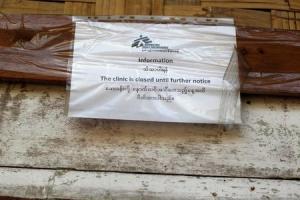
INN DIN Myanmar (Reuters) - Visitors to the medical facility in one of Myanmar's poorest and most remote regions are greeted by a padlocked gate and a sign reading: "Clinic closed until further notice."
A vehicle that used to ferry around doctors and patients parked next to the neat compound of bamboo and brick buildings in the western state of Rakhine is covered in thick dust.
Since international aid groups were forced out of the area in February and March, members of the minority Muslim Rohingya community who relied on them say basic health care services have all but disappeared.
Worst affected are those in Northern Rakhine State (NRS), home to most of Myanmar's 1.3 million Rohingya who are stalked by sickness and malnourishment and as yet untouched by reforms under a semi-civilian government which took power in 2011.
Many people in and around the village of Inn Din, a collection of bamboo houses with thatched roofs and earthen floors a two-hour drive from NRS's biggest town Maungdaw, speak of disease and preventable death.
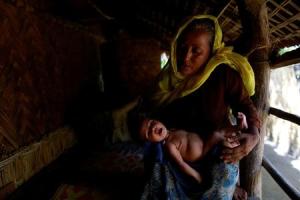
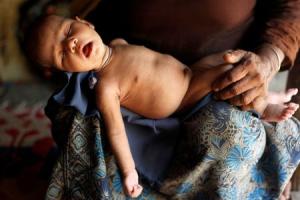
Nurfasa, born in late May, fidgeted in her grandmother's arms, her chest rising and falling with labored breaths. The desperately weak infant opened her mouth wide as if to cry, but no sound came out.
For the first 20 days of her life, all Nurfasa had for nutrition was ground-up rice powder mixed with water, because her mother, legs swollen and womb racked with pain, could not produce enough milk to feed her.
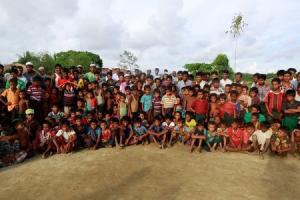
Rohingya Muslims attend a wrestling festival at Kyaukpannu village in Maungdaw, northern Rakhine sta …
"We don't have the money to go to Maungdaw and the MSF clinic here is closed," said her grandmother Montai Begum. "We showed the baby to the government midwife in the village, but she asked for money."
GLIMMER OF HOPE?
The expulsion of international aid organizations stems from the violence that erupted across Rakhine state in 2012 between ethnic Rakhine Buddhists and Rohingya Muslims, killing at least 200 people and displacing 140,000, most of them Rohingya.
When Medecins Sans Frontieres-Holland said it had treated people it believed were victims of sectarian violence near Maungdaw in January, the government expelled the group for flavoring Muslims. Myanmar denies the attack took place.
And after a foreign staff member from another aid organization, Malteser International, was rumored to have desecrated a Buddhist flag, NGO and U.N. offices in Rakhine came under attack and groups withdrew.
MSF's departure has had "a major humanitarian impact", said Pierre Peron, spokesman for the United Nations' coordination agency UNOCHA.
"MSF had built up a program over 20 years and it was reaching places that were very difficult to reach, and that's not something that can be done overnight," he said.
MSF hopes it can return soon after the government announced on Thursday that the group could go back to Rakhine, a decision the organization welcomed.
Whether that commitment is fulfilled, and under what conditions, may be questions for talks over the coming days.
Some aid workers fret that the announcement has more to do with politics than resolving the humanitarian crisis.
Yanghee Lee, the new UN human rights envoy to Myanmar, is in the country on a 10-day visit that included a trip to Rakhine.
U.S. Secretary of State John Kerry may visit Myanmar for the ASEAN foreign ministers' meeting in August, and President Barack Obama is also expected before the end of 2014.
Timing is crucial. The health crisis could worsen as monsoon rains set in, making sanitation more difficult, and experts warn of the risk of diseases such as malaria and tuberculosis spreading in the absence of reliable medical care.
Than Tun, a Buddhist community leader and member of the Emergency Coordination Center (ECC) set up by the government to oversee international NGOs (non-governmental organizations), confirmed MSF-Holland would be allowed back to NRS.
But he underlined the level of mistrust between the Buddhist community and anyone it suspected of siding with Muslims.
"Although we have agreed to allow them in, we are rather worried that they will not cooperate with us with full transparency like other INGOs," he told Reuters. "We find it difficult to trust them."
TRUST IS SCARCE
Rohingya, who are stateless because the government considers them to be illegal Bengali immigrants, often do not dare go to state-run hospitals and clinics for fear of what may happen.
Aisyah Begum, 25, was still mourning for her husband, Kamal Husor, who was injured while working in the forest in May.
According to Aisyah, the private doctor in Maungdaw, a bone-jarring two-hour drive away, said he could not help.
She decided against going to the public hospital - she had heard Rohingya die there - and treated the wound with medicine from a make-shift pharmacy. Nineteen days later, Husor, 55, passed away from what was probably a treatable infection.
"Had MSF been open, I would have taken him there," she said, looking forlorn. "I trusted them."
Assessing the impact of the aid group's exit is difficult, with no one to provide reliable data on disease and death rates.
But in the last quarter of 2013, MSF treated about 9,000 patients every month, and about 1,000 pregnant women in the six clinics it ran in NRS. Over the same period, it referred 160-200 people monthly to hospitals for life-saving treatment.
Rakhine officials play down the role of international aid organizations.
Government medical teams have been making limited visits to Rohingya areas, but foreign aid workers say they are inadequate.
"The Ministry of Health has been providing better health care than MSF or Malteser," Than Tun said. "And we can see this with our own eyes."
ACCESS RESTRICTED
Access to NRS is severely restricted and only a handful of foreign reporters have been there.
A Reuters team traveled seven hours by boat and car from Rakhine's capital Sittwe on a recent visit, one of the few times an international news organization has been allowed into NRS.
They witnessed evidence of a growing health crisis in a region where Rohingya say their basic human rights are denied.
International news coverage of the Rohingyas' plight has focused on sprawling, squalid camps outside Sittwe where those displaced by violence live. In NRS, many more Rohingya exist in what they call apartheid-like conditions.
NRS's maternal mortality rate is double Myanmar's national average - which, at 200 deaths per 100,000 live births, is already one of Asia's worst.
In Buthidaung and Maungdaw, two of NRS's three townships, malnutrition rates rival those in war-torn regions of sub-Saharan Africa.
Myanmar was a military dictatorship for almost 50 years until a semi-civilian government took power in 2011, but reforms have largely passed NRS by - many Rohingya cannot travel, marry or seek medical treatment without official permission.
Opposition leader Aung San Suu Kyi, who led the fight for democracy while the military ran the country, has faced rare criticism abroad for her failure to defend the Rohingya.
(Editing by Mike Collett-White)