Thursday, 15 October 2015

Myanmar separatist group Arakan Army leader Renin Su nabbed in Rangamati

Source BDnews, 14 Oct
Photo taken from Facebook.
Police in Rangamati in Bangladesh's Chittagong Hill Tracts say they have nabbed Renin Su, a top leader of the Myanmar separatist group, Arakan Army.
Rajsthali police OC Wahidullah Sarkar said on Wednesday that Su was arrested from an under-construction mosque at Islampur around3am.
The operation to nab Renin Su was jointly conducted by BGB's Major Shabbir Ahmed, Major Kamal Pasha and OC Wahidullah Sarkar.
Renin Su is now in police custody at the Rajsthali Police Station.
The separatist leader is a medical graduate who has lived in Netherlands.
For the last few years, he has been living in Rangamati since he married a local Marma tribal girl.

He has a house in Rajsthali, police said.
Bangladesh security agencies say Renin Su has since then been a commander of the separatist Arakan Army.

On Aug 24, guerillas of the Arakan Army attacked a joint patrol of the Bangladesh Army and the Border Guard Bangladesh (BGB) at Thanchi in Bandarban district.
After that, the security forces have been trying to track down Renin Su.
They raided his Rajsthali house two days after the Thanchi attack. Renin Su could not be found but his lieutenant Ong U Rakhine was nabbed from there.
Cloth for combat fatigues used by the Arakan Army were seized along with cameras, laptops, propaganda material and two horses.

Ong U Rakhine admitted last month before a Rangamati court that he was a member of the Arakan Army.

He also provided information about Renin Su.
Two caretakers of the Rajsthali house—Mong Chu Aung Marma and Chui Aung Marma—are now in police custody.

Bangladesh police has shut down the bank account of an Arakan Army leader Renin Su and his close relatives.

Tuesday, 6 October 2015

Myanmar president sued over alleged Rohingya abuse

Source Aljazeera, 5 Oct

Activists' suit alleges Thein Sein, top officials planned and instigated 'hate crimes' against Myanmar's Rohingya

October 5, 2015 10:15PM ET

Muslim rights activists have filed a lawsuit in the United States against Myanmar President Thein Sein, accusing him and several ministers of human rights abuses against minority Rohingyas, just a few weeks before an historic general election.

The complaint filed in Manhattan federal court accused Thein Sein and top officials of planning and instigating "hate crimes and discrimination amounting to genocide."

Thumbnail image for Who are the Rohingya of Myanmar?

According to the plaintiffs, Muslim Rohingya are "subjected to genocide, torture, arbitrary detention, cruel, inhuman and degrading treatment" by officials controlled by Thein Sein and his ministers.

Myanmar's government spokesman was not immediately available for comment, and did not respond to emailed requests.

The civil lawsuit was filed on Thursday by Burma Task Force, a group of 19 Muslim organizations, and a Rohingya man, Hitay Lwin Oo.

It seeks compensatory and punitive damages for alleged violations of the Alien Tort Statute (ATS), a U.S. law often invoked in lawsuits alleging human rights abuses.

The government will have a chance to respond to the lawsuit once it is served. It typically takes at least a few months for a judge to decide whether a case may proceed.

In 2013, the U.S. Supreme Court made it harder to pursue many ATS lawsuits. It said claims must "touch and concern" U.S. territory "with sufficient force" to displace the presumption that the law does not cover non-U.S. conduct.

Myanmar does not consider the Rohingya to be citizens, rendering them effectively stateless, while denying that it discriminates against them or that they are fleeing persecution.

 A tide of anti-Muslim sentiment swept through the country a year after the military ended its rule in 2011, morphing into communal violence.

At least 200 people were killed and more than 140,000, mainly Rohingyas, were displaced in fighting between Muslims and Buddhists in Myanmar's western Rakhine State.

During the flare up of the boat people crisis in Asia in May, Myanmar denied that its treatment of the Rohingya caused their exodus.

Religious and ethnic tensions are intensifying ahead of Nov. 8 elections in Myanmar. The government has barred most Rohingyas from voting and registering as candidates, drawing criticism from western countries and undercutting Myanmar's efforts to portray the poll as its first free and fair election in 25 years.

Reuters

Sunday, 4 October 2015

Myanmar: Religious tensions grow as thousands of nationalist monks stage rally

Source Christiantoday, 4 Oct


Reuters : Hardline Buddhist monks and supporters celebrate the recent establishment of four controversial bills decried by rights groups as aimed at discriminating against the country's Muslim minority.

Thousands of Myanmar's nationalist monks and their supporters prayed, clapped and held speeches at a large rally in the country's biggest city on Sunday, in a show of growing clout of radical Buddhists ahead of a Nov. 8 election.

Religious tensions are running high in Myanmar ahead of the parliamentary poll billed as the country's first free and fair election in 25 years, largely stoked by the Ma Ba Tha, an organization led by the hardline monks who called the rally.

ADVERTISEMENT

It was a climax of their campaign to celebrate their successful push to establish four so-called Protection of Race and Religion Laws seen as targeting women and the country's Muslim minority.

The monks have emerged as a powerful force in the run up to the poll, sharply criticizing Aung San Suu Kyi's opposition National League for Democracy for opposing the laws.

"Today is the victory. Ma Ba Tha tried for many years to enact the laws to protect the country, people, nationalism and religion," said Nyanissara, a senior monk at the organization.

Thousands of devotees in white t-shirts with the Ma Ba Tha logo, monks in burgundy and nuns in pink robes crowded in front of the stage at a sports hall in Myanmar's commercial capital of Yangon. Hundreds of buses and trucks lined the streets leading to the site.

One of the bills sets punishments for people who have more than one spouse or live with an unmarried partner other than the spouse. Others require Buddhist women to register their marriages in advance if marrying a man who is not Buddhist.


The laws are dangerous for the country, set out the potential for discrimination on religious grounds and create the environment for serious communal tension, New York-based Human Rights Watch said in August.

The government denies the laws are anti-Muslim.

"We realized that laws are needed to protect the religion and nationalism. The other three religions of the country already have laws that protect them," said Ashin Tilawkar Biwonsa, chairman of Ma Ba Tha, referring to Islam, Hinduism and Christianity.

An overwhelming majority of Myanmar citizens are Buddhist.

The Ma Ba Tha said it invited representatives of the United States and western countries to the rally, but their chairs remained empty throughout the ceremony.

Aung Thein Lin, a former minister who is running in elections for the ruling Union Solidarity and Development Party attended the rally.

One of the most outspoken leaders of the group, Wirathu, on Sunday endorsed president Thein Sein, whose USDP is facing a stiff battle against the widely popular NLD.

Charles Bo asked not use ‘Rohingya’ in front of Pope

Source Mizzima, 1 Oct
 
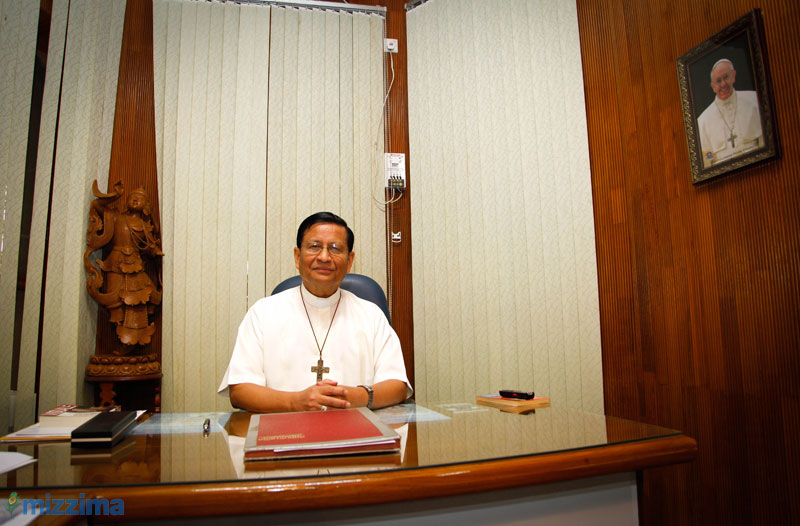
Charles Bo was requested not to use the term 'Rohingya' during his visit to the Vatican for the 'Month of the Holy Rosary,' Photo by Mizzima

Charles Bo was requested not to use the term 'Rohingya' during his visit to the Vatican for the 'Month of the Holy Rosary,' Photo by Mizzima.dpuf-

Officials from the Ministry of Religious Affairs have approached Cardinal Charles Bo to request that he not use the word Rohingya in the presence of Pope Francis.

Myanmar's first Cardinal is flying to Rome on 1 October for the month of the Holy Rosary held in Vatican City.

"The Religious Minister wanted to meet me but so far I haven't met him, only a few members who recently came to meet me regarding the term of 'Rohingya' persons. They requested me not to use the term Rohingya in front of Pope Francis," Cardinal Charles Bo told Mizzima News.

"If the word Rohingya is used it means the people understand that they are citizens of Rahkine State, that is the interpretation they would not like. Just [to use] the [term] Bengali or the Muslim from Rahkine State,"

"So, the situation there is very crucial, I think we have to solve this problem before it becomes too prolonged, before there is more violence and also the worry of international terrorism and other things."

When asked if he would use the term in front of Pope Francis he said he would use "Rohingya to indicate [the issue]" but would address the people as Muslim's from Rahkine state because of the sensitivity of the subject.

He said he will refuse to use the term "Bengali" as some of those who identify as Rohingya, their families have been in the region for over a century.

Myanmar's government in the past has worked hard to prevent the use of the word, with government officials scolding UN Secretary-General, Ban Ki Moon for using the word in December 2014 after usingit at the ASEAN summit held in Naypyitaw.

Read the whole interview in next week's Mizzima Weekly Magazine

Friday, 18 September 2015

Does the Voice of America Want to Be Associated With an Extremist Buddhist Group?

Source chicagomonitor, 16 Sept

 
Ma-Ba-Tha-Thumb

What would the reaction be if the "official external broadcast institution of the United States federal government," Voice of America (VOA), shared programming space on a satellite provider that also hosted programming by Al-Qaeda or ISIS? One could expect criticism to be rife and swift.

Fox News and other right-wing media would air non-stop coverage propagating conspiracy theories about President Barack Obama's administration being in the pocket of "Islamic terrorists." Liberal media outlets would likely react by saying that the right-wing was overreacting to an issue that was out of the control of the administration, since they signed an agreement with the hypothetical satellite provider a few years before the extremists.

This scenario in actuality is not at all a hypothetical, it is being played out today, only the extremists that share programming space on the same satellite provider as VOA are not AlQaeda or ISIS but rather an ultra-nationalist, violent Buddhist organization known as Ma Ba Tha (Association for the Protection of Race and Religion).

The Ma Ba Tha grew out of the 969 movement and have been behind acts of terrorism targeting Burmese Muslims, specifically the stateless Rohingya, considered one of the most "persecuted peoples" in the world. The Ma Ba Tha haveinstigated pogroms in which hundreds of Rohingya have been killed and many more thousands have been forced to flee either to concentration camps or onto perilous boat journeys where they face the dire possibility of death by drowning, human trafficking, and slavery.

The Ma Ba Tha regularly dehumanizes Burmese Muslims, describing them in their sermons and rallies as "mad dogs," who are "taking over" Burma and insidiously trying to replace Buddhism with Islam. This year Ma Ba Tha drafted discriminatory legislation targeting Muslims and women called the "Protection of Race and Religion Bills" which swiftly passed and have already been enacted into law.

The United Nations Special Rapporteur on Human Rights, Yanghee Lee, has stated that the bills "heighten discrimination against minorities and women," also adding that "[a]t a time when thousands of Rohingya are already fleeing the country by boat, this sends precisely the wrong signal to these communities."

In light of this the VOA should reconsider its relationship with Burma's most popular satellite company, SkyNet. SkNet is owned by Burma's largest media company, Shwe Thanlwin Media Co., Ltd. Shwe Thanlwin Company was founded and is owned by Kyaw Win, "a close associate of Kyaw Hsan, a former military general." The company "enjoyed exclusive business relations with the Ministry of Industry in the 2000s."

Shwe Thanlwin Kyaw Win is on the EU sanctions list. Many of Kyaw Win's associates and supporters are also on the US sanctions list, including military generals who are members of the State Peace and Development Council.

These facts did not stop Voice of America from signing a deal with SkyNet in 2012 to carry its Asian programming. The aforementioned extremist Ma Ba Tha have also signed a deal with SkyNet to carry their programming and broadcast their hate sermons. So now the VOA is in a position where it shares programming space on the same satellite provider as an extremist, violent religious movement!

One cannot help but note that at the very least there would be an outcry and calls for condemnation if in a different context it was revealed that a US-funded institution such as the VOA was signing agreements with a private company like SkyNet that simultaneously has dealings with an extremist religious organization. This is doubly the case when this extremist organization is known to have a radical agenda that advances Islamophobia and genocide against an oppressed, stateless minority.

The VOA charter states that it seeks to be a "reliable" and "credible" source for news. However, this credibility is hampered when it is associated with the likes of Ma Ba Tha, even when that association is through the platform of a media company. We should ask the VOA, the Secretary of State and the US ambassador to Burma to call upon SkyNet to sever their relationship with Ma Ba Tha.

(This article originally appeared on the Burma Task Force USA site under the title "Does the Voice of America Want to Be Associated With the Extremist Ma Ba Tha?")

Tauseef Akbar is a Chicago-based writer and activist and has worked with a number of national civil rights organizations. He holds a BA in English with a concentration on Creative Writing and is pursuing his graduate degree in Islamic studies.

The views expressed in this article are the author's own and do not necessarily reflect Chicago Monitor's editorial policy.

Thursday, 3 September 2015

Baba Solja finds Burmese saviours

Source Mg, 4 Sept

As the world marks victory over Japan Day, a remarkable story is told of a Nigerian soldier rescued by Rohingya villagersAstonishing: This detailed account of Isaac Fadoyebo's story is a result of the author's discovery of a slim volume of the original text written by Fadoyebo himself.

Astonishing: This detailed account of Isaac Fadoyebo's story is a result of the author's discovery of a slim volume of the original text written by Fadoyebo himself.

A few months before he was shot as an enemy soldier in its sweltering jungles, 16-year-old Nigerian Isaac Fadoyebo had never even heard of Burma. The journey that led him there began in a fit of youthful exuberance when he ran away from his village in southwestern Nigeria and signed up to fight for Britain in World War II.

He joined an estimated 100 000 others from Britain's colonies of Gambia, Ghana and Sierra Leone who sailed from West Africa's creek-lined coast around the Cape of Good Hope and onwards to Burma. There, Japanese soldiers ambushed his platoon and Fadoyebo was left for dead behind enemy lines.

What happened next captures not just the personal bravery of one man and the strangers into whose midst he was catapulted, but shines a light on a forgotten front of the war.

The ripple effects of the Southeast Asian conflict radiated from Burma's Rohingya Muslim minority, whose persecution today is a direct war legacy, to the returning West African soldiers who later started the region's march towards independence.

Alongside Nigeria's own inability to remember its war dead, this story is also one of Britain's often-neglected debt to its colonial soldiers, and how two British men helped to resuscitate that legacy.

Even in Britain, the 81st and 82nd divisions – the Allies' West African force – were known as the "forgotten army" as all eyes became fixed on the threat of Nazism closer to home. The eight in 10 West Africans in those divisions in Burma were a forgotten contingent in the forgotten army.

Now Fadoyebo was to become one of its dead. It was monsoon season in Burma, a time of mosquito-filled heat and lashing rains. Too weak to move, he lay bleeding in the tropical forest 9 600km from home and waited for the end.

Nigeria in the war

Seventy years later, there's still disbelief about this remarkable chapter in Nigeria's history. "But for my grandfather being involved, I never would have been able to put into perspective the fact that Nigeria was in the war," said Fadoyebo's grandson, Ayo, a human resources worker in Lagos. "I knew Nigerians fought, but it was so distant I couldn't place how it affected me as a Nigerian."

It was a feeling common even at the time. In countless villages such as the sleepy hilltop one of Owo, where Fadoyebo lived, the bloodshed had been a distant thing rumbling on in remote lands. There were vague rumours Hitler wanted to invade Nigeria itself, to plunder its mineral wealth. But the tentacles of the far-flung battles reached Owo when a recruitment truck rolled into the bushes in December 1941. Among the curious onlookers was Fadoyebo, a tall, well-built teenager. The colonial officer's exhortations to fight for the empire didn't rouse him; he sensed a chance to escape the sleepy backwater, earn money and see the world.

Fadoyebo's tale from there might have been lost to history were it not for British journalist Barnaby Phillips, who chronicled the astonishing story in his lucid, detailed book Another Man's War.

In 2011, Phillips took time off from working in Athens to research the "Burma Boys" in London's Imperial War Museum. The addition of East African recruits swelled Britain's colonial army to a 500 000-strong force. But Phillips noticed something rare when he began reading the available literature.

Among the hundreds of books, he chanced upon a slim book by one Isaac Fadoyebo. "It was called A Stroke of Unbelievable Luck and was a beautiful, 70-page manuscript by a Nigerian who not only survived an extraordinary experience, but put it all down in writing," Phillips said, still amazed at his own good fortune.

That was down to David Killingray, an English professor specialising in imperial history. He received the handwritten manuscript – Fadoyebo's only one – in 1989. "I immediately realised this was extraordinary, and set about getting it published," he said. Several hundred copies languished in academic and military libraries for years.

Fadoyebo's story

Fadoyebo's story began on March???2 1944, when his platoon was eating breakfast on a steep bank of Burma's Kaladan River. Suddenly they came under ferocious attack from the Japanese, who were expertly trained in jungle warfare. Men fell around Fadoyebo and a bullet pierced his thigh. He dropped down in anguish.

"He knew what was coming. The Japanese, take a prisoner? A white man, like Captain Brown, perhaps, but a black man? No chance," Phillips's opening transports readers viscerally to the scene.

The final shots never came; perhaps the Japanese believed he would succumb to his wounds. Another soldier, David Kagbo, was also wounded. Fadoyebo crawled to him and they waited together for death.

Villagers brought them food. Fadoyebo's stroke of unbelievable luck was going down in a village of Bengali Muslims, known as Rohingya, who sided with the British. For weeks, they brought sustenance, sometimes every other day, sometimes at longer intervals.

Eventually, a farmer named Shuyiman helped the two men limp to his home. There, at risk of death, he sheltered the two strangers until British forces broke through again in December. Their rescuers knew them only by Muslim names they adopted in deference to the villagers: Fadoyebo was Suleman and Kagbo was Dauda. Fadoyebo never forgot his saviours. "God sent them to save me," he would always say later.

"He had an unquantifiable desire to know what had happened to Shuyiman's family. He talked about them all the time," Ayo said.

A call from a stranger six decades later proved to be another stroke of good fortune. After chancing on his memoirs, Phillips had spent weeks in an effort to track down Fadoyebo. "I was so worried. I thought he wouldn't be able to understand me, he'd be deaf, he wouldn't be able to catch my English over the phone," he said, explaining the moment he finally found a working phone number for Fadoyebo.

"I gave this long speech about who I was, what I wanted to do and so on." There was a long pause on the other end. Then a deep voice replied: "Mr Phillips, when are you comingto Nigeria?"

That began a friendship between the two until, moved by his friend's pleas, Phillips journeyed to Burma in hope of finding Shuyiman's family and passing on the thanks the veteran had longed to give for decades.

History fading

It's difficult not to worry about how quickly history can fade in Nigeria. Official Western accounts long played down the contribution of Africans in the Asian campaign – allied commander General Slim never thanked the 14th Army, of which they were part – and few young Nigerians know of it.

"As children we didn't go to the village very often; if we had, we would have known about it," said Ayo, who said his grandfather never talked about his wartime experiences until the call from Phillips. During an extended visit to the village in 2002, a cousin introduced Ayo to everyone by declaring: "This is the grandson of Baba Solja."

"As soon as he said that, no further explanation was needed. It was established who I was," Ayo said.

Nigeria's military still has 81st and 82nd divisions in honour of the veterans; VJ Day celebrations are invariably muted. "We celebrate Second World War veterans at every opportunity. Just like any other Nigerian soldier who dies serving, their children have been awarded scholarships and other welfare packages," said spokesperson Rabe Abubakar.

Next to the neatly manicured World War II graves in a cemetery partly maintained by the Commonwealth War Graves Commission in downtown Lagos are the litter-strewn, unkempt grounds that house the government-run memorials for Nigerian peacekeepers in the 1990s.

At least one man's memories were properly looked after. In a documentary he made later, Phillips travels across wide expanses of jewel-green fields dotted with crumbling temples in Burma's Rakhine state.

It's a risky journey, given the turmoil affecting Rohingya Muslims there, and there's every chance that the village where Fadoyebo was rescued has been razed. Phillips eventually finds the right location – the story of the two African men is part of local folklore.

Watched by chattering monkeys, Shuyiman's family struggle to hold back tears as he delivers Fadoyebo's letter. "His real name is Isaac Fadoyebo and he wants you to know he thinks of your mother and father and sister every day," Phillips begins, himself tearful.

Photographs of Fadoyebo are passed round. The women clutch them to their chests. One man blinks furiously. Another woman covers her hand with her face and sobs. "We've thought of him for so long," she says, wiping her eyes with her headscarf.

Being able to thank those who sheltered him meant Fadoyebo was at peace even when old age sent him to hospital in 2013. Incapacitated in bed, he discussed attending his grandson's wedding when he got better, and picking up a wartime medal that the government had promised. "I'm fine, don't worry. I'll pick up the medal when I'm out of the hospital," he told Ayo just before he died on September 9.

Two days later, the medal, 68 years in coming, finally arrived.

– © Guardian News & Media 2015

Wednesday, 26 August 2015

Rohingya IDPs Detained in Rangoon: Police

Source Irrawaddy, 26 Aug
 

Bangladeshi nationals found on two boats by the Burma Navy in May are repatriated on Tuesday. (Photo: IPRD)Bangladeshi nationals found on two boats by the Burma Navy in May are repatriated on Tuesday. (Photo: IPRD)

RANGOON — Police in Rangoon Division's Hmawbi Township have detained 10 Rohingya Muslims and the driver of the vehicle in which they were found riding, according to local law enforcement.

A police officer in Hmawbi Township told The Irrawaddy that local authorities were holding the internal migrants, but he declined to provide specifics of the case over the phone.

Citing a police source, a BBC Burmese radio report on Wednesday said each of the Rohingya paid a 1.2 million kyats (US$940) bribe to the Burma Army in order to smuggle them to Rangoon from two camps for internally displaced persons (IDPs) in Arakan State's Sittwe Township.

The 10 men and women were part of a larger group of 29 Rohingya, according to The Voice daily, with two other vehicles having thus far evaded authorities.

The Rohingya minority in Arakan State are subject to severe restrictions on movement, and more than 100,000 remain in IDP camps after deadly violence in 2012 between Arakanese Buddhists and Muslims drove them from their homes.

Meanwhile, 125 migrants were deported from western Burma to Bangladesh on Tuesday, as more than 100 people remain in shelters near the border, potentially awaiting the same fate, according to a local immigration official.

"We deported them at 2 pm yesterday after two country officers signed an agreement. There are even more, 101 people, remaining who are awaiting deportation," Khin Soe, an immigration officer in Sittwe, told The Irrawaddy on Wednesday.

Two separate boats packed with refugees and economic migrants were discovered by the Burma Navy in May, seeing more than 900 people brought onto Burmese soil. Burmese immigration authorities have been holding the migrants at temporary shelters in Taung Pyo Let Wai village in Arakan State's Maungdaw Township, where their nationalities are undergoing scrutiny.

The governments of the two countries have been cooperating in the process, which has seen hundreds of Bangladeshi nationals repatriated in several batches since the boats carrying them were brought to shore. At least 187 of the boats' passengers were found to be from Burma.

Earlier this year, thousands of migrants from Bangladesh and refugees from Arakan State began washing up on the shores of other Southeast Asian nations after human traffickers abandoned them at sea. Those from Burma were predominantly Rohingya fleeing state-sanctioned persecution and hardscrabble IDP camp existences in the country's western coastal state.

Monday, 24 August 2015

Rohingya MP banned from contesting election

Source Asian review, 23 Aug


USDP Lower House MP for Buthidaung Township Shwe Maung (Photo: Patrick Boehler / The Irrawaddy)

YANGON -- One of five lawmakers from Myanmar's Muslim Rohingya minority who have sat in the country's national and regional parliaments since 2010 has been barred from contesting the upcoming Nov. 8 national election.

Shwe Maung, speaking to the Nikkei Asian Review on Sunday, said he had received an official notice from the government's election commission that he was not eligible to run in the election - even though he holds a seat in national parliament. He said he would appeal the decision take by the district election sub-commission in Maungdaw, a Rohingya-majority district in northern Rakhine state, bordering Bangladesh.

"I have seven days to appeal and perhaps tomorrow I will make the appeal at the Rakhine state regional electoral commission," said Shwe Maung, who was elected in 2010 as a lawmaker in Myanmar's lower house, representing the Union Solidarity and Development Party, the military-backed ruling party that recently saw the purge of its erstwhile leader, Shwe Mann, the current speaker of parliament.

Shwe Maung said that the local election commission, which is part of the national Union Election Commission, said he was deemed ineligible to contest the election as his parents were not citizens of Myanmar.

Shwe Maung disputes this, saying that both his parents received national identity cards in 1952, four years after the country, then known as Burma, won its independence from Britain.

Sunday, 23 August 2015

Fate Of Rohingyas In Bengal Prisons Hangs In Balance

Source Huffingtonpost, 23 Aug
 
ROHINGYA MUSLIMS INDIA
Representative image. Burmese refugees from the Rohingya community, a predominantly Muslim sect in Burma, take refuge on a street near the United Nations High Commission for Refugees (UNHCR) office in New Delhi on May 6, 2012. Eight hundred Burmese refugees have set up a temporary camp near the UNHCR office in South Delhi since April 9, 2012. The UNHCR has issued them asylum seeker cards but they have been demanding refugee status. AFP PHOTO/ Andrew Caballero-Reynolds (Photo credit shou | AFP via Getty Images

KOLKATA -- Over 80 Rohingya Muslims lodged in various prisons across Bengal are staring at an uncertain future as their plea to get refugee status is yet to be heard by Indian authorities.

The 83 Rohingyas, including several women, were arrested in the past five-six years when they were trying to cross over to India through Bangladesh. Of these 83, 27 have already completed their sentences but are still in jails.

"We have written to state home department and also to the MHA regarding the issue of Rohingyas lodged in Bengal prisons and also about those 27 prisoners who have already completed their sentence. But we are yet to receive any communication from them. So they are still in prison as we can't just let them go," ADG (prisons) Adhir Sharma told PTI.

He said that the matter has been informed to the state Home department and the state home department has taken up the issue with MHA.

"After we were informed by the jail authorities, we have given several reminders and letters to MHA. But there has been no concrete response," said a senior official of the state home department on condition of anonymity.

The official added that the issue of Rohingyas has been a sensitive one as there are reports that terrorist organisations have being trying to exploit the condition of Rohingyas worldwide.

"It is not just a case of a foreigner asking for refugee status. The case of Rohingyas is different from others seeking refugee status," said the official.

Just a few months ago, NGO Commonwealth Human Rights Initiative (CHRI), which works in coordination with United Nations High Commissioner for Refugees (UNHCR), had approached the state home department and the jail authorities so that the Rohingyas can be granted refugee status.

"Few months ago we were able to talk to the Rohingyas lodged in various prisons, and we made preparations so that their plea seeking refugee status can be forwarded to UNHRC, who had forwarded it to Ministry of Home Affairs. But as of now nothing has moved forward," said Madhurima Dhanuka, consultant with Commonwealth Human Rights Initiative (CHRI), told PTI.

The Rohingyas are among millions of stateless people worldwide due to the fallout of clashes with Buddhists in Myanmar. Thousands more, unregistered, are living in other parts of the country such as Jammu and Hyderabad.

According to UNHCR, there are five important pointers that cumulatively form the criteria for being termed as a 'refugee'.

"Owing to well-founded fear of being persecuted for reasons of race, religion, nationality, membership to a particular social group or political opinion, is outside the country of origin of his nationality and is unable or owing to such fear, is unwilling to avail himself of protection of that country," UNHCR states.

In the case of Rohingyas, there are certain laid down identification tests to differentiate between a Rohingya lodged in prison and other inmates.

"We identify a Rohingya from other inmates on the basis of geographical description, religion, language, physical features, education, occupation, and the kind of house they had in Myanmar," said Dhanuka.

According to her, an asylum seeker approaches UNHCR in New Delhi following which the UN body gives a registration form to fill asking broad details like name, country of origin and why he or she fled the country.

"Once the person fills up the form and submits it to UNHCR, the person is given status of person of concern to UNHCR. UNHCR then gives document to that effect. Following various interviews and examinations if the case is found positive she is granted refugee status and settled within his or her community," she says.

"We had managed to interview few adults and few children in Balurghat jail and Berhampur jail. Their case studies were forwarded to UNHCR office in New Delhi office," an NGO official said.

When contacted, UNHCR officials said one of the main problems with Rohingyas is that they sneak into India through Bengal from Bangladesh and are detained as illegal Bangladeshi immigrants.

While talking about the number of Rohingyas having registered as refugees under UNHCR and living in India, Shuchita Mehta, Public Information Officer of UNHCR India, said, "There are around 9,150 Rohingya refugees and 2,406 asylum seekers registered with UNHCR in India."

The state home ministry official too agreed with the views of UNHCR, and said, "They don't want to go back to Myanmar fearing they would be killed and most of them identify themselves as Bangladeshis so that they can be pushed back to the neighbouring country after serving jail term."

The UNHCR official also said that it has been organising sensitisation programmes for jail officials and police officers and these were aimed towards helping the officials to identify and distinguish the Rohingyas from others and help them to appeal to UNHCR for refugee status.


Muslim Rohingya women sit inside a tent at Mansi Internally Displaced Persons (IDP) camp in Sittwe on May 14, 2013. Boats carrying scores of Rohingya Muslims fleeing a cyclone have capsized off Myanmar's coast, the UN said on May 14, heightening fears over the storm which threatens camps for tens of thousands of displaced people. (STR/AFP/Getty Images

Thursday, 20 August 2015

SAARC-ASEAN Academics Observe World Humanitarian Day—Sorrowing Elegies of ‘Dying-Alive’ Rohingya Children Voiced Across Asia

Source livewirereporter, 20 Aug

Rohingya Refugees Face Health Crisis As MyanmarLam Yik Fei—Getty Images: Rosheda Bagoung holds her malnourished child inside the tent at the Dar Paing refugee camp in Sittwe, Burma, on May 10, 2014 (http://time.com/2888864/rohingya-myanmar-burma-camps-sittwe/)
The ongoing slaughtering of innocent Rohingya children is not an atrocity against an ethnic minority's small babies, but the unbroken chains atrocities and massacre outrages, against all humans and the whole humanity! SAARC-ASEAN Post-doc Academia.

Breaking Featured-News/UN Observances/Asia – August 20, 2015 – "Waging a 'genocidal-war' or a 'raging-clampdown' on small innocent children is not easy…!", remind academics from all over Asia, while observing 2015's 'World Humanitarian Day'.

"Even, when being in a war, one is going to pull the trigger on a lonely innocent baby, a myriad of thorny questions still besieges the mind—which of the stimuli can be able to justify this inhumane brutality…?—what objective can be achieved by slaughtering these 'tiny-selves'…?—what purpose can be served by thrashing these 'little beings'…?"

What's more…?—Nonethelessly, these acts of inhumaneness aren't happening in a battlefield. These are not unsystematic or all of a sudden random acts of individual or communal violence in their very 'nature of occurrence'—but are precisely methodical, systematic and state-backed executions of unprecedented cruelty and cold-bloodedness, being manifested in Burma, 'every-night-and-every-day, in an unceasing way'.

These are the 'sorrowing elegies' of dying-alive desperate children of the most persecuted lonely minority 'Rohingya'. The Rohingya's screams have been voiced and re-echoed by post-doctoral academicians across the ASEAN and SAARC regions, on the UN proclaimed World Humanitarian Day's Observance, that is marked cross-regionally for the first time  

"This is not an atrocity against an ethnic minority's small children, but the unbroken chains atrocities and massacre outrages, against all humans and the whole humanity—the humanitarian outcries, that are now well converting to a global 'mirror to the blind' as I have earlier made the facts brought-forth to the global attention, and made them admitted to the UN and rest of the world, through SAIRI report on the subject-matter", maintains Professor Dr. Aurangzeb Hafi, who documented a detailed and well-read testimonial-description on 'Rohingya Children Crisis' last month. The testimony-document was predominantly instituted to the UN and the global hierarchies in particular, and primed for the international cross-boundary academic spheres in general.     

"Every single neutral observer is now able to find much more horrific details and horrendous facts that are still secreted and, though failed, yet ut-mostly 'tried' to be kept concealed from the public eye," establishes further Dr. Hafi

"We, the academicians of ASEAN and SAARC regions, under the patronage-benefaction of Justice(R) S.S. Paru L.L.D., Chancellor Emeritus SAARC-ASEAN Post-doc Academia(Indonesia), Dr. Faisar N.M. (Sri Lanka), Dr. Bareera N.B. (Pakistan), Dr. Dass U.(India), Prof. Emeritus Dr. Zaki and Dr. Khalida M. Khan Dr. F. M. Bhatti(Pakistan), Dr. M.S.Salawal Salah from SAARC Post-doc Academia, along with tens of hundreds of other academics from all over Asia, unanimously re-echo the plea-elegies of desperate Rohingya children on this World Humanitarian Day of 2015" …. "Now… let the cries of these lonely children be our clarion call…!!!

"These longsuffering 'stateless' and 'restless' entities—the Rohingyas and their desperate children—are on their knees before the collective conscience of the world—the international community—the UN, the governments and the entire humanity." 

"These glimmering flowers are being reduced and converted to dusky coffins, floating on the Andaman Sea."

"The world has become a global village; we are all inhabitants of the same planet to which they belong, and—where alongside, they are being oppressed, thrashed, beleaguered and de-humanized—their homes being burned down—their heads being smashed on roads—their bodies being ruined and crumpled in streets—their small children being enslaved—their women being made sex-slaves—and, due to the unapproachability and inaccessibility to food and water they are forced to drink their own urine to survive…!!!

"They are like us all—their lives are as precious as our's—their small babies are like our own small kids—the children that are now crying to seek a rescue—  'begging-for-their-lives'—these desperate kids are not, but like ours…!!!"

"And, if by now, we fail, therefore, to respond at this vulnerable hour, or if the global community continues to shy away from taking a 'moral stand', then, there can be no more justifiable reason for the pursuit of a humane society or for persisting and sticking to even the least realms of humaneness!"

"We have to strive for a 'principal resolve' of the 'Rohingya Children Crisis' as a 'Moral Imperative'—if not a legal requisite!"

These were the phraseological supplications of Rohingya children, that were categorically presaged by Professor Qadhi Aurangzeb Al Hafi, earlier in SAIRI's 1st situation report on 'Rohingya Children's De-humanizing Genocidal Clamp-down'.

Media Contact
Company Name: SAARC-ASEAN Academics
Contact Person: Dr. Alex Jayawardene
Email: Send Email
Phone: 0094775993698
City: Colombo
Country: Sri Lanka
Website: http://www.thestateless.com/2015/07/hundreds-of-thousands-of-rohingya-children-at-high-risk-of-infantile-mortality-enslavement-disabilities-coercive-atrocities-bear-the-hallmarks-of-genocidal-clamp-down.html


Wednesday, 5 August 2015

The Slow-Burning Genocide Of Myanmar's Rohingya

Source maungzarni, 10 July
 
By Maung Zarni and Alice Cowley

Abstract: Since 1978, the Rohingya, a Muslim minority of Western Burma, have been subject to a state-sponsored process of destruction. The Rohingya have deep historical roots in the borderlands of Rakhine State, Myanmar, and were recognized officially both as citizens and as an ethnic group by three successive governments of post-independence Burma. In 1978, General Ne Win’s socialist military dictatorship launched the first large-scale campaign against the Rohingya in Rakhine State with the intent first of expelling them en masse from Western Burma and subsequently legalizing the systematic erasure of Rohingya group identity and legitimizing their physical destruction. This on-going process has continued to the present day under the civilian-military rule of President Thein Sein’s government. Since 2012, the Rohingya have been subject to renewed waves of hate campaigns and accompanying violence, killings and ostracization that aim both to destroy the Rohingya and to permanently remove them from their ancestral homes in Rakhine State.

Findings from the authors’ three-year research on the plight of the Rohingya lead us to conclude that Rohingya have been subject to a process of slow-burning genocide over the past thirty-five years. The destruction of the Rohingya is carried out both by civilian populations backed by the state and perpetrated directly by state actors and state institutions. Both the State in Burma and the local community have committed four out of five acts of genocide as spelled out by the 1948 Convention on the Punishment and Prevention of the Crime of Genocide. Despite growing evidence of genocide, the international community has so far avoided calling this large scale human suffering genocide because no powerful member states of the UN Security Council have any appetite to forego their commercial and strategic interests in Burma to address the slow-burning Rohingya genocide.
- See more at: http://www.maungzarni.net/2014/07/the-slow-burning-genocide-of-myanmars.html#sthash.1NSCcgRU.dpuf

Tuesday, 4 August 2015

Myanmar floods affect 21,000 Rohingya Muslims

Source Presstv, 5 Aug

Soldiers and rescue workers load food aid onto a military helicopter in Sittwe airport in Myanmar's Rakhine state on August 4, 2015 (AFP)
Soldiers and rescue workers load food aid onto a military helicopter in Sittwe airport in Myanmar's Rakhine state on August 4, 2015 (AFP

Heavy rains and flooding caused by cyclone Komen in Myanmar affects camps housing thousands of Rohingya Muslims who were displaced by ethnic violence in the country's Rakhine state, the Office of the UN High Commissioner for Refugees (UNHCR) says.

"In 24 camps assessed so far, a quarter of the temporary shelters are damaged, and more than 21,000 displaced people affected as a result," said UNHCR spokesperson Adrian Edwards on Tuesday.

Alongside Chin state and the Sagaing and Magway regions, Rakhine has been declared a natural disaster zone by the Myanmar government.

"The floods are hitting children and families who are already very vulnerable, including those living in camps in Rakhine state," said Shalini Bahuguna, from the UN Children's Fund on Monday.

According to reports, security forces turned out Muslims from abandoned schools and community centers where they had taken shelter.

An aerial view shows floodwaters inundating houses and vegetation in Kalaymyo, in Myanmar's Sagaing region, on August 3, 2015. (AFP)

Also On Monday, the Myanmar government announced that 39 people had died due the flooding that has so far affected over 200,000 people.

The UN recognizes the Rohingya Muslims as one of the world's most persecuted communities, who were forced to move from their homes to make-shift coastal camps in 2012, following deadly attacks by government-backed Buddhist extremists.